By Staff Reporter
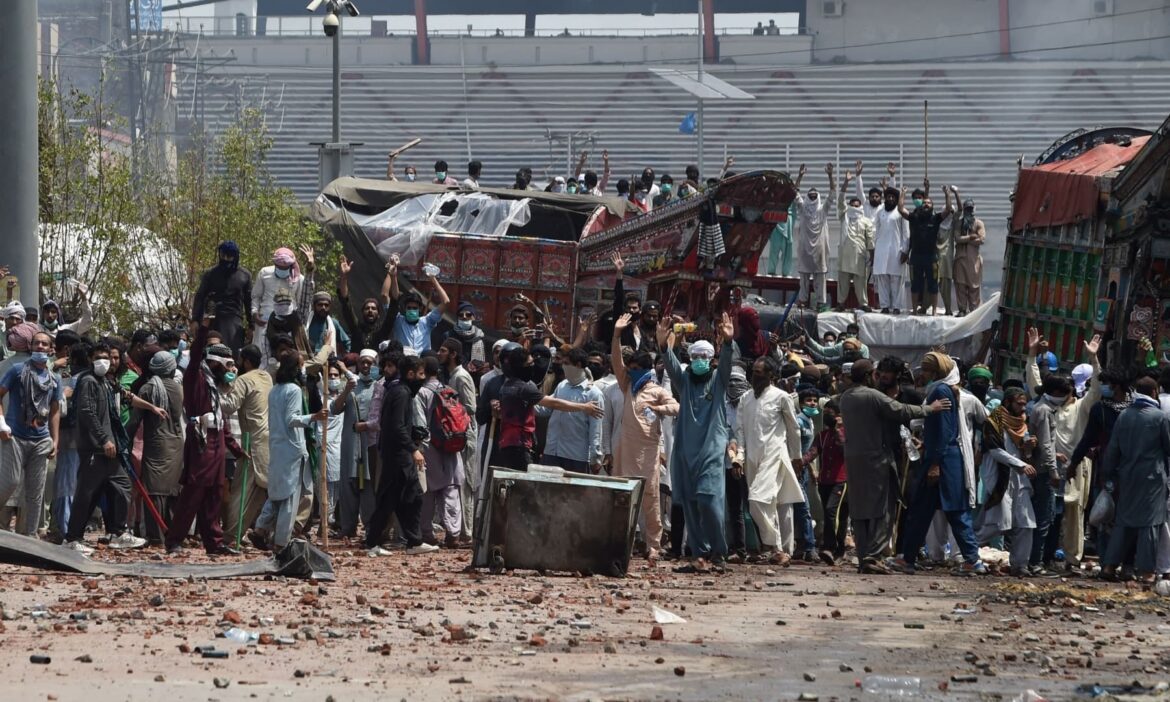
ISLAMABAD: The federal government on Thursday imposed a nationwide ban on the religio-political Tehreek-i-Labbaik Pakistan party, classifying it under the country’s anti-terrorism laws after a series of violent protests this month that led to clashes with law enforcement and widespread disruptions.
The decision, approved unanimously by the federal cabinet, followed a recommendation from the Punjab provincial government, which cited the party’s history of inciting violence and breaching earlier commitments to refrain from such activities. The move revives a similar ban enacted in 2021, which was lifted after six months on the condition that the group would avoid unrest.
The Punjab government announced last Friday it had formally approved a recommendation to ban the TLP and sent it to the government for final enforcement. Punjab’s move came a few days after a pre-dawn operation by law enforcement authorities in Muridke, a town near Lahore, where the TLP had set up a protest camp en route to Islamabad. The crackdown led to violent clashes and dozens of arrests, effectively halting the group’s planned march.
The party said its march toward Islamabad was for peaceful purposes and was intended to culminate in a sit-in outside the US Embassy in Islamabad to demonstrate solidarity with Gaza.
A statement from the Prime Minister’s Office described the cabinet’s deliberations, noting that the interior ministry had presented a summary based on Punjab’s request. Officials were briefed on the “violent and terrorist activities of TLP in the country.” “The meeting was informed that this organisation, established since 2016, has incited violence across the country. Due to the organisation, incidents of violence have occurred in different parts of the country,” the statement said.
It highlighted the party’s previous ban and its revocation, adding that the current action stemmed in part from the group’s failure to honor guarantees made in 2021. “In the past, security personnel and innocent bystanders have been killed in violent protests and rallies by the TLP,” the statement said. “The federal cabinet, after a briefing given to the meeting and the recommendation of the Punjab government, unanimously concluded that the TLP is involved in terrorism and violent acts.”
Adviser to the Prime Minister on Political Affairs Rana Sanaullah said the ban aimed not to eradicate the party but to excise its anti-state and terrorist elements. He said the government took no issue with the group’s religious positions, but noted that its past protests had repeatedly escalated into bloodshed, including the 2017 demonstrations in Faizabad.
The ban places the TLP on lists maintained by the National Counter-Terrorism Authority, subjecting it to sanctions like travel restrictions and asset freezes. It also invokes the Fourth Schedule of the Anti-Terrorism Act, a watch list for those linked to terrorism, which has historically targeted militant groups such as Tehreek-i-Taliban Pakistan, sectarian outfits like Lashkar-i-Jhangvi, and separatist organizations including the Baloch Liberation Army.
While provincial governments can propose such bans, the federal authorities must refer the matter to the Supreme Court under Article 17(2) of the Constitution, which addresses groups operating against Pakistan’s sovereignty or integrity. The court holds final authority, and a similar provision exists in Section 212 of the Elections Act 2017. Analysts note that many past efforts to outlaw political entities have stalled at this stage.
The TLP, led by its chief Saad Hussain Rizvi, is known for its street mobilization and confrontational politics. The party has repeatedly staged mass sit-ins and marches to Islamabad since its rise in 2017. Previous protests have often turned violent, resulting in extended clashes with police and days-long disruption of traffic on key highways leading to the capital.
TLP has its ideological roots in Barelvi Islam, a mainstream sect traditionally seen as moderate but for which blasphemy is a red line. It was formed in 2015 by Rizvi’s wheelchair-bound father, Khadim Hussain Rizvi, known for his fiery speeches and harsh criticism of political opponents.
The party started making waves in 2016 when it protested the execution of Mumtaz Qadri, a bodyguard who assassinated the governor of Punjab over his stance on blasphemy.
The TLP bagged 2.2 million votes in the 2018 national elections, mostly from the easter Punjab province, and won two provincial seats in southern Sindh. It also emerged as the third-largest party in Punjab, behind former prime minister Imran Khan’s Pakistan Tehreek-e-Insaf (PTI) and ex-premier Nawaz Sharif’s Pakistan Muslim League-Nawaz (PML-N).
According to Gallup Pakistan, over 2.89 million people voted for the far-right party in the 2024 national elections, 0.76 million more compared to the 2018 polls.
Copyright © 2021 Independent Pakistan | All rights reserved