By Staff Reporter
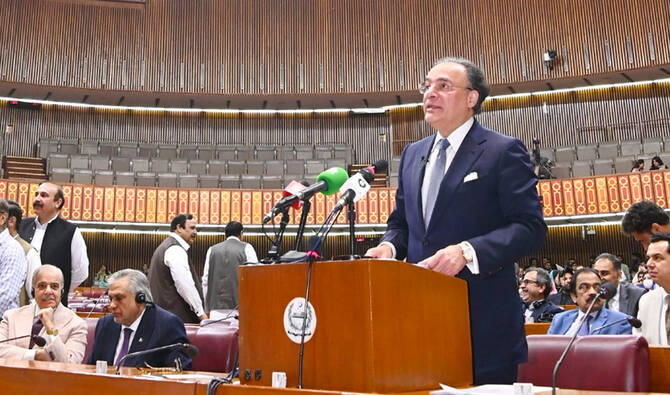
ISLAMABAD: The National Assembly passed the federal budget for the next fiscal year on Tuesday after the opposition walked out of the chamber following an acrimonious debate in which the opposition leader accused the government of trampling the constitution and his speech was blacked out on state television and social media.
Finance Minister Muhammad Aurangzeb moved the budget bill for approval after the walkout by the opposition alliance led by National Assembly Opposition Leader Mehmood Khan Achakzai, clearing the way for its passage without significant resistance in the House.
The session was marked by a rare and direct confrontation between Achakzai and Speaker Ayaz Sadiq, whose decision to bar Achakzai’s remarks from being broadcast live on parliamentary social media channels and television drew immediate protests — particularly since Sadiq had only days earlier lifted longstanding restrictions on airing opposition members’ speeches.
Achakzai later posted excerpts of what he described as his censored address on the social media platform X, writing: “We have taken an oath to protect the Constitution of Pakistan. You have supported undemocratic forces in trampling the Constitution; through your vote, you have clipped the wings of the judiciary.”
A SPEAKER UNBOUND
The confrontation inside the chamber was among the sharpest in recent parliamentary memory. Achakzai opened his remarks with a broadside against the speaker himself, noting that the government had now completed two and a half years in office and that the tone of engagement would have to change accordingly.
“You did not care about the Constitution and law as you dismissed 14 of your colleagues from the Assembly,” he told Sadiq, in what appeared to be a reference to the disqualification of members belonging to former prime minister Imran Khan’s Pakistan Tehreek-e-Insaf party.
He also criticised the government over the sentencing of Baloch Yakjehti Committee leader Dr Mahrang Baloch to life imprisonment and its handling of recent unrest in Azad Jammu and Kashmir.
Directing his remarks at Prime Minister Shehbaz Sharif, who was present in the chamber, Achakzai questioned whether the state saw Khyber Pakhtunkhwa as genuinely part of Pakistan. “Pakistan is not some imaginary country that exists in the skies. It means Khyber Pakhtunkhwa, Balochistan, Sindh, and Punjab,” he said. “Why don’t you see KP as part of Pakistan?”
He urged the prime minister to call representatives of Balochistan and Sindh to the floor and assure them that their children had rights over their provinces’ natural resources. “What are you afraid of?” he demanded.
Sadiq responded sharply, accusing the opposition of being in a “state of confusion” and declaring that he would not permit anyone to speak against “Pakistan, armed forces, and the judiciary.” He added, in remarks that drew immediate attention: “If you call this a violation of the Constitution, then I am willing to commit such violations.”
The speaker also alleged that the opposition had repeatedly declined invitations to participate in parliamentary committees, and said the House stood united “when it comes to Pakistan.”
In a separate written statement issued later in the day, Sadiq offered a more measured formulation, saying freedom of expression “must be exercised within the framework of the Constitution, rules and established parliamentary norms,” and that maintaining the sanctity of parliament remained his foremost responsibility.
THE WALKOUT
Achakzai led most of the opposition out of the chamber before concluding his remarks. Notably, the parliamentary bloc of Jamiat Ulema-i-Islam-Fazl, a religious party that has positioned itself separately from other opposition factions, remained seated.
The budget was subsequently presented and passed with the treasury benches in attendance.
SHARIF HAILS IRAN MEDIATION ROLE
Prime Minister Shehbaz Sharif, in his address to the House following the walkout, used the occasion primarily to highlight what he described as Pakistan’s pivotal role in mediating between the United States and Iran at talks held over the weekend at the Swiss resort of Burgenstock.
He said Pakistan had worked “with complete sincerity” to narrow differences between the two sides, with Qatar also participating as a mediator, and that dialogue that began on Sunday had stretched past midnight into Monday.
A joint statement issued by the mediators in the early hours of Monday confirmed that technical negotiations between Washington and Tehran would continue over a 60-day period, covering Iran’s nuclear programme, ballistic missile capabilities and frozen financial assets.
“We fully hope that the MoU will turn into a long-lasting agreement over the next 60 days, leading to peace in the world,” Sharif said, adding that Iranian President Masoud Pezeshkian was due to visit Islamabad later on Tuesday, with bilateral ties expected to dominate those discussions.
The premier congratulated the nation and all members of the House — including the opposition — on what he called Pakistan’s “key” and “historic” contribution to the diplomatic process, saying international media coverage had placed Pakistan on front pages around the world in a way no amount of money could have purchased.
Sharif also pushed back against Achakzai’s characterisation of the current government as illegitimate, saying the 2018 elections that brought his political opponents to power deserved equal scrutiny. “If the government that came after those polls was legitimate, then the incumbent government is also legitimate,” he said.
He expressed regret that the opposition leader had left the chamber on a day when the Iranian president was due to arrive, saying it was not the moment to air differences.
Copyright © 2021 Independent Pakistan | All rights reserved