By Staff Reporter
ISLAMABAD: Pakistan’s top digital assets regulator used a high-profile Zurich gathering of central bankers and financial policymakers this week to demand that emerging economies help write the rules governing tokenized finance, warning that developing nations risk being sidelined as wealthier countries race to set global standards for digital money.
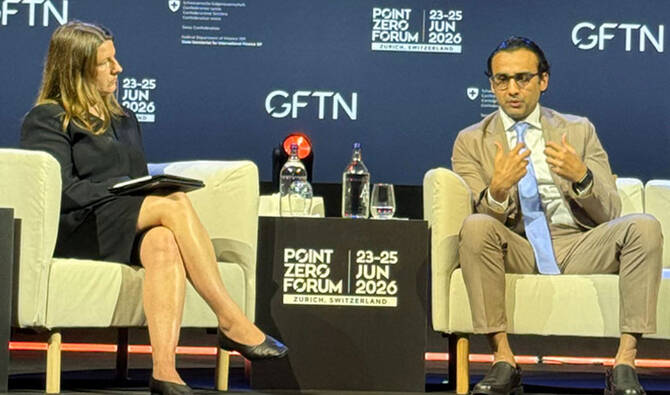
Bilal bin Saqib, chairman of Pakistan’s Virtual Assets Regulatory Authority (PVARA) and a minister of state, made the remarks at the Point Zero Forum, an annual conference organised by the Global Finance and Technology Network (GFTN) that brings together regulators, central bankers, and industry leaders to discuss the future of financial technology. This year’s edition ran June 23-25.
“The financial system is now being automated through software and blockchain, and software knows no borders,” Saqib told the forum. “We have always thought of money as something that only the state can control. One flag, one border, one currency. That era is coming to an end.”
His remarks carried the weight of a country that has emerged as one of the world’s most active digital asset markets. Pakistan ranks third globally in public cryptocurrency adoption, behind only India and the United States, according to Chainalysis’s 2025 Global Crypto Adoption Index — a position driven by a large, young, mobile-first population, one of the world’s biggest freelance workforces, annual remittances exceeding $38 billion, and rising stablecoin use as a hedge against persistent inflation.
Saqib joined Dr. Mampho Modise, deputy governor of the South African Reserve Bank, on a panel examining how tokenized money — encompassing stablecoins, central bank digital currencies (CBDCs) and other blockchain-based instruments — could achieve scale, and what is preventing it from doing so. The session, titled “Unchaining Tokenized Money: Stablecoins, CBDCs, and the Race for Scale,” probed the roles that regulators, banks, and technology providers might play in building interoperable digital financial systems.
Laying out what he called a “Pakistan First” approach to digital assets, Saqib argued that the country had moved beyond debating whether to permit crypto adoption — a question he said was settled by the behaviour of its own citizens. “Those countries that will succeed will have the courage to say one thing: It’s happened, our people are already here,” he said. “Our responsibility is not to stop economic innovation, but to better manage it.”
The sharper edge of his message was aimed at the architecture of emerging global digital finance frameworks, which Pakistan and other developing economies fear could be shaped predominantly by wealthier nations and their institutions. “Our position is that developing economies should play a role in setting the rules for tokenized finance, not simply inherit a framework built elsewhere,” he said.
Beyond the main stage, Saqib attended a series of invitation-only sessions with central bankers and financial officials from Singapore, Japan, the Philippines, the Gulf and Europe, where major global banks and prominent digital asset institutions were also represented, PVARA said.
Those closed-door discussions, PVARA said, circled a question now pressing on policymakers across the developing world: how to capture the efficiencies of dollar-denominated tokenized money — faster payments, lower remittance costs, broader financial inclusion — without ceding sovereignty over national payment systems or sacrificing oversight of domestic financial flows.
The tension is not abstract. As stablecoin usage spreads and cross-border digital payment corridors expand, regulators in countries with weaker currencies face the prospect of de facto dollarization accelerating beyond their control, even as their citizens benefit from the practical conveniences of digital dollar instruments.
Pakistan’s push for a seat at the table comes as international standard-setters, including the Financial Stability Board and the Bank for International Settlements, continue consultations on frameworks for digital assets that will carry significant influence over how emerging market regulators can act. PVARA was formally established last year as Islamabad moved to bring the country’s sprawling informal crypto sector under regulatory oversight.
Copyright © 2021 Independent Pakistan | All rights reserved