By Staff Reporter
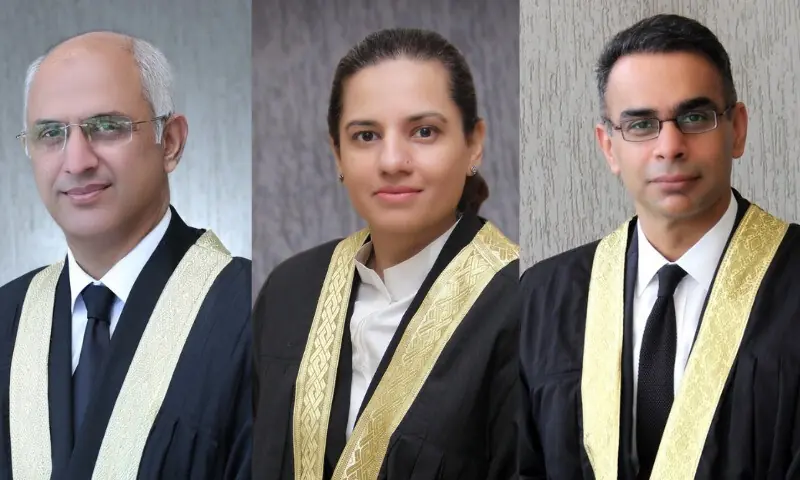
ISLAMABAD: The Ministry of Law and Justice on Wednesday notified the transfer of three judges from the Islamabad High Court to other provincial high courts, a day after the Judicial Commission of Pakistan approved the moves in a decision that immediately drew sharp criticism from lawyers’ organizations for what they described as a lack of transparency and uniform standards.
The notification said President Asif Ali Zardari had approved the transfers on the commission’s recommendation under Article 200 of the Constitution. Justice Mohsin Akhtar Kayani was moved to the Lahore High Court, Justice Babar Sattar to the Peshawar High Court and Justice Saman Rafat Imtiaz to the Sindh High Court. A separate summary sent to the Prime Minister’s Office, dated Tuesday, confirmed that the commission had voted in favor of the transfers by a majority of its total membership during a meeting on April 28.
Under Article 200(1), the president may transfer a high court judge to another high court on the commission’s recommendation. The provision states that a transferred judge’s seniority is calculated from the date of his or her original appointment as a high court judge. The transfers come after a constitutional amendment, enacted through the 27th Amendment, that eliminated the previous requirement of a judge’s consent for such a move. The revised clause also provides that a judge who refuses a transfer may face proceedings before the Supreme Judicial Council under Article 209.
The Islamabad Bar Council took serious notice of the development in a statement issued Tuesday, before the formal notification. It described the transfers as appearing to lack transparency and raised the possibility of “mala fide intent.” The council called for “a structured, periodic and across-the-board rotation policy” for judges of the Islamabad High Court and subordinate judiciary based on uniform, disclosed criteria. “Isolated and non-uniform transfers, undertaken without any disclosed objective criteria, damage public confidence and judicial integrity,” the statement said. It added that any rotation policy “must be free from arbitrariness or extraneous considerations.”
The Islamabad High Court Bar Association issued a separate statement acknowledging that the transfers fell within the constitutional framework but stressed that such authority “should be exercised with uniformity, transparency and principled consistency across the board.” The association urged the authorities to develop “a comprehensive rotation mechanism in the interest of fair and transparent administration of justice.”
The three judges were part of a group of six Islamabad High Court judges who, in a letter to members of the Supreme Judicial Council in March 2024, alleged that Pakistan’s intelligence agencies had interfered in judicial affairs. The letter cited attempts to pressure judges through the abduction and torture of their relatives and secret surveillance inside their homes.
They were also among the five judges who, in February 2025, formally opposed the proposed transfer of then-Lahore High Court Justice Dogar to Islamabad, warning that his elevation as chief justice would violate constitutional procedures and established judicial norms. Despite the objection, Justice Dogar was appointed acting chief justice of the Islamabad High Court on Feb. 13, 2025. The following day, when he took the oath, five judges — including the three now being transferred — boycotted the ceremony.
The episode triggered a significant administrative restructuring at the court. Amendments to the high court rules curtailed the decision-making authority previously exercised by senior puisne judge Kayani. The court’s Administration Committee, formerly composed of the chief justice, the senior puisne judge and one other senior judge, was reconstituted to include Chief Justice Dogar and two judges of his choosing. Chief Justice Dogar was sworn in as the permanent chief justice on July 8, 2025. In the ensuing reshuffling of committees, the five senior judges who had opposed his appointment were sidelined.
In September 2025, the same five judges filed separate petitions in the Supreme Court challenging several internal practices at the Islamabad High Court, including the composition of benches, the preparation of rosters and the transfer of cases. The transfers announced Wednesday mark the first major use of the revised Article 200 process since the constitutional change. Legal observers said the episode has heightened tensions within Pakistan’s judiciary and revived long-standing questions about the balance of power between the commission, the executive and the bar.
Copyright © 2021 Independent Pakistan | All rights reserved