By Staff Reporter
ISLAMABAD: Pakistan’s foreign office on Wednesday rejected a claim by Indian Home Minister Amit Shah that New Delhi had killed all three militants responsible for an attack in Pahalgam, dismissing the statement as “replete with fabrications” and questioning its timing and credibility.
The dispute stems from an assault on April 22, 2025, when gunmen opened fire on tourists in Pahalgam, a scenic town in occupied Kashmir, killing 26 people. India pointed the finger at Pakistan, alleging Islamabad’s support for the attackers, a charge Pakistan has staunchly denied. The attack ignited a four-day clash between the two nuclear-armed neighbors, leaving more than 70 dead across the border.
Addressing India’s parliament on Tuesday, Shah told lawmakers that the three militants behind the Pahalgam bloodshed had been eliminated in a joint operation by the military, paramilitary forces, and police on the outskirts of Srinagar. He identified the gunmen as Pakistani nationals, framing the operation as a decisive blow against cross-border terrorism.
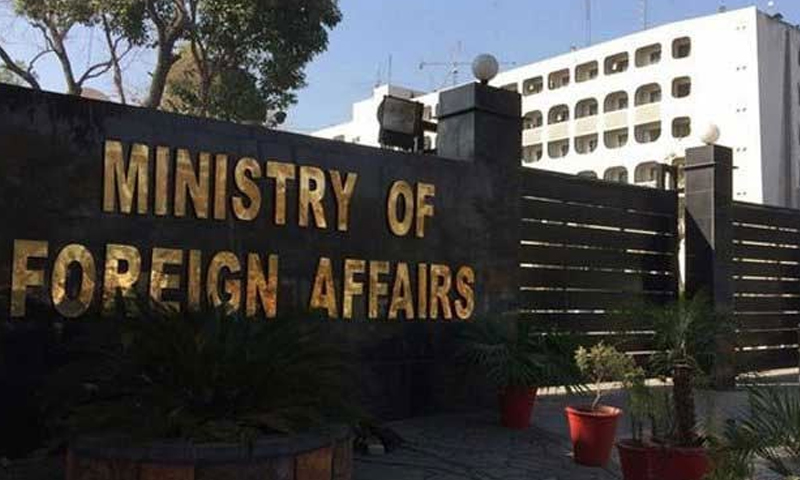
Pakistan’s foreign office shot back with a sharply worded rebuttal. “The account given by the Indian Home Minister is replete with fabrications, leading to serious questions about its credibility,” the office said in a statement. It went further, casting doubt on the timing of Shah’s announcement: “Is it a mere coincidence that the alleged perpetrators of the Pahalgam Attack were killed at the start of the Lok Sabha debate?”
“Pakistan categorically rejects the baseless assertions and provocative claims made by the Indian leaders during the Lok Sabha debate on the so-called ‘Operation Sindoor’,” Foreign Office spokesperson, Ambassador Shafqat Ali Khan, said. “These statements reflect a dangerous tendency to distort facts, justify aggression and glorify conflict for domestic consumption.”
Khan accused India of launching its May 6-7 air strikes without credible evidence or a thorough investigation into the Pahalgam attack, resulting in the deaths of innocent civilians rather than the alleged terrorists. “The world knows that India attacked Pakistan without any verifiable evidence or a credible investigation into the Pahalgam Attack,” he said. “During the intervening night of May 6 and 7, 2025, India’s targeting of the alleged terrorist infrastructure resulted actually in the martyrdom of innocent men, women, and children. India failed to achieve any of its strategic objectives. On the other hand, Pakistan’s resounding success in neutralising the Indian fighter jets and military targets is an indisputable fact.”
The escalating war of words underscores the deep-seated animosity between India and Pakistan, whose rivalry has simmered since their independence from British rule in 1947. The two nations have fought three wars, two over the contested region of Kashmir, which both claim in full but control only in part. India has long accused Pakistan of arming and funding Kashmiri freedom fighters, while Pakistan denies the allegations and counters that India stokes unrest in its own provinces of Balochistan and Khyber Pakhtunkhwa.
The foreign office also took aim at India’s refusal to engage in a transparent investigation into the Pahalgam attack. Prime Minister Shehbaz Sharif had proposed a joint inquiry, an offer the foreign office said India spurned in favor of “the path of belligerence and aggression.”
The Foreign Office also criticized India’s narrative surrounding the ceasefire, urging Indian leaders to acknowledge their losses and the role of international mediators. “Instead of misleading their compatriots, the Indian leaders would be well-advised to acknowledge the losses incurred by their armed forces and accept the active role played by the third parties in realising the ceasefire,” Khan said.
The Foreign Office statement also took aim at India’s broader rhetoric, rejecting New Delhi’s claims of establishing a “new normal” in bilateral relations through military strikes. It dismissed India’s narrative of “nuclear blackmail” by Pakistan as “a misleading and self-serving construct” intended to mask India’s own escalatory actions. “For us, the only ‘normal’ in bilateral relations is respect for sovereignty and territorial integrity, and adherence to the principles and purposes of the UN Charter,” the statement read.
Pakistan emphasized that its deterrence of India relied on conventional military capabilities, not nuclear threats. “It is well known that Pakistan deterred India through its conventional capabilities, affirming that discipline and restraint remain its guiding principles,” the Foreign Office said.
The statement further condemned India’s stance on the Indus Waters Treaty, a critical agreement governing shared river resources. “India’s decision to hold the treaty in abeyance shows its blatant disregard for the sanctity of international treaties, and strikes at a fundamental pillar of regional cooperation,” Khan said. He urged India to honor the treaty’s terms rather than “taking pride in a unilateral and illegal move.”
The Foreign Office warned that “India’s continued reliance on disinformation, jingoism, and chest-thumping risks destabilising South Asia,” while reaffirming Pakistan’s commitment to “peace, regional stability and a meaningful dialogue for resolution of all outstanding issues.”
Despite the heated rhetoric, Pakistan struck a note of restraint, affirming its role as “a responsible state committed to peace and regional stability.” The foreign office expressed Islamabad’s desire to pursue “meaningful dialogue” with India to resolve longstanding disputes, including the fate of Kashmir, a region that remains a flashpoint in their decades-long conflict.
Copyright © 2021 Independent Pakistan | All rights reserved