By Staff Reporter
ISLAMABAD: The military said on Sunday 23 soldiers had been killed and 29 wounded in overnight clashes along the border with Afghanistan, where it said forces repelled an unprovoked attack by Afghan Taliban fighters and affiliated militants.
More than 200 Taliban and terrorist fighters had been killed in the fighting, which escalated tensions between the two neighbors amid accusations of cross-border terrorism. The clashes, which began on the night of Oct. 11 and continued into early Sunday, involved firing and physical raids from the Afghan side, said a statement from the Inter-Services Public Relations, the military’s public affairs arm.
The confrontation marks an unprecedented escalation of hostilities along the porous 2,611-kilometer (1,622-mile) frontier, known as the Durand Line, and threatens to unravel already fragile relations between Islamabad and Kabul.
Earlier in the week, Afghan authorities accused Pakistan of bombing the capital, Kabul, and a market in the country’s east. Pakistan did not claim responsibility for the assault. Pakistan has previously struck locations inside Afghanistan, targeting what it alleges are militant hideouts, but these have been in remote and mountainous areas. The two sides have also skirmished along the border in the past.
The ISPR statement described the assault as an attempt to destabilise border areas and facilitate terrorism, attributing it to the Afghan Taliban and “Fitna-al-Khawarij,” a term used for the banned Tehreek-i-Taliban Pakistan, and “Fitna-al-Hindustan,” referring to terrorist organisations in Balochistan.
“During overnight skirmishes, 23 brave sons of Pakistan embraced shahadat (martyrdom) while defending the territorial integrity of our beloved country against this outrageous action,” the statement said, adding that “according to credible intelligence estimates and damage assessment, more than 200 Taliban and affiliated terrorists have been neutralised, while the number of injured is much higher.”
Afghan officials countered that the fighting was a retaliatory response to Pakistani airstrikes earlier in the week, which they said violated their sovereignty. Pakistan has not confirmed conducting those strikes but has long accused Kabul of harboring militants, including the Tehreek-i-Taliban Pakistan. Afghanistan denies the allegations, insisting it does not allow its territory to be used for attacks against its neighbor.
The skirmishes unfolded at multiple points along the porous border, including Angoor Adda, Bajaur, Kurram, Dir and Chitral in Pakistan’s Khyber Pakhtunkhwa province, and Bahram Chah in Balochistan, according to a report by state-run Radio Pakistan. “Afghan forces carried out unprovoked firing at several locations,” the report said.
In response, Pakistani forces launched precision strikes and raids against Taliban camps, posts, terrorist training facilities and support networks on Afghan soil, the military statement said. It emphasized that measures were taken to avoid civilian casualties. “All possible measures were taken to avoid collateral damage and to protect civilian lives,” the statement added.
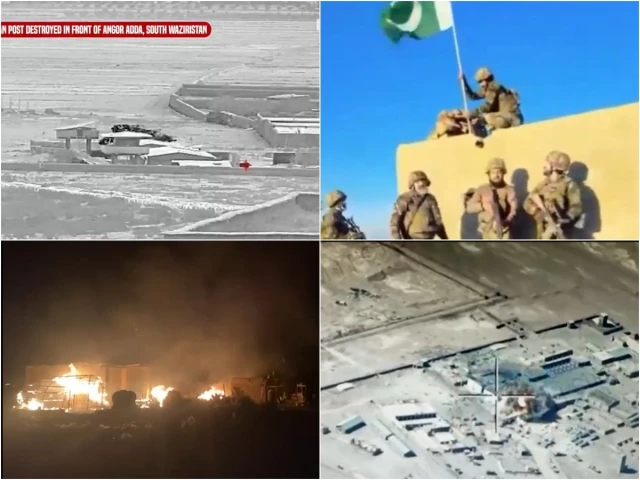
The military reported destroying multiple Taliban locations, briefly capturing 21 hostile positions on the Afghan side, and rendering terrorist training camps inoperative. “The infrastructural damages to Taliban posts, camps, headquarters and support networks of terrorists are extensive, all along the border and range from tactical to operational depth,” the ISPR said.
Details from state media painted a picture of targeted operations. PTV News reported strikes on the Durrani Camp, Manojba Camp Battalion Headquarters, Manojba Camp-2 and Ghaznali Headquarters in the Noshki sector, which were “neutralised completely.” Dozens of Taliban soldiers and militants were reportedly killed there. Security sources also described the destruction of the Asmatullah Karar Camp at Spin Boldak, described as one of the Taliban’s largest bases for operations against Pakistan, where fighters suffered “heavy losses.”
Radio Pakistan shared footage of a “second engagement and destruction” of the Asmatullah Karar camp. Other targets included the second Battalion Headquarters in the Brabcha area, from where militants were said to launch into Pakistan; the Barikot base camp; Manojba Camp-3; Karzai post; and Shapola Khula Taliban post, according to PTV News posts on X. In the Zhob sector, forces occupied an Afghan post and hoisted the Pakistani flag, destroying a Humvee armored personnel carrier, state media reported. Tanks at mountain positions opposite Kurram were eliminated, and earlier reports cited the destruction of Afghanistan’s Jandusar Post, Turkmenzai camp and Kharchar Fort. Afghan forces also attacked Pakistani posts in the Baramcha area of Chagai district, bordering Helmand province, with heavy weapons, a senior official said. Attempts to infiltrate into Pishin and Zhob districts were repelled.
From Kabul, Afghan government spokesman Zabihullah Mujahid urged Pakistan to “desist from using force as such actions will have negative consequences.” At a news conference, he alleged that “certain elements within the Pakistani security establishment want to destabilise Afghanistan” and warned that Kabul “possessed weapons to respond.” He added that the Afghanistan Islamic Emirate had made “efforts to resolve issues with Pakistan.”
Relations between the neighbors have sharply deteriorated since 2021, when optimism following the Taliban’s return to power in Kabul gave way to mounting distrust over cross-border militancy. In the years after Kabul’s takeover, Pakistan has accused the Afghan government of tolerating and even providing sanctuary to fighters from the Tehreek-e-Taliban Pakistan (TTP) and other militant groups. Kabul rejects those claims, insisting it does not permit its territory to be used against other states.
Tensions deepened still further in 2023, when Pakistan launched a sweeping deportation campaign against undocumented Afghans, ordering all “unregistered foreigners” to leave by Nov. 1 that year or face expulsion. Islamabad said the move was intended to curb militancy and crime, though rights groups and Afghan officials have condemned it as punitive.
Since then, the deportations have become a recurring flashpoint: by 2025, more than 800,000 Afghans had been repatriated or forced out.
India’s expanding ties to the Taliban, through diplomacy and reconstruction assistance, have further stoked Pakistani fears. Islamabad views New Delhi’s deeper role in Afghan affairs as a strategic encirclement, especially given India’s historic rivalry with Pakistan.
Pakistani leaders responded with strong condemnations. President Asif Ali Zardari said there would be “no compromise” on sovereignty, citing United Nations reports confirming attacks from Afghan soil. “Terrorism is a shared challenge and its burden cannot be placed on any single country,” he said in a statement. He urged the Afghan interim government to take “concrete and verifiable action” against militants and termed terrorism “sponsored by India” as the “greatest threat to regional peace and stability.”
Zardari also criticised Afghanistan for turning away from the struggle in India-occupied Kashmir, calling it an injustice to history and the Muslim ummah. He reaffirmed Pakistan’s rejection of India’s claims over Jammu and Kashmir as contrary to international law and UN Security Council resolutions. Highlighting Pakistan’s hosting of Afghan refugees, he said their “dignified repatriation” was essential for peace, while pledging continued support for Afghan educational and humanitarian needs.
Prime Minister Shehbaz Sharif condemned the “provocation by Afghanistan” and asserted, “There will be no compromise on Pakistan’s defence, and every provocation will be met with a strong and effective response.” The prime minister noted that Pakistan had shared information on terrorist groups using Afghan soil and expressed hope that Kabul would prevent such use.
The military statement framed the clashes as vindicating Pakistan’s position that the Taliban government facilitates terrorists. “If the Taliban government continues to sponsor terrorist outfits, in cohorts with India, for the shortsighted objective of destabilising the region, the people and the state of Pakistan will not rest until the menace of terrorism emanating from Afghanistan is completely eliminated,” it said. It noted the timing coincided with the Afghan Taliban foreign minister’s visit to India, described as the region’s biggest terrorism sponsor, and called on Kabul to neutralize groups like Fitna-al-Khawarij, Fitna-al-Hindustan and ISKP/Daesh. Otherwise, Pakistan would continue defending itself. The statement urged the Taliban to prioritize peace and development over “irresponsible sabre-rattling.”
Copyright © 2021 Independent Pakistan | All rights reserved