By Staff Reporter
ISLAMABAD: The defence minister said on Monday the state would not negotiate with militants behind a wave of attacks in Balochistan, describing the violence as a cover for criminal activities linked to smuggling networks and foreign support, as security forces reported killing more than 170 terrorists in counter-operations.
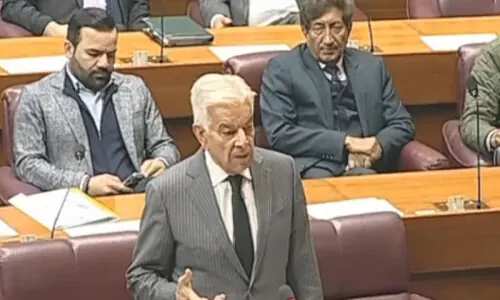
Khawaja Asif told the National Assembly that the attacks, carried out by the outlawed Balochistan Liberation Army (BLA), had no political or nationalist basis and were driven by financial motives after government crackdowns on illegal trade. “The state’s bottom line was that nobody in Pakistan will be allowed to rationalise violence,” Asif said during a briefing on the security situation in the southwestern province.
“I want to assure on behalf of the government that no negotiations will be held with these people. The way they are employing brutal force, so much so that they don’t even spare civilians, women and children, the response to them will be made with the full force of the state,” the minister said. “When you try to rationalise violence or dress it up as a freedom movement — it is not acceptable because it is not true. This is a cover to legitimise criminal activities.”
The remarks came after coordinated assaults on Saturday across at least 12 towns in Balochistan, including Quetta, Mastung, Nushki, Dalbandin, Kharan, Panjgur, Tump, Gwadar and Pasni. Militants targeted civilians and security installations, with suicide bombers, including women, involved in the operations. The attacks began in the early hours of Saturday, with multiple cells striking government and security targets. Security forces responded with gun battles and sweep operations to clear the areas.
Balochistan Chief Minister Sarfraz Bugti confirmed on Sunday that the toll stood at 31 civilians and 17 security personnel dead. By Monday, security officials said 22 more militants had been taken out, pushing the total neutralised to 177 in three days. The military’s media wing labelled the attackers as affiliated with “India-sponsored Fitna al-Hindustan,” a term used by Pakistani officials to refer to alleged Indian-backed separatist groups.
Asif pointed to Indian proxies at work in Balochistan, with Afghanistan serving as a base for terrorist leaders and logistics. “The terrorists’ leadership is based in Afghanistan, and they receive support from there.” The minister said the movement had been hijacked by smuggling operations, particularly oil, which generated billions of rupees in losses to the state. “Billions and trillions of rupees were being lost to smuggling, mainly oil smuggling. This criminal mafia began supporting the movement.”
The minister detailed how commodities meant for transit trade to Afghanistan were diverted back into Pakistan and sold locally, prompting government actions that led to protests, including a prolonged one at the Chaman border. “The members of this movement would call it a nationalistic movement, but it turned into a movement of criminals and smugglers. They began funding it.” Asif said the BLA served as the military wing of these criminal networks, providing protection for smuggling activities. An estimate shows smugglers earned Rs4 billion daily from Iranian oil alone, sold at inflated prices in cities like Karachi before the crackdown.
“It has turned into a nexus of the bureaucracy, tribal leadership and criminal elements,” he said, accusing political leaders and officials of exploiting development funds in the province. Balochistan, Pakistan’s largest province by area but sparsest by population—with one person every 35 km—posed unique challenges for security and officials said controlling this is way more difficult than a populated city or area, and there is a need for the deployment of forces on a massive scale.
The minister rejected narratives of deprivation in Balochistan, pointing to the province’s share under the National Finance Commission, per capita budget and allocations in the Public Sector Development Programme. He also dismissed claims about missing persons, alleging that names on such lists often belonged to killed terrorists. “This narrative has been concocted,” he said, adding that he had once supported protests on the issue but now saw it as hijacked by criminal elements.
The minister detailed the militants’ sophisticated weaponry, including rifles worth Rs2 million ($7,200) and thermal sights costing $4,000-$5,000, questioning their funding sources. “Who is providing funds for it?” He recalled incidents where passengers were pulled from buses, like the Jaffar Express, and killed after identity checks, describing it as planted discrimination. “From where has this discrimination been planted?”
Asif called the events a “wake-up call” and urged the assembly to play a role. “One hundred and seventy-seven terrorists have been killed,” he said. “Let this House play some role in this crisis. Otherwise, we, who are not much relevant anyway, will become even more irrelevant.”
In the Senate, Prime Minister’s Adviser on Political Affairs Rana Sanaullah said terrorists must be condemned without qualification. “Terrorists must be called terrorists without any ‘ifs or buts’,” he said, rejecting any link to resentment or rights issues in Balochistan. Sanaullah dismissed impressions of lost government writ, noting that small groups could carry out crimes anywhere. “They kill people from other provinces in front of their families and then go into hiding,” he said. “What kind of grievance is this, that you murder innocent people?”
Opposition Leader Senator Allama Nasir Abbas criticised the government for security lapses, saying the state lacked writ in Balochistan at night. “The country was facing an economic, political, and law-and-order crisis,” he said, calling for accountability and dialogue. “Your duty is not to cry, it is to restore the writ of the state.” The Senate unanimously passed a resolution condemning the attacks, presented by Law Minister Azam Nazeer Tarar. It paid tribute to security forces and called for investigations to bring perpetrators to justice.
The opposition alliance Tehreek Tahafuz Ayeen-i-Pakistan (TTAP) condemned the violence in a statement on X, calling it a “security failure” by the provincial government and law enforcement. “A terrorist attack in the province on such a large scale was a failure on the part of the provincial government and LEAs,” it said. “Only governments whose own moral standing was not under question were capable of combating terrorism.”
Copyright © 2021 Independent Pakistan | All rights reserved