By Staff Reporter
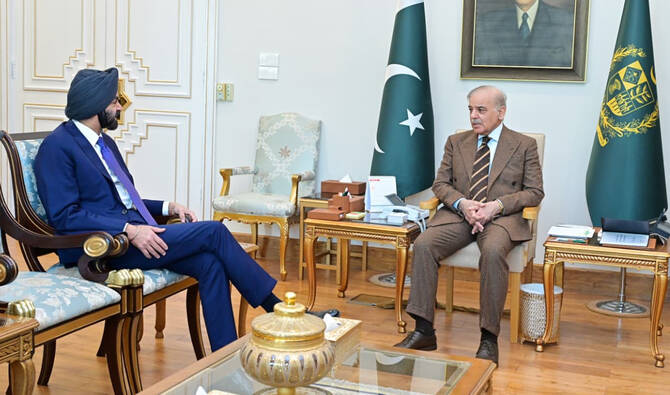
ISLAMABAD: Prime Minister Shehbaz Sharif and World Bank Group President Ajay Banga agreed on Monday to accelerate the implementation of development projects and bolster oversight mechanisms, as the cash-strapped South Asian nation pushes forward with a broad reform agenda backed by international lenders.
The meeting, held at the prime minister’s office in Islamabad, marked Banga’s first official visit to Pakistan since taking the helm of the World Bank Group. It comes as Pakistan grapples with balance-of-payments pressures, high cost of living and the need for structural changes to foster sustainable growth, amid support from institutions including the World Bank and the International Monetary Fund.
Sharif welcomed Banga and highlighted the World Bank Group’s longstanding partnership with Pakistan, particularly its role in the 10-year Country Partnership Framework (CPF) unveiled last year, according to a statement from the prime minister’s office. The framework pledges $20 billion in lending over the coming decade, targeting challenges such as climate change impacts and private-sector expansion.
The prime minister outlined Pakistan’s comprehensive, homegrown reform program, which spans sectors including energy, agribusiness, digital development, fiscal reforms and job creation, the statement said. He emphasized the government’s commitment to unlocking job-rich growth and enhancing investor confidence through these structural adjustments. Sharif and Banga reiterated the importance of fast-tracking project execution and ensuring robust oversight to achieve results “at speed and scale” on priorities aligned with the CPF, the statement added. Such steps would support Sharif’s efforts to clear bottlenecks in development initiatives, it said.
Banga, in turn, commended Pakistan’s ongoing reforms and pledged to deepen collaboration via a “One World Bank Group” approach, according to the statement. He stressed that mobilizing greater private resources, alongside close coordination with other development partners, was essential to realizing the government’s ambitious agenda.
Pakistan has leaned heavily on multilateral financing in recent years to navigate its economic woes. The country is currently operating under a $7 billion IMF bailout package, which mandates measures to increase government revenues and secure external funding, much of it from loans provided by China and Gulf states. When the CPF was announced last January, Sharif described it on social media platform X as a plan to channel the World Bank’s $20 billion commitment into areas like clean energy and climate resilience from 2026 onward. The World Bank, in its own statement at the time, underscored the need for policy and institutional reforms to stimulate private-sector growth and free up fiscal space for investments in critical sectors.
“We are focused on prioritising investment and advisory interventions that will help crowd-in much needed private investment in sectors critical for Pakistan’s sustainable growth and job creation, including energy and water, agriculture, access to finance, manufacturing and digital infrastructure,” Zeeshan Sheikh, the World Bank’s International Finance Corporation country manager for Pakistan and Afghanistan, said in a statement then. The World Bank has committed approximately $17 billion to Pakistan across 106 projects to date.
Sharif also praised Banga’s leadership in reshaping the World Bank Group into a more effective development partner, and acknowledged its assistance in building resilient infrastructure, advancing human capital and boosting productive private investments.
Copyright © 2021 Independent Pakistan | All rights reserved