By Staff Reporter
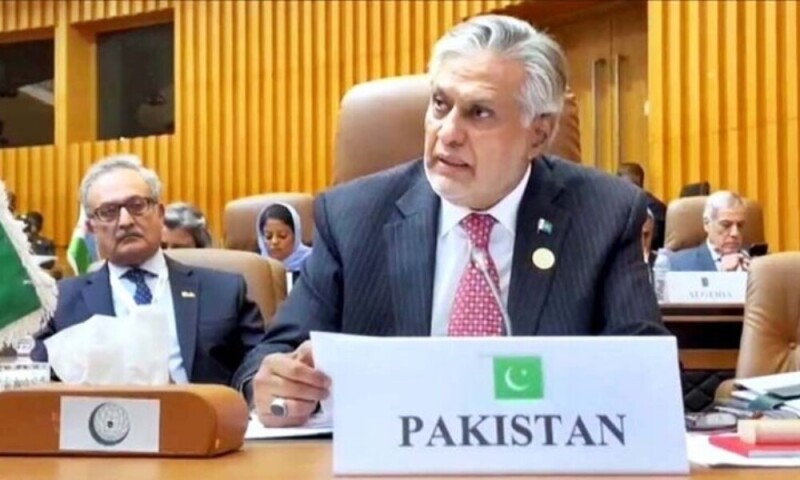
ISLAMABAD: Deputy prime minister and foreign minister, Ishaq Dar, warned on Friday that India’s suspension of the Indus Waters Treaty constituted an “illegal and unilateral” act that posed a “real threat” to regional stability, as he delivered a sweeping critique of multiple global conflicts at an Indo-Pacific ministerial forum in Brussels.
Speaking at a roundtable hosted by the European Union, Dar framed the treaty dispute, which escalated in April after a deadly attack in occupied Kashmir, as part of a broader pattern of unresolved tensions between the two nuclear-armed neighbors. He insisted that water, a vital resource for both nations, must remain a domain of cooperation rather than a tool of political leverage. “Water must be a source of cooperation and not weaponised for politics,” Dar said.
India placed the 1960 World Bank-brokered treaty in abeyance after the April attack in Pahalgam that killed 26 people, an incident New Delhi attributed to militants supported by Pakistan. Islamabad has vehemently denied any involvement and has described any move to restrict its water share as tantamount to an “act of war.” Pakistani officials have said the treaty contains no clause permitting unilateral suspension and have threatened legal recourse, arguing that India’s action violates the 1969 Vienna Convention on the Law of Treaties.
Dar linked the water crisis directly to the longstanding dispute over Kashmir. “We believe that durable peace in South Asia cannot be achieved without a peaceful resolution of decades-old Jammu and Kashmir dispute in accordance with relevant United Nations Security Council resolutions and aspirations of Kashmiri people,” he said.
On Afghanistan, Dar described the neighboring country as a relationship of continuing strategic weight for Pakistan and for the region at large. Ties have deteriorated sharply in recent years, largely over Islamabad’s accusations that the Taliban authorities in Kabul have failed to curb the Tehreek-i-Taliban Pakistan militants who stage cross-border attacks.
“We desire a peaceful, stable, friendly, connected, and prosperous Afghanistan,” he said. “We urge the Afghan Taliban regime to act responsibly, honour their commitments, and work towards rooting out terrorism from its soil.”
Turning to the Middle East, Dar said the crisis in Gaza and the wider Israeli-Palestinian conflict “impacts us all directly.” He praised what he described as successful mediation that produced a ceasefire agreement. “Pakistan commends efforts of President Trump, along with eight Arab Islamic countries, including Pakistan, leading to the signing of the peace agreement in Sharm el-Sheikh, heralding a ceasefire. He immediately added a sharp caveat: “The ongoing atrocities in Gaza and violations of the peace agreement must end, as well as the illegal occupation of Palestinian lands.” Mr
Dar reiterated Pakistan’s longstanding position that a lasting solution required “a credible, time-bound political process consistent with relevant [UNSC] resolutions, leading to the establishment of an independent, sovereign, viable, and contiguous state of Palestine based on pre-1967 borders, with al-Quds al-Sharif as its capital.”
On Ukraine, Dar noted the war’s severe spill-over effects on global energy and food prices, “with real consequences for people around the globe.” He said Pakistan’s stance remained anchored in the principles of the United Nations Charter and expressed hope for an early negotiated settlement. “The model of cooperation adopted by the [EU] offers many lessons for the international community,” he said, “proving that inclusivity and interdependence are the surest foundations of peace and prosperity.”
Copyright © 2021 Independent Pakistan | All rights reserved