By Staff Reporter
ISLAMABAD: Pakistan has pledged to stand “shoulder to shoulder” with Saudi Arabia after a run of Houthi missile attacks on the kingdom’s airports, with Prime Minister Shehbaz Sharif declaring his country’s commitment to Riyadh’s security “resolute”.
In a post on X on Friday, Sharif condemned the attacks on King Khalid International Airport in Riyadh and Abha International Airport, which he said had caused civilian casualties. He praised the “vigilance and professionalism” of the Saudi armed forces and the Saudi-led coalition in Yemen for intercepting ballistic missiles.
“In line with the Makkah Joint Defence Agreement, and recent decisions taken by its Strategic Political and Defence Committee, our commitment to the Kingdom’s sovereignty, territorial integrity and security is resolute,” he wrote.
He added that Pakistan fully supported Saudi Arabia’s “legitimate right to defend its people and protect its cities and vital infrastructure”. He called on the Houthis to cease their attacks immediately, and said Islamabad would “continue to stand shoulder to shoulder with Saudi Arabia in the face of these threats”.
The prime minister’s statement followed a week of escalating strikes on the kingdom. On Wednesday, Saudi authorities said three people had been killed and 36 injured in attacks on two international airports. One person, a Sudanese national, was killed and eight wounded at King Khalid airport, while Moroccan and Algerian residents were among the dead at Abha, where 28 people were injured.
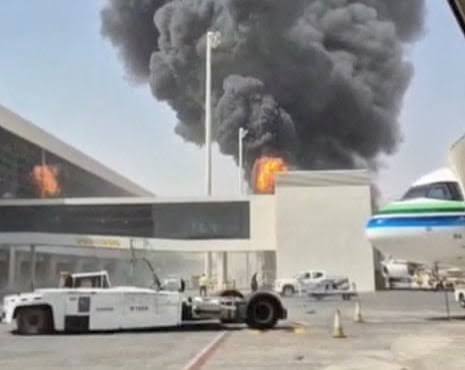
The Houthis struck again on Thursday, with two attacks on King Khalid airport. Saudi aviation authorities said three Saudi nationals, including a pilot, were killed. A Saudia Airlines plane was damaged and smoke rose over the airport. The Houthis said they had fired on the airport. A Saudi-led coalition that backs pro-government forces in Yemen said it had “destroyed the ballistic missile launch platform” used in the attack on Riyadh. Taken together, Saudi figures put the toll from the two sets of attacks at at least six dead.
Hundreds of flights were cancelled on Thursday, though Saudi authorities said airport operations and air traffic had returned to normal by Friday. Lufthansa Group has said it will suspend Riyadh flights until 16 October. The disruption comes days before Riyadh is due to host a major meeting of global oil chiefs.
Questions over what Pakistan is actually doing for its ally were put to the Foreign Office at its weekly briefing on Friday. Spokesperson Sajjad Haider Khan said Pakistan already had a “substantial number” of forces and resources in Riyadh, and that it was now up to the Makkah Defence Alliance to assess the threat and decide how to respond.
“It is now up to the organisation to assess the threat perception and operate in accordance with its own mandate,” he said. He declined to discuss how the alliance would handle the situation, saying it “would not be appropriate” for him to do so, and called it speculative to suggest which countries might become involved. He described the Houthis as a militia with a history of “proxy activities” that had “contributed to regional instability”.
The alliance is a three-way arrangement between Pakistan, Saudi Arabia and Turkey, signed on 7 August. It commits the signatories to treating an attack on one as an attack on all. All three have described it as defensive and aimed at collective deterrence. It sits alongside a separate bilateral defence agreement between Islamabad and Riyadh signed in September 2025.
On Monday, the three countries held an emergency meeting in Riyadh and agreed to move “immediately to the practical implementation of the collective defence commitments”, including the rapid deployment of military forces and capabilities in the kingdom. Defence Minister Khawaja Asif, who attended, said afterwards that both Pakistan and Turkey had a “presence in theatre” but that only Saudi troops were involved in combat operations. He described the Pakistani and Turkish role as supportive, involving “reconnaissance and other things”. On Thursday, he said nothing in the alliance barred its members from becoming directly involved if one of them were threatened.
Pakistan’s military has also spoken openly about its presence. Lt Gen Ahmed Sharif Chaudhry, the military spokesman, told CNN this week that Pakistani soldiers were serving in the kingdom in “multiple capabilities and domains”. On 18 September he said Pakistan would go to “any extent” to defend Saudi Arabia, and that its commitment was “unconditional”. Reuters reported in May that Pakistan had deployed 8,000 troops, a squadron of fighter jets and an air defence system to the kingdom under the bilateral pact.
The government has nonetheless pushed back on some reports. The Ministry of Information this week called a Reuters report of 30,000 to 40,000 Pakistani troops in Saudi Arabia “speculative”. On Thursday it dismissed as “fake and fabricated” a claim that Pakistan Air Force aircraft were being used against the Houthis.
The fighting has deepened since Yemen’s civil war reignited in July, when the Houthis, who control most of the country’s northwest, captured swathes of coastal land. Yemen’s internationally recognised government declared a major counter-offensive this week and said Houthi fighters had been pushed out of strategic areas on the Red Sea and from the port city of Mocha. The Houthis say they are holding their ground, and military sources on both sides who spoke to AFP have reported no major changes on the front lines. Houthi officials and affiliated media said Saudi air strikes hit targets in the Yemeni capital, Sanaa, overnight.
The Houthis say they are targeting the kingdom over its support for government forces. They have declared a maritime blockade on Saudi Arabia and are attacking its ships in the Red Sea. They have also warned people in Saudi Arabia to stay away from oil facilities, which they say are legitimate targets. Reuters reported on Thursday that France and Saudi Arabia were exploring ways for the French military to help protect the Yanbu oil terminal on the Red Sea coast.
The Yemen front has become the fiercest in a wider regional conflict triggered by the US and Israeli attack on Iran on 28 February. Pakistan, which shares a border with Iran, is watched closely for how far it will go in support of Riyadh. Donald Trump has said the US will not attack Iran before the midterm elections on 3 November, and that Washington and Tehran are holding “productive discussions”.
Copyright © 2021 Independent Pakistan | All rights reserved