By Staff Reporter
ISLAMABAD: Pakistan’s deputy prime minister and foreign minister, Ishaq Dar, said on Sunday that both Washington and Tehran had voiced confidence in Islamabad’s ability to facilitate talks aimed at ending the Middle East conflict that has engulfed the region since US and Israeli strikes on Iran in late February.
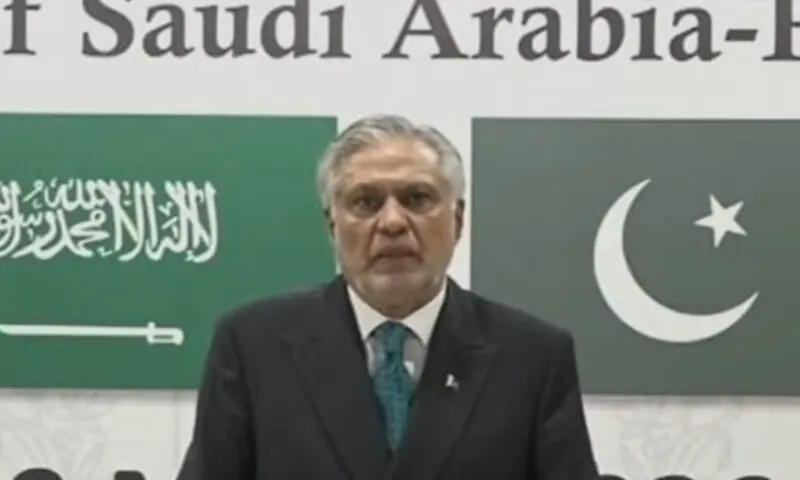
Speaking in a televised address at the conclusion of a quadrilateral meeting in Islamabad, Dar said the gathering of foreign ministers from Pakistan, Saudi Arabia, Turkiye and Egypt is a platform for “detailed and in-depth” discussions on the crisis and ways to secure an early and permanent ceasefire. The meeting, the second in the format after an initial session in Riyadh on 19 March, came as Pakistan has intensified its diplomatic efforts to create space for direct US-Iran negotiations.
Dar told reporters that he had briefed his counterparts on the prospects of potential talks to be hosted in Islamabad. The visiting ministers, he said, gave their “fullest support” to the initiative and reaffirmed their unity in working to contain the situation, reduce the risk of military escalation and create conditions for structured negotiations. “The foreign ministers advocated dialogue and diplomacy as the only viable pathway to prevent conflict and to promote regional peace and harmony,” Dar said. “They called for upholding principles of the United Nations Charter, including respect for the sovereignty and territorial integrity of all states.”
The four countries also agreed that the continuing war was “not in favour of anyone and would only lead to death and destruction”, he added, stressing the importance of Muslim unity at a time of regional turmoil. They expressed concern over the conflict’s “devastating impact on lives and livelihood across the wider region”.
A committee of senior officials from the four foreign ministries was established to work out the practical details of enhanced cooperation, Dar said. He thanked the visiting ministers for their backing of Pakistan’s peace efforts and noted that the gathering had also reviewed ways to strengthen ties among the four “brotherly countries”.
The summit took place against a backdrop of heightened security in Islamabad’s Red Zone, where government buildings and diplomatic missions are located. Roads were sealed off and the driveway of the foreign ministry was decorated with the flags of the four participating nations. Egyptian foreign minister Badr Abdelatty and his Turkish counterpart, Hakan Fidan, arrived on Saturday night, while Saudi Arabia’s Prince Faisal bin Farhan Al Saud landed on Sunday afternoon.
Before the main quadrilateral session, Dar held separate bilateral meetings with each of the three ministers. In his talks with Fidan, both sides reaffirmed Pakistan’s commitment to expanding cooperation “across all sectors of mutual interest” and emphasised the “historic and fraternal ties” between the two countries. They exchanged views on regional developments, including the situation in Iran, and stressed the need for dialogue and diplomatic engagement.
Similar language was used in Dar’s meeting with Abdelatty, which the Pakistani foreign ministry described as a follow-up to recent high-level contacts, including discussions in Riyadh earlier this month and Abdelatty’s visit to Pakistan in November 2025. The two ministers expressed satisfaction with the trajectory of defence and security cooperation and agreed to strengthen trade and investment links, including through the reactivation of a joint ministerial commission.
Dar appreciated Egypt’s support in Pakistan’s efforts to combat hepatitis C and welcomed continued health-sector collaboration. Both sides also reaffirmed their support for the Palestinian people. Dar “strongly condemned the continued aggression by Israeli occupying forces in Gaza and the West Bank” and thanked Egypt for its role in facilitating humanitarian assistance to Gaza, including to Pakistani relief efforts.
In his meeting with Prince Faisal, the ministers discussed “evolving regional and international developments” and agreed on the importance of dialogue, diplomacy and collective action to promote peace and stability. They pledged to maintain close coordination at both bilateral and multilateral levels. Dar also posted on X after the meetings, welcoming the ministers and describing the discussions as “candid and constructive”. He highlighted the countries’ “strong fraternal ties” and their shared focus on “advancing peace and stability” while deepening partnership and cooperation.
Pakistan has stepped up its diplomatic activity in recent weeks as it seeks to de-escalate hostilities that erupted after US and Israeli strikes on Iran on 28 February. Tehran has since launched retaliatory attacks, drawing in wider regional actors. Islamabad has engaged intensively with Washington, Gulf capitals and other Muslim nations in an attempt to open channels for dialogue.
The quadrilateral format is seen by diplomats as an important track feeding into broader efforts to end the fighting, helping to consolidate regional support for de-escalation and align positions ahead of any US-Iran talks. Although neither Washington nor Tehran participated in Sunday’s meeting, it is regarded as a preparatory step toward a possible diplomatic opening.
Dar emphasised Pakistan’s longstanding engagement with the United States, describing the relationship as “very important”. He said Islamabad had been actively involved in efforts to de-escalate the situation and find a peaceful resolution. “Pakistan is very happy that both Iran and the US have expressed their confidence in Pakistan to facilitate the talks,” he said. “Pakistan will be honoured to host and facilitate meaningful talks between the two sides in the coming days, for a comprehensive and lasting settlement of the ongoing conflict.”
He said that he had held a detailed telephone conversation with China’s foreign minister, Wang Yi, who “fully supports Pakistan’s initiative to host Iran-US talks”. Dar also spoke with the UN secretary general, who expressed full support for the Pakistani effort, and with several other foreign counterparts who offered similar backing. “Therefore, there is strong appreciation and support among all our friends for the efforts being made by Pakistan,” Dar said. “We will continue our efforts with sincerity and commitment.”
The quadrilateral meeting had originally been planned for Turkiye but was shifted to Islamabad at short notice because of Dar’s involvement in the US-Iran facilitation effort. A diplomatic source indicated that talks in Islamabad could take place around Tuesday, possibly involving US secretary of state Marco Rubio and Iranian foreign minister Abbas Araghchi. Another diplomat suggested there was an expectation in some quarters that Washington might announce a ceasefire to coincide with the start of dialogue, in line with Tehran’s demand for confidence-building measures. However, the source cautioned that developments remained fluid and would depend on events over the next 48 hours. Germany’s foreign minister, Johann Wadephul, said on Friday that a direct US-Iran meeting would take place in Pakistan “very soon”.
Copyright © 2021 Independent Pakistan | All rights reserved