By Staff Reporter
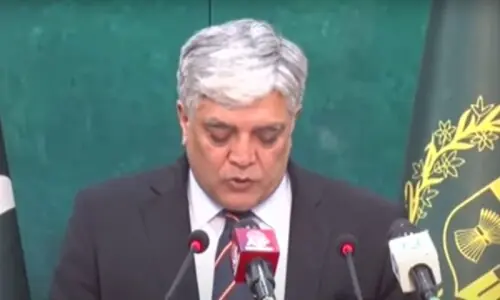
ISLAMABAD : Pakistan on Friday asserted its authority over the fate of Afghan refugees on its soil, urging Germany to swiftly accept thousands who were promised refuge in Berlin while warning Kabul to crack down on terrorist safe havens across the border.
The comments from Foreign Office spokesperson Ambassador Shafqat Ali Khan came as Islamabad pushes forward with deporting up to 1 million documented Afghan refugees, a campaign that intensified last month after the interior ministry declared that Proof of Registration (PoR) cardholders, the final group of Afghans legally residing in Pakistan without visas, had become unlawful residents following the June 30 expiration of their cards.
“Those Afghans waiting to travel to Germany should be deported promptly,” Khan said at a press briefing, referring to 2,400 Afghan refugees who had been assured sanctuary by Berlin before a shift in German policy under a new government hardened its stance on migrants. Germany has since indicated it is weighing an appeal to accept 200 of them.
“Germany should take in these refugees as soon as possible,” the spokesperson added. “Pakistani law will apply to those Afghans living here. We will decide what to do with refugees in Pakistan.”
Khan also pointed to an August statement from the German foreign ministry posted on X, in which Berlin said it takes the issue “very seriously.”
“I have seen the German foreign minister’s statement,” Khan said. “Germany will have to take the issue of Afghans in Pakistan seriously.”
Pakistan, which is not a party to the 1951 Geneva Convention on refugees, relies instead on its Foreigners Act. That law grants authorities the power to arrest, detain and expel foreigners, including refugees and asylum seekers, lacking valid documentation.
The spokesperson’s remarks extended to broader tensions with Afghanistan, emphasising that Kabul must address terrorism emanating from its territory. “Terrorist safe havens still exist in Afghanistan,” Khan said. “Pakistan knows how to defend its territory and its people.”
Khan referenced an operation in the border region with Afghanistan targeting terrorists, alluding to drone strikes reportedly conducted by Pakistan on Aug. 28. “Afghanistan needs to stop allowing its territory to be used for acts of terrorism.”
Islamabad has long cautioned Kabul against permitting its land to serve as a launchpad for attacks into Pakistan, insisting that it retains the capability to strike at militants responsible for such incursions.
The statements followed this week’s meeting of the Shanghai Cooperation Organization’s (SCO) Council of Heads of State, where members renewed their pledge to support Afghanistan as an independent, neutral and peaceful state, devoid of terrorism, war and drugs. They also voiced willingness to back international efforts for peace and development there.
“Member states reiterated that the formation of an inclusive government with broad participation of representatives of all ethno-political groups of Afghan society is the only way to achieve lasting peace and stability in the country,” the declaration stated.
At the same SCO gathering in China, Pakistan condemned Israel’s continuing military campaign against Palestinians and demanded an immediate ceasefire in Gaza. Prime Minister Shehbaz Sharif used the platform to reaffirm backing for the next stage of the China-Pakistan Economic Corridor (CPEC), a cornerstone of bilateral ties.
Israeli forces have recently advanced into sections of Gaza City, preparing to seize control of the densely populated area that houses about a million people, many displaced repeatedly amid the conflict.
On Thursday, Israeli strikes claimed 28 lives, pushing the death toll from Israel’s two-year war to 64,000, according to Palestinian health officials. Last month, the Integrated Food Security Phase Classification (IPC) system declared Gaza City in official famine, affecting roughly 514,000 people.
Pakistan, which maintains no diplomatic ties with Israel, has steadfastly criticized the war on Gaza, advocating for unimpeded humanitarian aid to Palestinian territories and the creation of an independent, sovereign and contiguous Palestinian state based on pre-1967 borders, with East Jerusalem as its capital.
“At the SCO CHS summit, the Prime Minister Sharif presented Pakistan’s perspective on pressing regional and global issues, highlighting strategies to strengthen SCO’s role in fostering regional cooperation and stability,” Khan said at the weekly press briefing in Islamabad.
“The prime minister unequivocally denounced Israel’s inhuman military offensive against Gaza and called for an immediate and unconditional ceasefire.”
During his trip to China for the summit, Sharif met with President Xi Jinping and Premier Li Qiang, praising Beijing’s contributions to Pakistan’s socio-economic progress.
“He lauded the significance of China-Pakistan Economic Corridor as a flagship project of President Xi Jinping’s Belt and Road Initiative, and reaffirmed the desire to continue working closely with China for the successful implementation of the next phase of upgraded CPEC with its five new corridors,” Khan said.
“This would help both countries to build an even stronger Pakistan-China community with a shared future.”
China stands as a vital strategic partner for Pakistan, having invested tens of billions in energy and infrastructure under CPEC. The corridor’s second phase emphasizes growth, livelihood and innovation, aligning with Pakistan’s “5 Es” framework: exports, e-Pakistan, energy, environment and equity.
On Thursday, the two nations inked 21 memorandums of understanding and joint ventures valued at $4.2 billion to boost business-to-business collaboration across various sectors, according to Pakistani state media.
Copyright © 2021 Independent Pakistan | All rights reserved