By Staff Reporter
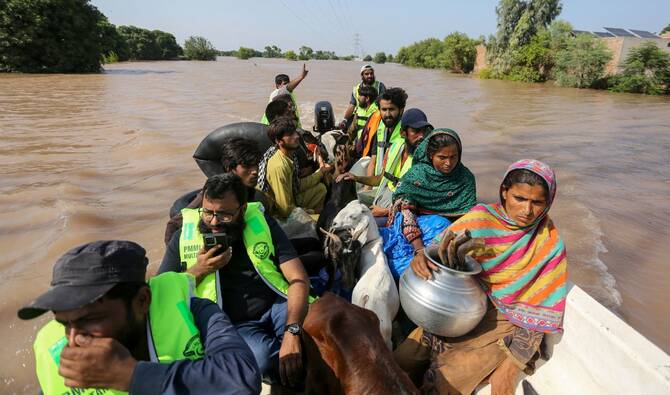
KARACHI: Authorities in Pakistan’s southern Sindh province have evacuated over 109,000 people from low-lying areas as severe flooding in eastern Punjab, triggered by torrential monsoon rains, swells rivers and threatens downstream regions, disaster officials said on Friday.
The Provincial Disaster Management Authority (PDMA) Punjab reported a high flood situation at Trimmu and Panjnad headworks, with significant water inflows recorded across multiple rivers. The River Chenab at Marala Headworks registered a flow of 117,000 cusecs, rising to 248,000 cusecs at Khanki Headworks, 385,000 cusecs at Qadirabad Headworks, and peaking at 554,000 cusecs at Chiniot Bridge.
At Trimmu Headworks, water flow reached 239,000 cusecs. In the River Ravi, water discharge was measured at 80,000 cusecs at Jassar, 110,000 cusecs at Ravi Siphon, 108,000 cusecs at Shahdara, and 138,000 cusecs at Balloki Headworks. Following heavy rains in upper regions, the River Sutlej saw flows of 319,000 cusecs at Ganda Singh Wala, 102,000 cusecs at Islam Headworks, and 224,000 cusecs at Panjnad Headworks.
“Monsoon rains are predicted in most districts of Punjab till September 9,” the PDMA said in a statement, urging caution. “Citizens should take precautionary measures and never go near rivers for recreational activities. Refrain from fishing and other activities in rivers.”
The monsoon season, which delivers up to 80% of Pakistan’s annual rainfall, is critical for agriculture and food security but has become increasingly destructive due to erratic and extreme weather patterns.
The current floods have killed 46 people, displaced 1.8 million, and inundated 1.3 million acres of farmland in Punjab, the country’s breadbasket, over the past two weeks, according to official data. An additional 3.9 million people have been affected. Nationwide, rains, floods, landslides, and related incidents have claimed at least 884 lives since June 26, the National Disaster Management Authority (NDMA) reported. The disaster echoes the catastrophic 2022 floods, when a third of Pakistan was submerged, over 1,700 people died, and economic losses exceeded $35 billion.
As floodwaters move downstream, the NDMA warned on Thursday evening that northern Sindh districts, including Sukkur, Ghotki, Larkana, Khairpur, Dadu, and Jacobabad, are at risk, while southern districts such as Thatta, Sujawal, Badin, Tharparkar, Umerkot, Sanghar, Karachi, Hyderabad, and Jamshoro could face heavy downpours in the coming days.
First Lady Aseefa Bhutto Zardari, inspecting protective embankments and relief camps near Nawabshah, emphasized preparedness. “Your lives are precious, and no unnecessary risk should be taken in the face of natural calamities,” she told communities. “Effective coordination between departments, close monitoring, and advanced planning are essential if we are to manage this challenge successfully.”
Pakistan, one of the world’s most climate-vulnerable nations, has faced increasingly frequent and severe weather events, including heatwaves, untimely rains, storms, cyclones, and droughts, which scientists attribute to human-driven climate change. In May, at least 32 people were killed in severe storms across the country.
In Sindh, Senior Minister Sharjeel Inam Memon said 109,320 people have been relocated from the katcha areas, with 14,430 evacuated in the past 24 hours. Nearly 27,801 people have received medical assistance, including 6,900 in the last day. Over 346,000 cattle have been moved to safety, and more than 754,500 have been vaccinated. “In view of a possible flood, people from the katcha areas are being evacuated to safe locations,” Memon said, stressing that the dangers “could not be ignored.”
He noted that Sindh’s government is coordinating closely with Punjab authorities and monitoring water levels, with a “low” flood reported at Guddu, Sukkur, and Kotri barrages in Sindh, and at Marala on the Chenab in Punjab.
The Punjab PDMA reported that 3.8 million people have been affected by flooding in the Chenab and Ravi-Sutlej rivers. “1.8 million people trapped by floods have been rescued and relocated to safe places,” a PDMA report stated, citing the Punjab relief commissioner. Authorities have established 415 relief camps in severely flooded areas and 466 in other affected regions, alongside 398 veterinary camps for livestock.
Copyright © 2021 Independent Pakistan | All rights reserved