By Staff Reporter
ISLAMABAD: The petroleum minister pledged on Tuesday to anchor fuel prices to actual import costs after oil company executives warned that seven formula overhauls in three months had erased a full year’s industry profits in a single pricing cycle and were pushing foreign investors toward the exit.
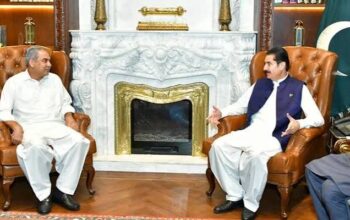
The assurance came at a hastily convened meeting in Islamabad, where Petroleum Minister Ali Pervaiz Malik and Petroleum Secretary Hamed Yaqoob Shaikh sought to contain an industry backlash over repeated, abrupt changes to Pakistan’s fuel pricing mechanism — adjustments that executives said had destabilised business planning and undermined investor confidence in one of the country’s most capital-intensive sectors.
Malik told chief executives of several oil marketing companies and refineries that upcoming petrol prices would be set using a $15.85-per-barrel import premium based on the latest cargo procured by state-owned Pakistan State Oil, which officials acknowledged had suffered the heaviest losses from the recent adjustments. Diesel prices would continue to be benchmarked against Pakistan State Oil’s import premium from Kuwait Petroleum, currently running at $5 to $6 per barrel.
Malik also said the seven-day pricing cycle would remain unchanged in the near term.
Asif Iqbal, chairman of the Oil Companies Advisory Council, which represents more than three dozen firms, told the minister the pricing formula had been overhauled seven times for diesel and four times for petrol since March — a pace of upheaval he said had shattered business confidence across the sector. The June 19 price adjustment had, in the space of a single day, wiped out the profits accumulated across the preceding year, Iqbal said. No credible foreign investor, he warned, could be expected to commit capital to the sector under such conditions.
Amir Abbassciy of Cynergico Petroleum said refineries were bearing a disproportionate burden because of the large-scale availability of smuggled high-speed diesel in Pakistan’s domestic market. He called for outright price deregulation and effective government action against fuel smuggling, reinforcing OCAC’s warning that fresh foreign investment had become practically untenable.
The meeting’s sharpest warning came from Wafi Energy chief executive Zubair Shaikh, who said the UAE-based parent company of his firm had reacted with shock upon learning that its Pakistani subsidiary had lost more money in a single pricing change than it had earned in profit across the preceding year. Shaikh said he could not guarantee that Wafi’s principal foreign shareholders would remain and indicated they were seriously weighing an exit from Pakistan.
A further complaint centred on cash. One executive told the minister that the Oil and Gas Regulatory Authority had withheld more than 66 billion rupees in price differential claims — sums owed to companies to compensate for losses arising from government-mandated pricing decisions rather than their own operational shortfalls. The squeeze was being compounded, the executive said, by commercial banks charging foreign exchange rates above the State Bank of Pakistan’s official benchmarks, creating acute working capital strains across the industry.
Refinery executives separately objected to a government demand that companies surrender 2.5 percent of so-called deemed duty — a levy originally earmarked to fund plant upgrades — despite the fact that no upgrade contracts had yet been signed, leaving the industry exposed to a cost it had not anticipated and for which no corresponding benefit had materialised.
Most of those present called for the restoration of the pricing formula in use before the recent overhaul, warning that a continuation of the current mechanism risked not only eliminating profits but impairing companies’ underlying working capital positions.
Malik said the prime minister had established a committee to review petroleum pricing policy and pledged that industry submissions would be incorporated into its deliberations. He said full price deregulation could not be introduced abruptly, describing the path forward as incremental — potentially a shift from weekly to daily price adjustments over time.
The meeting also produced an unusual broadside directed at the industry itself. Both the minister and the secretary complained, according to informed sources, that executives had at times softened their economic arguments when appearing before the National Coordination and Management Council, inadvertently weakening the Petroleum Division’s own hand in internal government discussions. One executive who left the room during the session to take a call from the council was reportedly reprimanded on the spot for undermining formal policy deliberations.
Company chiefs were also taken to task for failing to push back against what officials characterised as one-sided commentary on social media. When some executives voiced frustration at the Oil and Gas Regulatory Authority’s leadership being difficult to reach, Malik reportedly told them to escalate their concerns directly to the prime minister if they were dissatisfied with the regulator.
The OCAC chairman, for his part, said he had been granted a hearing by the authority on short notice, though he conceded that his submissions had not been reflected in the regulator’s final decisions.
Copyright © 2021 Independent Pakistan | All rights reserved