By Staff Reporter
ISLAMABAD: As a fragile ceasefire holds in Gaza after two years of devastating war, Pakistan said on Tuesday that it would send its top diplomat to Turkey next week for a pivotal meeting of foreign ministers from eight Arab and Muslim-majority nations, aimed at fleshing out the next phases of a United States-backed peace plan.
The gathering, hosted by Turkey, represents a critical juncture in the diplomatic push to solidify the truce brokered by President Donald Trump, which halted the Israeli genocide in Gaza earlier this month. It builds on an alliance formed last month by the eight countries, Pakistan, Turkey, Qatar, Saudi Arabia, Indonesia, Egypt, the United Arab Emirates and Jordan, that has pledged to align with Trump’s 20-point proposal to end the fighting, secure the release of hostages and rebuild the enclave as a demilitarized economic zone.
“Turkish Foreign Minister Hakan Fidan invited the Deputy Prime Minister and Foreign Minister Ishaq Dar to Turkiye for the forthcoming meeting next week of the eight Foreign Ministers of partner countries who were engaged on the sidelines of UNGA80 in the diplomatic process on Gaza,” Pakistan’s Foreign Office said in a statement.
The ministers are expected to review progress toward an immediate ceasefire, the exchange of all hostages and the remains of those killed, and the deployment of a multinational stabilisation force to secure and demilitarise Gaza. The plan also calls for Gulf-funded reconstruction to transform the territory into a terror-free economic zone, alongside unification of Gaza and the West Bank and a two-state solution, all within the framework of regional normalisation under the Abraham Accords.
Dar and Fidan discussed the evolving situation in Gaza during a recent call, along with “the next steps and modalities for achieving lasting peace in Palestine,” the Foreign Office said. The conversation underscored the group’s commitment to coordinated international efforts to stabilise the region and address the humanitarian crisis, including relief for civilians. The coalition emerged on Sept. 23 on the sidelines of the United Nations General Assembly in New York, evolving from the 2023 Arab-Islamic Contact Group.
They affirmed readiness to “engage positively and constructively” with the United States and other parties to implement a comprehensive deal ensuring unrestricted humanitarian aid, no displacement of Palestinians, the release of hostages, security guarantees for all sides, full Israeli withdrawal, Gaza’s reconstruction and its integration with the West Bank into a Palestinian state under international law. Yet even as the diplomats prepare to convene, uncertainties loom over the stabilisation force, a cornerstone of the plan intended to prevent a postwar power vacuum.
Pakistan is poised to announce soon whether it will contribute troops, with officials indicating that internal government and military discussions have reached an “advanced stage” and are leaning toward participation. Army Chief Field Marshal Asim Munir recently visited Egypt, Jordan and Saudi Arabia to discuss the Gaza plan and the proposed deployment. Indonesia and Azerbaijan are also expected to provide personnel, while the United Arab Emirates, Egypt and Qatar are in talks with Washington. The Trump administration has ruled out American ground troops but has dispatched 200 soldiers to Israel for coordination. Still, it remains unclear whether enough Arab and other states will commit forces, given the political sensitivities involved.
Israel has drawn a firm line against Turkish involvement, heightening tensions within the coalition. On Monday, Israeli Foreign Minister Gideon Saar said his country “has not surrendered its right to self-defence as part of the agreement brokered by Washington, Egypt, and Qatar.” He added that Israel would not accept Turkish armed forces in Gaza, citing Ankara’s “hostile approach” under President Recep Tayyip Erdogan, who has accused Israel of genocide. “So it is not reasonable for us to let their armed forces enter the Gaza Strip, we will not agree to that, and we said it to our American friends,” Saar said.
Complicating matters further, Pakistani officials swiftly debunked exaggerated reports circulating in Indian media. The Ministry of Information and Broadcasting on Tuesday “categorically rejected the ‘fake and misleading news’ of the Indian media outlets, claiming the deployment of 20,000 Pakistani troops for the Gaza peace force.” The ministry clarified that neither the Foreign Office nor the military’s Inter-Services Public Relations wing had endorsed any such mission, reaffirming Pakistan’s nonrecognition of Israel and its “clear, principled stance in support of Palestinian self-determination.”
Defense Minister Khawaja Asif, speaking on a private news channel, emphasised that deliberations on troop contributions were ongoing. “This thing has to be finalised [and] it is in process. The government will take a decision after passing through the process, and I don’t want to preempt it,” he said.
Asif said the government would consult Parliament and other institutions before deciding, stressing that any deployment would differ from a United Nations peacekeeping operation, focusing solely on Gaza’s external security while Palestinian authorities handle internal law and order.
The issue also surfaced during Dar’s recent meeting with Saudi Foreign Minister Faisal bin Farhan in Riyadh. “The two leaders discussed bilateral relations, regional and international developments, including the situation in Gaza, and reaffirmed their shared commitment to cooperation at multilateral fora, including the United Nations,” the Foreign Office said.
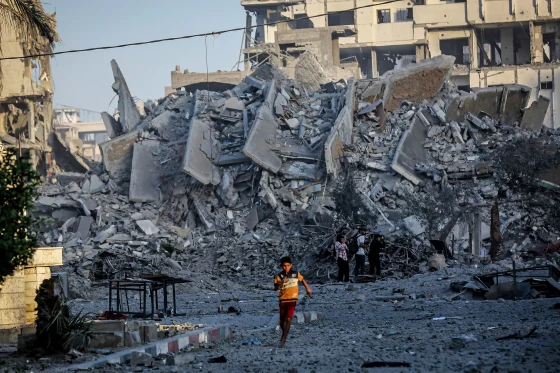
The upcoming Turkish meeting follows weeks of deliberations among the coalition states, with expectations that Pakistan’s final stance on troops could emerge from those talks. For now, the fragile truce persists, with Egyptian teams aiding in hostage body recoveries amid rubble from Israel’s campaign, which has killed over 66,000 Palestinians, mostly women and children, according to United Nations estimates. Gaza’s infrastructure lies in ruins, with famine and disease rampant.
Copyright © 2021 Independent Pakistan | All rights reserved