By Staff Reporter’
ISLAMABAD: Deputy prime minister and foreign minister, Ishaq Dar, said on Tuesday that the government would soon introduce a long-discussed constitutional amendment in Parliament, seeking to quell opposition concerns that the measure could erode provincial autonomy hard-won under a landmark 2010 reform.
The announcement came amid intensifying speculation over the proposed 27th Amendment, which has ignited a nationwide debate over its potential to reverse elements of the 18th Amendment. That earlier change devolved significant powers from the federal government to the provinces, including control over education and population matters.
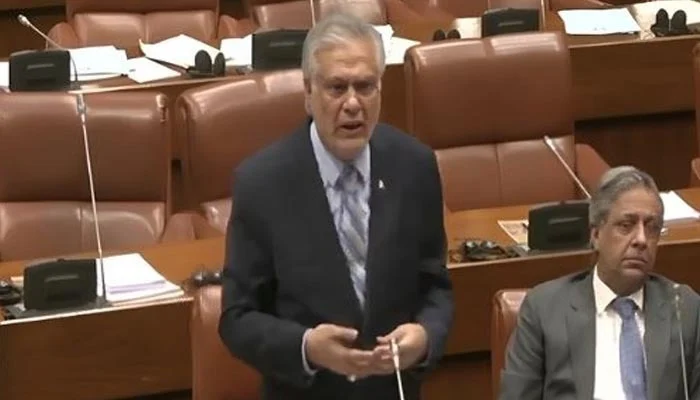
Speaking during a Senate session, Dar addressed the controversy head-on, confirming the government’s plans while emphasising a deliberate, transparent process. “Of course, the government is bringing it and will bring it … the 27th Amendment will arrive … and is about to arrive,” he said. “We will try that it is tabled in accordance with principles, laws and the Constitution.”
Dar sought to reassure critics, particularly from the opposition Pakistan Tehreek-e-Insaf (PTI), which has vowed to fight the amendment “tooth and nail.” He pledged that the proposal would undergo thorough scrutiny, including debates in Parliament and subcommittees. “The government does not have reservations against anything,” Dar told PTI Sen. Barrister Ali Zafar. “It will not be that the amendment is tabled and there is voting on it in a haphazard, ad hoc manner; this will not happen.”
He described the approach as following the “standard process” of legislation, noting initial consultations with the Pakistan Peoples Party (PPP), the government’s largest coalition partner. “I have had at least three rounds [of consultations] and the law minister has also held (consultations),” Dar said, adding the government would soon engage other allies to build consensus before presenting the full text.
The debate escalated on Monday when the PPP disclosed that the government had sought its backing for the changes. PPP Chairman Bilawal Bhutto-Zardari posted on X about the outreach, highlighting specific areas under discussion.
Dar acknowledged Bhutto-Zardari’s right to comment publicly. “The areas he identified are not in the air,” Dar said. “Let me also confess, there have been discussions on those topics.”
Dar urged Law Minister Azam Nazeer Tarar to introduce the amendment first in the Senate, citing its “professionalism and value input” over the National Assembly.
The proposed amendment requires a two-thirds majority in both houses of Parliament to pass. In the 336-member National Assembly, the ruling coalition commands 233 seats: 125 from the Pakistan Muslim League-Nawaz (PML-N), 74 from the PPP, 22 from the Muttahida Qaumi Movement (MQM), five from the Pakistan Muslim League-Quaid (PML-Q), four from the Istehkam-i-Pakistan Party, and one each from the Pakistan Muslim League-Zia (PML-Z), Balochistan Awami Party, and National Peoples Party. The opposition holds 103 seats.
In the 96-member Senate, however, the coalition falls short with 61 senators, needing at least three more votes to reach the required 64. In such cases, the government often courts support from the Jamiat Ulema-e-Islam-Fazl (JUI-F).
Prominent voices within the PPP have raised alarms about the implications. Former Senate chairman Raza Rabbani, a PPP stalwart, warned on Tuesday that the changes would effectively roll back the 18th Amendment. “The proposed constitutional amendments of the federal government, with reference to provincial autonomy, amount to a rollback of the 18th Amendment,” Rabbani said in a statement.
He cautioned that tampering with provincial powers could destabilize the federation. “In the brittle internal political situation, playing with provincial autonomy will cast deep shadows over the federation,” Rabbani said. He noted that the 18th Amendment had neutralized extreme nationalist sentiments by addressing provincial grievances. Revisiting it, he argued, would “lend vigour to their extra-constitutional activities.”
Rabbani also pointed to fiscal concerns, saying that re-centralising devolved ministries would impose a “financial burden” on the federal government. “Recalling the financial devolution will be against the scheme [of] participatory federalism,” he added. As an alternative, he suggested empowering provinces further. “If the federal government is unable to manage its finances, then let the provinces collect all the taxes and look after federal expenditures through the Council of Common Interests.”
Copyright © 2021 Independent Pakistan | All rights reserved