By Staff Reporter
ISLAMABAD: Senior Pakistani officials arrived in Turkey for the first formal meeting of a strategic committee established under a new trilateral defence pact with Turkey and Saudi Arabia, which commits each nation to treat an attack on any one of them as an attack on all three.
Deputy Prime Minister and Foreign Minister Ishaq Dar and Field Marshal Syed Asim Munir, Pakistan’s chief of defence forces, landed in Istanbul on Sunday, a day ahead of Monday’s inaugural session of the Strategic Political and Defence Committee, according to statements from Pakistan’s foreign office and the military’s media wing, Inter-Services Public Relations. The committee was created under the Makkah Joint Defence Agreement, which Pakistan, Turkey and Saudi Arabia signed on Aug. 7 during a summit in Makkah attended by Prime Minister Shehbaz Sharif, Turkish President Recep Tayyip Erdoğan and Saudi Crown Prince and Prime Minister Mohammed bin Salman.
Pakistan’s delegation also includes Defence Minister Khawaja Muhammad Asif, according to the foreign ministry, which said the country would be represented at the meeting by Dar, Asif and Munir. Turkey’s delegation is expected to include Foreign Minister Hakan Fidan, Defence Minister Yaşar Güler and Gen. Selçuk Bayraktaroğlu, chief of the Turkish general staff, according to the Turkish foreign ministry. Saudi Arabia’s foreign and defence ministers, along with its own chief of general staff, are also expected to attend.
The meeting marks the first substantive step toward building out a joint security framework since the three countries signed the defence agreement three weeks ago, at a moment of heightened tension across the region tied to the conflict between the United States and Iran. Under the pact’s central provision, an armed attack against any one of the three signatories will be treated as an attack against all of them — a mutual-defence clause that experts have compared to NATO’s Article 5.
The agreement builds on a bilateral Saudi-Pakistan mutual defence pact signed in 2025 and on the broader Islamic Military Counter Terrorism Coalition, a multinational security framework based in Riyadh.
Pakistani officials have been careful to describe the new arrangement as defensive rather than confrontational. The foreign ministry has said repeatedly that the pact is not directed at any particular country, and that other nations willing to accept its core principles would be free to join.
Abdulaziz Sager, chairman of the Gulf Research Center, a Saudi-based think tank, said the alliance reflects a broader shift underway among Middle Eastern and South Asian powers. “Three of the Muslim world’s most influential states are convening at a moment of heightened uncertainty, demonstrating a growing willingness among regional and middle powers to coordinate more closely on security matters,” Sager said. The trilateral framework, he added, could strengthen the three countries’ collective diplomatic and defence weight while contributing to a more regionally driven security order.
In Istanbul, the committee’s agenda is expected to focus on the practical architecture of the new alliance: setting up a permanent secretariat, establishing coordinating mechanisms among the three militaries, and mapping out a timeline for further cooperation, according to Turkish state broadcaster TRT and the Anadolu Agency, Turkey’s state-run news service. Officials are also expected to discuss expanding defence industry ties, including possible joint weapons production and research and development, as well as deepening counterterrorism coordination and working toward greater interoperability among the three countries’ armed forces. A Turkish foreign ministry source told Reuters that “international security issues” will be on the agenda.
Turkish officials have framed the pact in broader terms, describing it as a vehicle for regional stability rather than a narrow military arrangement. TRT reported that officials are expected to reiterate that the agreement offers member states a cooperative security framework built around prioritising peace and prosperity over conflict.
Pakistan’s foreign ministry, in a statement issued before the delegation’s departure, said the country’s participation reflects its “historic bonds of friendship” with Turkey and Saudi Arabia and its interest in “lasting regional peace and stability.”
Dar meets with Turkish counterpart
Upon landing in Istanbul on Sunday, Dar was received by Turkish Deputy Chief of Staff for Administration Brig. Gen. Şenol Varol, Pakistan’s ambassador to Turkey, Yusuf Junaid, and Turkish foreign ministry official Cihad Erginay, along with other senior Turkish government representatives, the foreign office said.
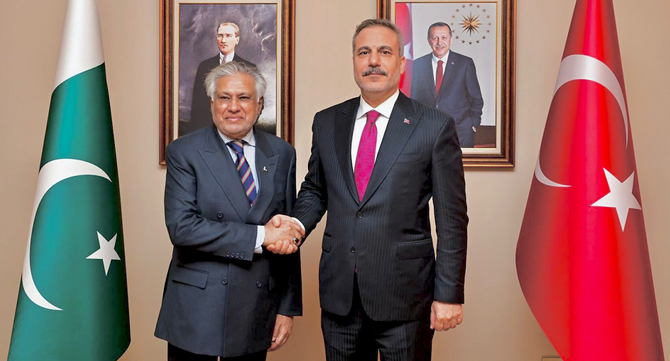
Dar then met separately with Fidan, his Turkish counterpart, for a wider discussion of bilateral relations. According to a readout released by Pakistan’s foreign ministry, the two men “expressed satisfaction” with the continued growth of political, economic, security and cultural ties between their countries. They also agreed to convene the next session of the Pakistan-Turkey High-Level Strategic Cooperation Council in the near future, and reaffirmed a shared commitment to regional peace and stability.
Several senior Pakistani diplomats accompanied Dar at the meeting, including Special Secretary for U.N. Affairs Nabeel Munir, Director General for U.N. Affairs Umar Siddique, First Secretary Qazi Saleem and Deputy Director to the Foreign Minister Agha Hunain.
Dar’s Istanbul visit is also expected to include a separate gathering of the Regional-4 group — Pakistan, Turkey, Saudi Arabia and Egypt — which formed in March to coordinate on regional security issues, including mediation efforts between the United States and Iran. Dar had confirmed his participation in that meeting earlier this month, in response to an invitation from Fidan, the foreign office said.
The last R-4 gathering was held Aug. 5 in Amman, Jordan, where the four countries’ representatives, according to Pakistan’s foreign office, “reaffirmed the importance of continued consultation and close coordination” in support of regional stability.
Copyright © 2021 Independent Pakistan | All rights reserved