By Staff Reporter
ISLAMABAD: Pakistan’s top diplomat delivered a pointed warning to an international audience on Friday, cautioning that any effort to strip his country of water it is owed under a six-decade-old treaty with India would carry grave consequences for peace across South Asia.
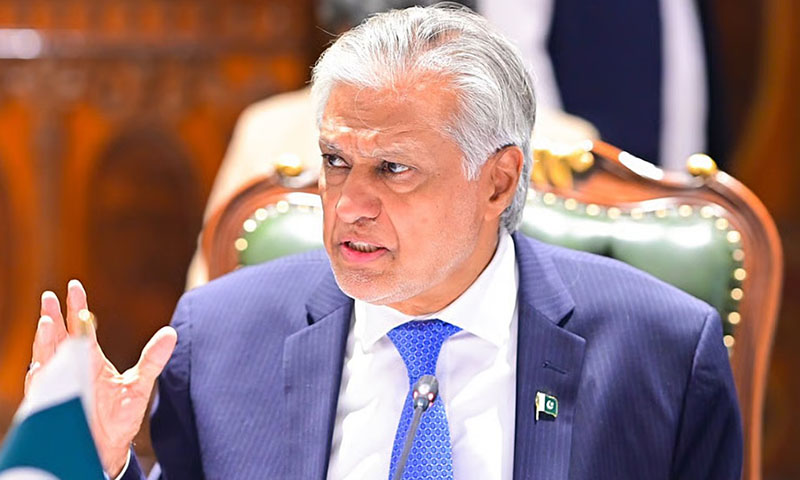
Deputy Prime Minister and Foreign Minister Ishaq Dar, addressing a Washington seminar by video link, said the Indus Waters Treaty remains “valid, binding and fully operative” more than a year after India suspended its participation in the pact — a rupture that has left one of the world’s most closely watched water-sharing arrangements in limbo.
“Any attempt to deprive Pakistan of the waters rightfully allocated to it under the Indus Waters Treaty would have profound consequences for regional peace and security,” Dar told the gathering, convened under the title “The Indus Waters Treaty: South Asian Security at the Crossroads.”
The treaty, brokered by the World Bank in 1960, has long been held up as a rare example of cooperation between the nuclear-armed rivals, surviving three wars and decades of hostility. That record fractured in April 2025, when India announced it was placing its treaty obligations in abeyance, a decision that followed an attack on tourists in Indian-administered Kashmir’s Pahalgam region that killed 26 people. New Delhi pointed to what it described as cross-border links to the assault. Islamabad has denied any involvement and has called for an independent international investigation into the killings.
The diplomatic fallout proved swift and severe. Relations between the two countries deteriorated in the weeks that followed, culminating in four days of military confrontation in May 2025 before a ceasefire took hold. The water treaty, however, has remained frozen. Indian officials have said their position on the matter has not changed since the ceasefire took effect.
Dar used his address Friday to press the case that India’s move lacks any legal foundation, telling the seminar the treaty itself contains no mechanism for either side to walk away from its terms unilaterally.
“The treaty contains no provision permitting either party to unilaterally suspend or place it in abeyance,” he said, adding that no government can, “through a unilateral political declaration, extinguish obligations solemnly undertaken under international law.”
The foreign minister framed the dispute as reaching well beyond the two countries involved, arguing it tests the broader credibility of international agreements at a moment when treaty commitments worldwide face growing strain.
“If solemn treaty obligations can simply be set aside whenever political relations deteriorate, the very purpose of concluding the treaties is undermined,” Dar said.
He returned repeatedly to the basic geography that has bound India and Pakistan to the treaty since its signing, noting that neither country can alter the physical paths the rivers take through the subcontinent.
“States cannot alter the direction in which rivers flow,” he said. “That is precisely why rules matter.”
Under the treaty’s terms, India was granted control over the three eastern rivers — the Ravi, Beas and Sutlej — while Pakistan received rights to the three western rivers, the Indus, Jhelum and Chenab, subject to certain specified uses by India. That river system, Dar said, underpins nearly every facet of Pakistani life.
“The Indus Basin is the lifeline of more than 250 million Pakistanis,” he said. “Water security for Pakistan is therefore inseparable from economic security, food security and, ultimately, national security.”
Pakistan has continued to press its case through the treaty’s formal dispute-resolution channels even as India has declined to participate, pursuing arbitration over Indian hydroelectric projects at Kishenganga and Ratle on the western rivers. The Court of Arbitration at The Hague has kept those proceedings moving, issuing earlier rulings on questions of jurisdiction and treaty interpretation.
Dar characterized Pakistan’s use of those mechanisms — the Permanent Indus Commission, a neutral expert, or the Court of Arbitration — not as a hostile act but as the ordinary functioning of a system both nations agreed to decades ago.
“Pakistan has consistently sought to resolve differences through dialogue, diplomacy and the mechanisms provided under the treaty,” he said.
The foreign minister connected the standoff to a problem with no diplomatic solution: a changing climate. Pakistan ranks among the most water-stressed nations on Earth, he noted, and is already contending with shifting rainfall patterns, retreating glaciers, and more frequent floods and droughts.
“These realities should compel greater and stronger cooperation,” Dar said, calling on India to resume data-sharing and technical coordination. “But adaptation cannot mean abandonment of agreed legal rights and obligations.”
He argued that the treaty was built to withstand exactly this kind of political rupture, with dispute-resolution provisions designed to function regardless of the broader state of relations between the two countries.
“The answer to disagreement was therefore built into the treaty itself: dialogue, technical engagement and lawful dispute resolution,” he said, adding that implementation of the accord “was never made contingent upon political convenience.”
Dar closed his remarks by laying out three principles he said should guide the path forward: that the treaty be honored “in letter and spirit,” that disputes be routed through its established mechanisms, and that both countries restore technical cooperation and data-sharing.
“These are not unreasonable demands,” he said. “They are the requirements of an agreement solemnly concluded by two sovereign states and sustained for more than six decades.”
He pointed to Pakistan’s recent involvement in facilitating dialogue during tensions between the United States and Iran as evidence of a broader foreign policy approach favoring negotiation over confrontation.
“Pakistan seeks to be a force for peace and stability, in South Asia and beyond,” he said.
The foreign minister’s closing message centered on the river system at the heart of the dispute, which he described as something to be protected rather than contested.
“Shared waters must never be weaponized,” Dar said. “They should remain a bridge between nations, governed by law, sustained through cooperation, and protected for generations to come.”
Copyright © 2021 Independent Pakistan | All rights reserved