By Staff Reporter
ISLAMABAD: Prime Minister Shehbaz Sharif ordered tax authority to submit its restructuring program to independent third-party audits, adding a layer of external scrutiny to an overhaul that has already reshaped how the government collects revenue and polices smuggling.
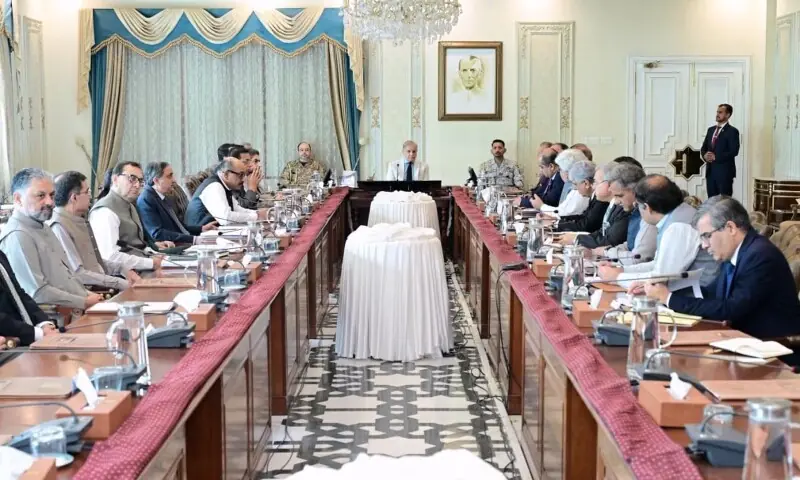
Sharif’s directive came on Friday during a weekly review of reforms at the Federal Board of Revenue, where officials presented figures showing digital invoicing has expanded more than tenfold over the past year and customs revenue per shipment has climbed following the rollout of automated assessments.
The prime minister told the meeting that reform measures must be completed within their stipulated timeframes and that their transparency, effectiveness and sustainability should be verified through audits conducted outside the agency itself, according to a statement from his office. He linked the overhaul directly to the country’s broader development goals, framing digitalization, production monitoring and automation as the three pillars underpinning the effort.
Pakistan has struggled for years to widen its tax base and rein in a shadow economy that has starved successive governments of revenue, forcing repeated recourse to external lenders. The FBR reforms represent one of the more ambitious attempts to address that gap through technology rather than rate increases alone, with officials betting that better data and enforcement can succeed where previous efforts fell short.
Central to the program is IRIS 3.0, a new tax operating model being built alongside a centralized data hub intended to make the system more integrated and data-driven. International consultants have been hired to help design the platform, officials told the meeting, and work is underway on a pilot for automated taxation under the same initiative. Officials said the government eventually intends to apply artificial intelligence and machine learning to tax collection, though that capability remains a future-stage goal rather than a current feature.
The meeting also reviewed the restructuring of Pakistan Revenue Automation Ltd., the state-owned company that operates the FBR’s technology infrastructure. New senior leadership has been appointed across technology, data security, operations and tax-domain expertise, officials said, as the government looks to professionalize the unit responsible for running the digital backbone of the tax system.
On enforcement, officials reported that faceless assessment — a system that removes direct contact between customs officers and importers in an effort to reduce discretion and opportunities for corruption — has lifted average revenue per Goods Declaration by 12% during the first half of 2026. The mechanism has also improved the government’s ability to flag irregularities in import filings, according to the briefing.
The customs authority is in the final stages of recruiting 280 goods evaluators to deepen the integration of its assessment system, officials said. Separately, the government is building a Central Assessment Unit in Islamabad, which is scheduled to begin operating under an interim arrangement by the end of this year, ahead of a fully integrated facility targeted for completion in June 2027.
Digital invoicing, a key metric the government has used to track progress in documenting the economy, rose to more than 2.5 trillion rupees in July, from 236 billion rupees a year earlier. Officials said they are targeting 4 trillion rupees in digital invoicing transactions by December.
On smuggling, officials said the government has completed GIS tagging of legal petrol pumps, GPS tracking of petroleum products and a centralized tracking system that feeds into law enforcement operations. A mobile application called Raah-Guzar has contributed to the closure of roughly 2,500 illegal petrol pumps, officials said, as authorities continue to expand digital monitoring of fuel sales.
Sharif directed authorities to intensify action against tax evasion, smuggling and illegal businesses and to accelerate the broader reform timeline, reiterating that the changes should be independently audited, completed on schedule and designed to boost revenue while curbing illicit trade.
Copyright © 2021 Independent Pakistan | All rights reserved