By Staff Reporter
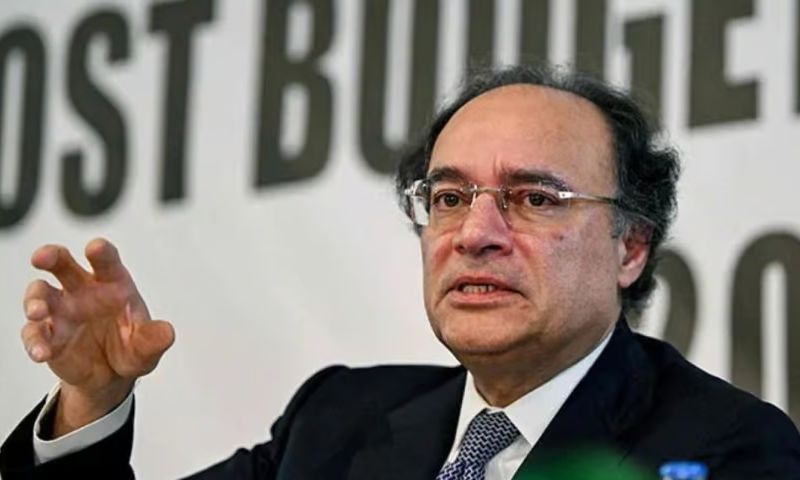
ISLAMABAD: Pakistan is preparing to return a $3.5 billion loan from the United Arab Emirates this month and is actively exploring eurobonds, Islamic sukuk, commercial borrowing and loans from other governments to replenish its foreign reserves and avoid any slippage on its International Monetary Fund program targets, Finance Minister Muhammad Aurangzeb said.
Speaking on the sidelines of the IMF and World Bank spring meetings in Washington, Aurangzeb told reporters that “all options are on the table” when asked whether Islamabad was in discussions with Saudi Arabia for replacement financing. The government is also considering dollar-settled rupee-linked bonds, he said, and expects to issue Eurobonds later this year. “We are looking at Eurobond, we are looking at Islamic sukuk, we are looking at dollar-settled rupee-linked bonds,” Aurangzeb said, adding that officials were also in talks on commercial loans from international banks.
The repayment of the UAE facility, due this month, will put immediate pressure on Pakistan’s foreign-exchange reserves, which currently stand at roughly 2.8 months of import cover. Maintaining at least that level “would be an important aspect of our overall macro stability as we go forward,” the minister said.
The country has been drawn deeper into the global spotlight as it mediates between the United States and Iran to help deescalate the conflict in the Middle East. The war has sent oil prices higher and disrupted energy markets, exposing Pakistan’s heavy reliance on imported fuels and remittances from Gulf states.
Aurangzeb said the government has not yet asked the IMF for any formal changes to its $7 billion lending program to accommodate the economic fallout. “Depending upon how things pan out over the next few weeks, that’s something which can be discussed,” he said. The IMF board is expected to approve the latest disbursement — just under $1.3 billion under the Extended Fund Facility and the Resilience and Sustainability Facility — by the end of this month or early next.
Pakistan also plans to launch its first-ever Panda bond next month: a $250 million issue denominated in Chinese yuan, the first tranche of a planned $1 billion program backed by the Asian Development Bank and the Asian Infrastructure Investment Bank. The minister expressed confidence that the economy could absorb the immediate impact of higher energy costs through the fiscal year ending June 30. GDP growth is projected near 4%, remittances are running at around $41.5 billion annually, and targeted social assistance for the poorest households remains intact, he said.
Even so, the conflict has underscored the need for longer-term resilience. Aurangzeb said Islamabad would now accelerate work on a strategic petroleum reserve — moving beyond reliance on purely commercial stocks — and speed up its shift toward renewable energy. “When you go through a supply shock like this … it sends a very clear view that we need to accelerate these journeys,” he said.
The finance ministry said Aurangzeb’s meetings in Washington were focused on cushioning the fallout from the Middle East crisis. In talks with the chief executive of the Saudi Fund for Development, the two sides discussed the conflict’s implications for global energy security and reaffirmed their commitment to deeper economic and development ties. Aurangzeb also welcomed a proposed short-term trade-finance facility of up to $500 million from the Multilateral Investment Guarantee Agency, describing it as vital for financing imports of food, fertilizer, energy and essential machinery. He urged faster progress on the facility to help meet Pakistan’s external financing requirements.
In a separate meeting with IMF Middle East and Central Asia Department Director Jihad Azour, the minister reviewed progress on reforms under the $7 billion program and expressed hope for early board approval of the staff-level agreement that would unlock about $1.2 billion. He described the Middle East conflict as “one of the most significant supply shocks in recent times” and said the government was managing its effects on growth and inflation while remaining committed to fiscal discipline and external debt obligations, including the recent repayment of a $1.3 billion Eurobond.
Meetings with US officials, including Trade Representative Jamieson Greer and Treasury counterparts, covered ways to expand trade, investment and market access. Aurangzeb also held discussions with executives from Google and Mastercard on artificial intelligence, digital payments and financial inclusion.
Copyright © 2021 Independent Pakistan | All rights reserved