By Staff Reporter
KARACHI: Pakistan’s mango industry is heading for one of its worst export seasons in recent memory, with revenue expected to fall by nearly 30 percent as a punishing combination of extreme weather, regional conflict and soaring freight costs squeezes producers from every direction.
Growers and exporters say this year’s harvest has been ravaged by abnormally high temperatures during the critical pollination window, compounded by violent windstorms that tore through orchards across the country’s principal growing belts. At the same time, geopolitical turmoil — from border closures with Afghanistan to the ripple effects of the conflict in the Middle East — has shut down key markets and driven shipping costs to levels that were unimaginable 12 months ago.
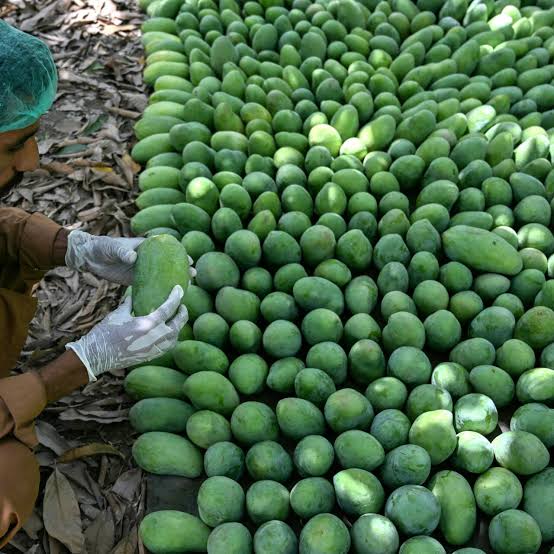
The result is an industry in acute distress. Pakistan, which produces around 1.9 million metric tons of mangoes annually and is among the world’s foremost growers of the fruit, typically exports less than four percent of its crop. But those exports — prized internationally for varieties such as Sindhri, Chaunsa and Anwar Ratol — generate substantial foreign exchange and sustain hundreds of thousands of farming families across Punjab and Sindh.
Last year, the country exported approximately 110,000 metric tons of mangoes worth close to $110 million. This season, industry leaders say the figure is likely to fall to somewhere between 75,000 and 80,000 metric tons, generating revenues of $75 million to $80 million — a shortfall that speaks to the scale of the crisis bearing down on Pakistan’s orchards.
“Our reduced target for this year was around 80,000 metric tons and given the current situation, we expect exports to remain between 75,000 and 80,000 metric tons, generating around $75 million to $80 million in revenue,” said Waheed Ahmad, patron-in-chief of the All Pakistan Fruit & Vegetable Exporters Importers and Merchants Association.
Among the most serious blows to the sector has been the near-total collapse of exports to Afghanistan, a market that in previous years absorbed between 18,000 and 19,000 tons of Pakistani mangoes. Since October 2025, Pakistan has kept its border crossings with Afghanistan closed following a series of deadly clashes and a sharp deterioration in security relations. The shutdown not only severed trade in mangoes but also halted Afghan transit cargo through Karachi. This year, Ahmad said, that volume is “almost zero.”
The loss is a significant one. The Gulf region, Iran and Afghanistan together account for roughly 80 percent of Pakistan’s mango exports — a concentration that leaves the industry acutely exposed to regional instability.
Those looking to redirect shipments elsewhere face a forbidding logistics landscape. Freight charges for a 40-foot container, which ran to between $1,000 and $1,400 last year, have risen to between $6,000 and $7,000 this season. Air freight, widely used for higher-value varieties destined for European and North American markets, has doubled from around 80 cents per kilogram to $1.60. Domestic transportation costs have also climbed, linked to the rise in global oil prices triggered by the US-Iran conflict, though Pakistan has announced a series of fuel price reductions in recent weeks.
The export season, which officially opened on 1 June and runs through September, got off to a delayed start. The crop matured more slowly than usual, and ongoing regional tensions have extended transit times, further complicating the logistics of getting time-sensitive fresh fruit to market.
The damage, however, begins long before the fruit reaches any port. In the orchards of Multan, Rahim Yar Khan, Sadiqabad, Mirpurkhas and Tando Allah Yar — the heartlands of Pakistani mango production — this year’s harvest has been punishing.
Tariq Mehmood Chaudhry, president of the Pakistan Farmers Coordination Committee, said that yields were down by around 15 percent, while extreme weather had destroyed a further 20 percent of the crop. Taken together, farmers across key growing areas were facing losses of around 35 percent.
The cause, he said, lay in an unusually fierce burst of heat between mid-February and mid-March, precisely when mango trees undergo pollination. Temperatures climbed above 35 degrees Celsius — well above the roughly 30 degrees at which pollination proceeds normally. The heat disrupted fruit setting at the earliest and most critical stage of the growing cycle, with consequences that rippled through the entire season.
“Climate change is not something farmers can tackle on their own,” Chaudhry said. “It requires government intervention and international support.”
His warning reflects a broader trend. Industry figures show that mango production has declined by between 15 and 20 per cent over the past five years, a trajectory that alarmed exporters and growers alike. Without structural reform, they argue, Pakistan risks slowly surrendering its position as a world-class mango producer — not through any single catastrophe, but through the slow attrition of seasons like this one.
Ahmad was direct in his assessment of what is at stake. “Pakistani mango is a Pakistani brand,” he said. “Punjab and Sindh governments need to come up with research-based solutions for growers. Without scientific support, it will become increasingly difficult to maintain both production and quality in the years ahead.”
The Ministry of Commerce did not respond to a request for comment. But Athar Hussain Khokhar, director general of the Trade Development Authority of Pakistan, outlined a vision for modernising the sector that, if implemented, could help insulate it from future climate shocks.
Khokhar pointed to the example of Egypt and Australia, where growers have adopted high-density plantations using smaller, more manageable trees. The approach allows for more precise control of irrigation, nutrition, pruning and pest management, while dwarf trees make fruit bagging and careful harvesting considerably easier — reducing mechanical damage, improving appearance and cutting post-harvest losses. The result, he argued, would be mangoes that meet the exacting standards demanded by international buyers.
He also made the case for investment in cold-chain infrastructure, traceability systems and value-added processing. Mango pulp, dehydrated products and individually quick-frozen fruit could, he said, open new markets, reduce wastage and generate export earnings that are not wholly contingent on the fortunes of the fresh fruit trade — a hedge against precisely the kind of season Pakistan is enduring now.
For the growers watching their orchards this summer, such reforms cannot come fast enough.
Copyright © 2021 Independent Pakistan | All rights reserved