By Staff Reporter
ISLAMABAD: Pakistan’s per capita income in dollar terms fell 11.38 percent to $1,568 in the outgoing fiscal year 2022-23, from $1,766 in the previous year, the National Accounts Committee (NAC) said.
The economy shrank by 0.29 percent in the fiscal year 2022-23, marking the slowest expansion in the country’s overall output over the past four years and a sharp drop from the rapid 6.1 percent growth achieved under the previous year’s Pakistan Tehreek-e-Insaf (PTI) government.
The growth of the agricultural, industrial, and services sectors has been projected at 1.55 percent, a negative growth of 2.94 percent, and 0.86 percent, respectively.
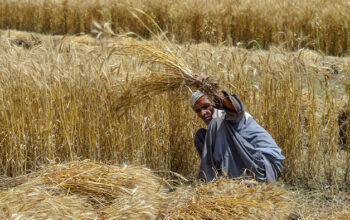
The provisional growth in the agricultural sector can be attributed to notable increases in key crop yields. Wheat yields experienced a significant surge of 5.4 percent, reaching 27.634 million tons compared to the previous year’s 26.208 million tons. Similarly, sugarcane production saw a rise of 2.8 percent, with output increasing from 88.65 million tons to 91.11 million tons. Additionally, maize yields witnessed a substantial growth of 6.9 percent, climbing from 9.52 million tons to 10.183 million tons.
On the other hand, there was a significant decline in the production of cotton crops, which dropped by 41 percent from 8.33 million bales to 4.91 million bales. Similarly, rice production also experienced a decline of 21.5 percent, falling from 9.32 million tons to 7.32 million tons. In addition, several other crops showed a modest growth rate of 0.23 percent.
The size of the economy in dollar terms also shrank, decreasing to $341.6 billion in the current fiscal year, from $375 billion in the previous year due to a massive exchange rate depreciation and a massive drop in the real GDP growth rate.
The size of the economy in rupee terms stood at Rs 38.927 trillion for the outgoing fiscal year 2022-23, against Rs 38.814 trillion for the last financial year 2021-22.
The NAC held its meeting on Wednesday without presenting any working paper. “This was mainly because there was haste in calculating the desirable growth number,” The News reported on Friday.
The provisional growth number of GDP showed education growth of 10.4 percent, which is the highest ever. The previous highest number was 3.7 percent in the fiscal year 2017-18. Health Services grew by 8.5 percent, which is even higher than 6.2 percent during the Covid-19 pandemic when it was the mainstay of the government and resources were diverted towards it to combat it effectively.
Other services are higher than last year, which is anomalous as most of it has a fixed growth rate of the base year. How can a small component of a variable can turn around the growth?
Wholesale and trade witnessed a negative growth of 4.46 percent despite negative growth of 3.2 percent in important agriculture crops, negative growth in large-scale manufacturing by 7.9 percent, and massive contraction in imports.
The services, which contribute 58 percent to the growth of the country, have allegedly witnessed major discrepancies after which the growth number turned from negative to positive.
The newspaper says There has been another anomaly as the government claimed in front of donors that 1.8 million animals were destroyed in the severe floods, but the livestock sector witnessed 3.78 percent growth.
In the industrial sector, a provisional negative growth rate of 2.94 percent was recorded, with large-scale manufacturing (LSM) witnessing a decline of 7.98 percent. The services sector experienced a relatively sluggish growth rate of 0.86 percent.
“The NAC meeting changed its timings four times on Wednesday. Initially, the Pakistan Bureau of Statistics (PBS) high-ups resisted, but there was a meeting convened in the Q Block (Ministry of Finance) whereby two senior officials informed the relevant quarters that the growth number must be turned into positive.”
Copyright © 2021 Independent Pakistan | All rights reserved