By Staff Reporter
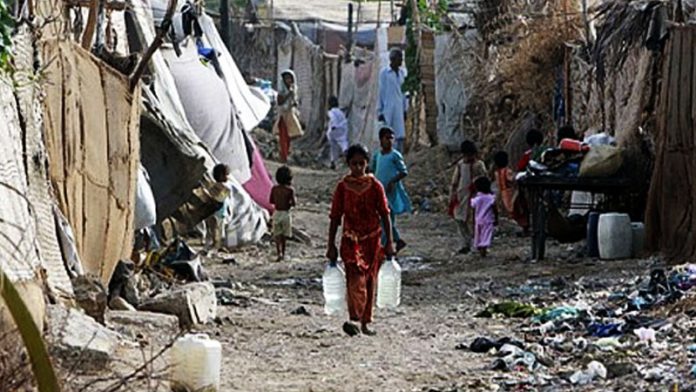
ISLAMABAD: Pakistan’s poverty rate climbed to 25.3% in the fiscal year through June 2024, reversing nearly two decades of steady declines, as economic shocks and policy missteps eroded earlier gains, according to a World Bank report.
The assessment, titled “Reclaiming Momentum Towards Prosperity: Pakistan’s Poverty, Equity and Resilience Assessment,” marks the first comprehensive review of poverty and welfare trends since the early 2000s. It draws on 25 years of household surveys, projections, geospatial analysis and administrative data.
After falling from 64.3% in 2001-02 to 21.9% in 2018-19, the national poverty rate started rising in 2020 amid compounding pressures including Covid-19, inflation, the 2022 floods and macroeconomic stress, the report said. A consumption-driven growth model that fueled initial progress has now hit its limits.
“Since 2021, poverty has begun to rise, exacerbated by COVID-19, the 2022 floods, inflation and faltering policies and reached 25.3 percent in 2023-24,” said Christina Wieser, a senior economist and one of the report’s lead authors.
She called for bold, sustained and people-centered reforms to reduce poverty, strengthen resilience and protect vulnerable populations. “Reforms that expand access to quality services, protect households from shocks and create better jobs, especially for the bottom 40 percent are essential to break cycles of poverty and deliver durable, inclusive growth.”
The World Bank in June lifted its global poverty threshold to $4.20 a day, with about 44.7% of Pakistanis falling below that line. Bolormaa Amgaabazar, the bank’s country director for Pakistan, cautioned against direct comparisons with the national estimate.
“They are not comparable,” he said. “The 45 percent is based on the upper middle-income poverty line that is the global poverty line, and the 25.3 percent is based on the national poverty line and projections based on that.”
Amgaabazar urged safeguarding past achievements while speeding up changes. “It will be critical to protect Pakistan’s hard-won poverty gains while accelerating reforms that expand jobs and opportunities — especially for women and young people,” he said. “By focusing on results — investing in people, places and access to opportunities, building resilience against shocks, prioritizing fiscal management and developing better data systems for decision-making — Pakistan can put poverty reduction back on track.”
Much of the progress over the past 20 years stemmed from households shifting from farm work to low-paying service jobs, driven by rising non-agricultural labor income. But slow and uneven structural transformation has curbed diversification, job creation and inclusive growth, resulting in low productivity across sectors.
Over 85% of jobs remain informal, with women and youth largely excluded from the labor force. Nearly 40% of children are stunted, a quarter of primary-school-aged children are out of school, and 75% of those attending have very limited reading comprehension skills.
Public services show widespread deficits. Only half of households had safely managed access to drinking water in 2018, and 31% lacked safe sanitation.
The report highlights persistent spatial disparities, with rural poverty more than twice as high as urban rates. Many districts that trailed decades ago still do, while unplanned urbanization has created crowded settlements with low living standards, dubbed “sterile agglomeration.”
To restore momentum, the World Bank outlined four pathways: Investing in human capital, places and public services while bolstering local governance; building household resilience via responsive and inclusive safety nets; adopting progressive fiscal measures like phasing out subsidies in favor of targeted spending and improving municipal finance; and enhancing timely data systems for better policy decisions.
The Household Integrated Economic Survey informed the bank’s official estimates, with projections beyond the 2018-19 round using microsimulation models. New figures will follow the release of 2024-25 data.
Pakistan has received more than $48.3 billion in World Bank assistance since joining in 1950. The current portfolio includes 54 projects with commitments totaling $15.7 billion. In January, the lender pledged $20 billion over 10 years under a country partnership framework to support inclusive and sustainable development.
Copyright © 2021 Independent Pakistan | All rights reserved