By Staff Reporter
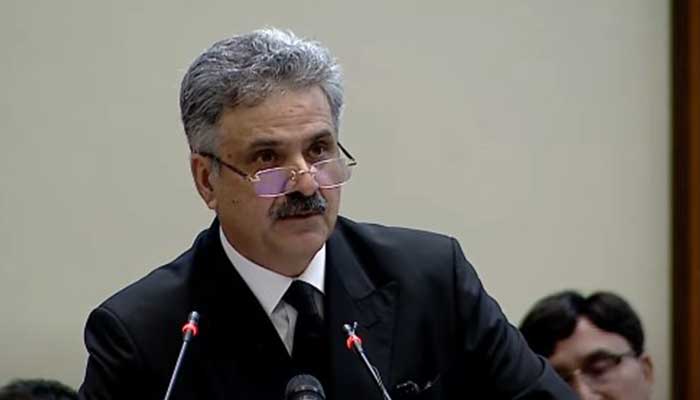
ISLAMABAD: Chief Justice Yahya Afridi said on Monday the Supreme Court of Pakistan is deepening ties with judicial bodies in Muslim-majority nations and also finalising an ethics charter for artificial intelligence to boost court efficiency, marking a bold push to modernise the judiciary.
Speaking at the annual Judicial Conference in Islamabad, which opens the judicial year, CJ Afridi detailed a sweeping reform agenda before an audience of senior judges, high court justices, and bar council members.
“In an interconnected world, judicial institutions cannot be strengthened in isolation,” Afridi said. The top judge said the Supreme Court has drafted a memorandum of understanding with China’s Supreme People’s Court and is reviewing a similar agreement with Türkiye’s Constitutional Court. The court is also fostering exchanges with the supreme courts of Bangladesh, Iran, Azerbaijan, and Denmark, while exploring broader collaboration with Saudi Arabia’s Muslim World League.
CJ Afridi said these partnerships aim to enhance the Supreme Court’s institutional capacity and adopt global best practices for Pakistan’s judiciary.
The Chief Justice emphasised technological upgrades as a cornerstone of reform. The court has introduced digital case filings, enabling electronic file transfers, and e-notices delivered via WhatsApp, SMS, and email. Upgraded digital infrastructure in Islamabad and branch registries now supports online hearings, with video link services extended to high courts nationwide.
“A Charter on the Ethical Use of AI is being finalized to ensure technology enhances judicial efficiency without supplanting human judgment,” CJ Afridi said. He announced plans for a fully paperless system, noting that case registration, records, and judgments are already accessible online. A facilitation center, set to be fully operational by October 1, will further streamline services for litigants.
CJ Afridi also disclosed that the court is preparing to use AI for case scheduling, though he cautioned, “We are not fully ready for its immediate application.” A project to digitise 61,000 case files is underway, with completion expected within six months.
The Chief Justice said on September 8, 2024, the Supreme Court faced a backlog of 60,635 cases. Over the past year, it received 20,811 new cases and resolved 22,863. “The backlog could have been reduced further, but many judges were engaged in Constitutional Benches requiring extended hearings,” he added.
To expedite justice, the court has implemented case management systems, expanded mediation facilities across provinces, and established metropolitan family courts for swift resolutions. Model Civil and Criminal Courts continue to operate with time-bound trials.
Afridi outlined five guiding pillars: technology, transparency, case management, legal framework strengthening, and improved service delivery. The Supreme Judicial Council has resolved 64 complaints against judges, with 72 under review and 65 pending. “By month’s end, remaining cases will be distributed among judges on a first-come, first-served basis,” he added.
Internal audit procedures are complete, with draft rules circulated among judges for feedback. A full court meeting will finalize these rules, and CJ Afridi urged judges with objections to submit them in writing.
To enhance accessibility, CJ Afridi has curtailed judicial protocol, reducing his own security detail from nine vehicles to two. “Security for judges has been scaled back, and protocol in the Red Zone has been minimized,” he said, noting that security may still be required outside Islamabad.
CJ Afridi stressed the judiciary’s commitment to tackling pressing issues, including missing persons cases. The National Judicial Policymaking Committee will convene on October 17 to address this and other critical matters.
Having toured remote areas to assess the justice system, he called for addressing challenges across Pakistan’s judiciary. “Transparency is essential to ensure justice,” he said, emphasising that technology and rapid case disposal are central to his vision.
Copyright © 2021 Independent Pakistan | All rights reserved