By Staff Reporter
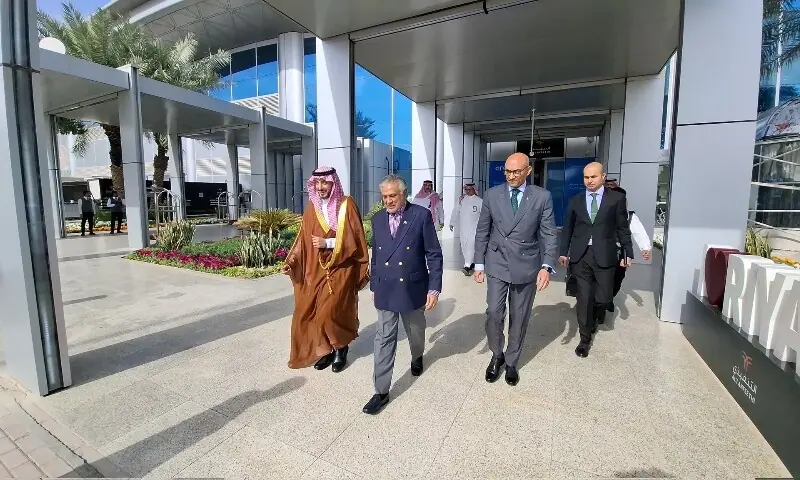
ISLAMABAD: Deputy Prime Minister and Foreign Minister Ishaq Dar landed in the Saudi capital on Wednesday to join an emergency gathering of Arab and Islamic foreign ministers, where he is expected to press for an immediate halt to the widening Middle East conflict triggered by US-Israeli strikes on Iran last month and Tehran’s retaliatory attacks on American and Gulf targets.
The two-day Consultative Ministerial Meeting, hosted by Saudi Arabia, comes as the region confronts what officials describe as its gravest security crisis in years. Iranian drone and missile barrages targeted Gulf states early Wednesday, hours after Israel killed two senior Iranian officials, forcing repeated closures of major airports including cargo hubs in Dubai and Doha. The disruptions have snarled trade routes, commercial flights and the delivery of critical medical supplies across the Arabian Peninsula.
Dar’s visit, at the invitation of Saudi Foreign Minister Prince Faisal bin Farhan Al Saud, underscores Pakistan’s self-described role as a “bridge builder” between the warring parties and its deepening strategic ties to Riyadh. Upon arrival, he was greeted by Pakistan’s Ambassador to Saudi Arabia Ahmed Farooq and senior Saudi Foreign Ministry officials, according to a statement from Islamabad’s Foreign Office.
In prepared remarks for the closed-door sessions, which run through Thursday, Dar is set to reaffirm Pakistan’s “complete support for the territorial integrity, sovereignty and political independence of all brotherly countries in the region” and demand “an end to all attacks on their territory,” the Foreign Office said. He will also renew Islamabad’s longstanding call for a “swift end” to the fighting and a return to “dialogue and diplomacy,” while spotlighting Pakistan’s recent diplomatic outreach and its determination to help resolve what it calls the region’s “prevailing grave security crisis.”
The gathering is the latest in a series of high-level Pakistani engagements with Saudi Arabia since the conflict erupted Feb. 28 with U.S.-Israeli strikes on Iran. Iranian counterstrikes have since hit U.S. assets and bases in Gulf countries, including Saudi territory. This trip marks the third Pakistani delegation to Riyadh in less than two weeks. On March 7, Pakistan’s Chief of Defence Forces and Army Staff, Field Marshal Asim Munir, met Saudi Defense Minister Khalid bin Salman to discuss Iran’s attacks on the kingdom. Five days later, Prime Minister Shehbaz Sharif held a restricted session with Saudi Crown Prince Mohammed bin Salman in which he conveyed Islamabad’s “full solidarity and support” and pledged joint efforts to restore regional peace, according to the prime minister’s foreign media spokesman Mosharraf Zaidi.
Both Sharif and Dar have maintained a steady stream of telephone calls with regional leaders since the war began, consistently urging de-escalation. On Monday, Iran’s Foreign Minister Abbas Araghchi publicly thanked the Pakistani government and people for their “strong solidarity and support” in the face of what he called American and Israeli aggression.
Turkish Foreign Minister Hakan Fidan is also attending Wednesday’s Riyadh meeting to discuss the rapidly evolving situation, according to a Reuters report. Saudi Arabia’s foreign ministry, in its own statement, said the gathering aims to “strengthen coordination on ways to support the security and stability of the region.” Pakistan maintains particularly close relations with Saudi Arabia, formalized through a strategic defense pact under which an act of aggression against one is treated as an attack on both. The partnership has long included substantial Saudi financial support for Pakistan’s economy and military cooperation.
Copyright © 2021 Independent Pakistan | All rights reserved