By Staff Reporter
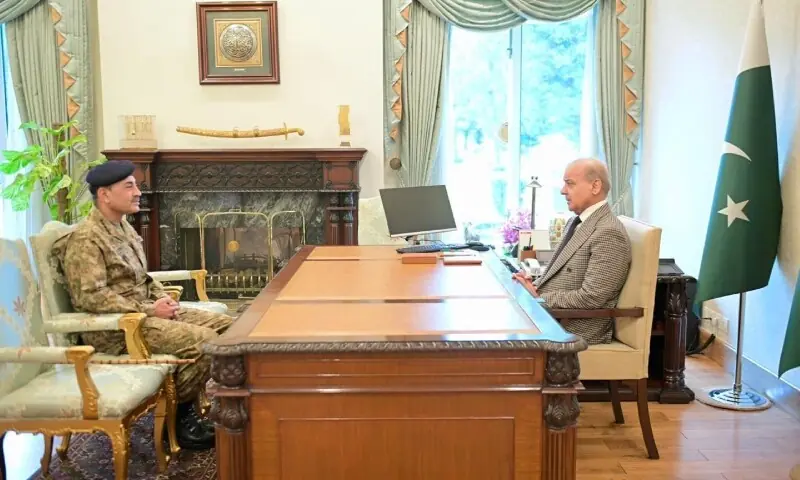
ISLAMABAD: Prime Minister Shehbaz Sharif and Field Marshal Asim Munir, Pakistan’s chief of army staff and chief of defence forces, met Thursday to review the country’s mediation efforts aimed at forging a lasting peace between the United States and Iran, just a day before delegations from both nations are expected to arrive here for direct negotiations.
A statement from the Prime Minister’s Office released after the meeting said Munir had called on Sharif to discuss on “the progress of Pakistan’s mediatory efforts to achieve sustainable peace in the region.” They expressed satisfaction with the de-escalation achieved so far and “stressed upon the need for maintaining peace and ceasefire by all parties.” The two leaders “appreciated the restraint demonstrated by all sides” and reaffirmed Pakistan’s readiness to “facilitate and provide all-out support to both sides to arrive at a peacefully negotiated settlement.”
The meeting came at a delicate moment. A two-week truce between Washington and Tehran, brokered in part through Pakistani channels, took effect only this week. Yet that fragile pause is already under strain from continued Israeli strikes in Lebanon, which Iran has denounced as a breach of the understanding. Pakistani officials have responded with urgent diplomacy, including telephone calls by Sharif to Lebanese Prime Minister Nawaf Salam, Bahrain’s King Hamad bin Isa al Khalifa and Qatar’s Emir Sheikh Tamim bin Hamad al Thani. In each conversation, the prime minister emphasised the need for restraint to allow the upcoming talks to proceed.
The United States and Iran have both confirmed they will send delegations to Islamabad for what officials on both sides have described as the first round of in-person negotiations, scheduled to begin Saturday. The White House said Vice President JD Vance would lead the American side, accompanied by Middle East envoy Steve Witkoff and Jared Kushner. Iranian President Masoud Pezeshkian has publicly affirmed Tehran’s participation.
Pakistani authorities, meanwhile, have declared a public holiday in the capital on Thursday and Friday — a step typically taken to ease security arrangements for high-level diplomatic gatherings — while keeping essential services running.
The conflict that brought the two adversaries to the negotiating table began on Feb. 28, when the United States and Israel launched military strikes against Iran. The fighting rapidly disrupted shipping through the Strait of Hormuz, the narrow waterway through which roughly one-fifth of the world’s oil and liquefied natural gas had flowed before the war. Global fuel prices spiked, and governments across Asia, Europe and the Middle East began scrambling for alternatives.
From the first hours of the crisis, Pakistan moved to position itself as a potential bridge. Sharif and Deputy Prime Minister and Foreign Minister Ishaq Dar immediately began contacting Iranian officials, leaders in the Gulf and other regional players, urging dialogue and de-escalation. On March 24, Sharif publicly offered to host “meaningful and conclusive talks” between the two sides. The following day, Washington transmitted a 15-point peace proposal to Tehran through Pakistani channels. Iran responded with five conditions of its own.
Although Iranian media initially portrayed the American proposal as rejected, Dar confirmed on March 26 that indirect talks were underway, with Islamabad relaying messages between the capitals. On March 29, the foreign ministers of Saudi Arabia, Turkey and Egypt traveled to Islamabad for a quadrilateral meeting focused on de-escalation. Dar later said both Washington and Tehran had expressed confidence in Pakistan’s ability to facilitate the dialogue.
The next day, in Beijing, Pakistani and Chinese officials issued a five-point initiative calling for a ceasefire, renewed dialogue and protection of critical infrastructure in the Gulf and the broader Middle East. The diplomatic tempo quickened further on April 5, when President Trump, after an expletive-laden social media post, set a precise deadline — 8 p.m. Eastern time the following Tuesday — for Iran to agree to a ceasefire and reopen the Strait of Hormuz. He warned that failure to comply would bring strikes on Iranian power plants and bridges.
Iranian media reported that Tehran had conveyed a detailed 10-clause response to the American proposal through Pakistan. The document called for an end to regional conflicts, a protocol guaranteeing safe passage through the strait, the lifting of sanctions and assistance with reconstruction. On the day of the deadline itself, Trump doubled down, writing that “a whole civilisation will die tonight, never to be brought back” if Iran did not comply — a statement that drew sharp criticism even inside the United States.
With the deadline hours away, Sharif made a public appeal to Trump to extend it by two weeks, citing steady progress in diplomatic channels. He also asked Iran to reopen the strait for the same period. Trump responded on Truth Social by announcing that, subject to Iran’s agreement to the “COMPLETE, IMMEDIATE, and SAFE OPENING” of the waterway, he would suspend planned attacks for two weeks. Shortly afterward, Iranian Foreign Minister Abbas Araghchi, speaking for the Supreme National Security Council, said Tehran would cease defensive operations if attacks on Iran halted.
The resulting truce rests on the 10-point Iranian framework, which Washington has accepted as a general basis for further talks. Yet it has remained precarious. Israel has continued airstrikes in Lebanon, actions that both Jerusalem and Washington insist fall outside the US-Iran understanding. Iranian officials have rejected that interpretation. “The Iran-US ceasefire terms are clear and explicit: the US must choose — ceasefire or continued war via Israel,” Araghchi said. “It cannot have both.” Tehran has warned it will withdraw from the arrangement if Israeli operations persist.
On Thursday, the Pakistani Foreign Office issued a strongly worded condemnation of the latest Israeli actions in Lebanon. “Pakistan condemns, in the strongest terms, the ongoing Israeli aggression against Lebanon, resulting in the loss of innocent lives and the widespread destruction of infrastructure,” the statement said. It described the strikes as “a blatant violation of international law and fundamental humanitarian principles” and called on the international community to act urgently. Lebanon on Thursday declared a national day of mourning after Israeli aircraft struck more than 100 sites across Beirut, the Bekaa Valley and southern Lebanon, killing at least 203 people and wounding more than 1,000, according to Lebanese health authorities. Hezbollah responded by firing rockets into Israel.
Sharif, in a separate statement posted on X, noted the violations without naming the party responsible and urged all sides to exercise restraint “to allow diplomacy to proceed towards a peaceful settlement of the conflict.” During his call with Salam, the Lebanese prime minister thanked Pakistan for its peace efforts and asked for continued support in ending the attacks on his country. Sharif, according to the Prime Minister’s Office, “strongly condemned Israel’s ongoing aggression against Lebanon” and expressed condolences for the loss of life.
Preparations for the weekend talks in Islamabad have been extensive. Interior Minister Mohsin Naqvi assured US Ambassador Natalie Baker of “foolproof security” for all foreign dignitaries. A 30-member American advance team arrived earlier in the week to review arrangements. A hotel inside the capital’s high-security Red Zone has been reserved and cleared for the delegations. Traffic diversions have been announced for the Express Highway, and large sections of the Red Zone and parts of Faisal Avenue are expected to be sealed. VVIP protocol under Pakistan’s Blue Book will be extended to the visitors. State-run hospitals and rescue services have been placed on high alert.
An Iranian diplomatic source told reporters that a delegation was expected, though initial announcements about timing had been withdrawn. Pakistani officials have described the talks as an opportunity to transform the temporary truce into a broader, negotiated settlement. For Pakistan, the role of mediator carries both opportunity and risk. The country maintains long-standing ties with both Washington and Tehran, as well as close relations with Beijing and the Gulf states. Its efforts have drawn public appreciation from multiple capitals. Yet the continued violence in Lebanon illustrates how quickly events outside the direct US-Iran channel can threaten the entire process.
Iranian Deputy Foreign Minister Saeed Khatibzadeh was quoted by Iranian state media as saying Tehran had come close to responding to what it viewed as a ceasefire breach before stepping back after Pakistani intervention. Sharif and Munir’s meeting Thursday was framed by Pakistani officials as a stock-taking exercise at a pivotal juncture. The prime minister’s office said he had “lauded the commitment of the parties involved in the process and wished them success in their pursuit of peace.” He also renewed an invitation to the arriving delegations and pledged Pakistan’s “highest consideration and support.”
The coming weekend will mark the first time the two sides meet face to face on Pakistani soil. The two-week truce has bought time, but the underlying issues — Israel, sanctions, regional proxy conflicts and the status of the Strait of Hormuz — are complex and deeply entrenched. Officials here hope the conversations can turn the temporary halt into something more lasting, even as events in Lebanon continue to test the fragile understanding that has been reached.
Copyright © 2021 Independent Pakistan | All rights reserved