By Staff Reporter
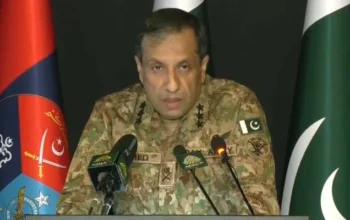
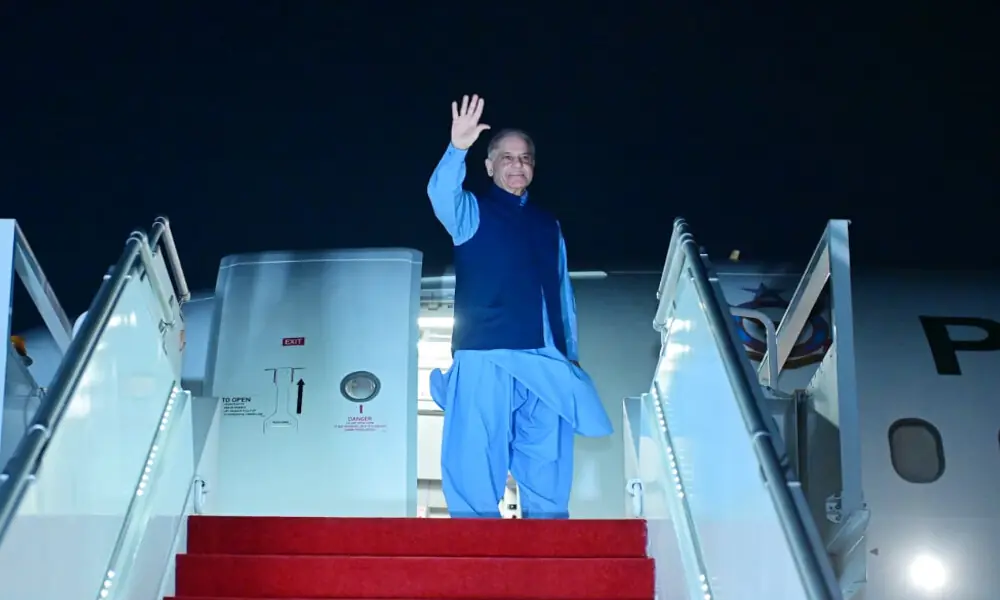
ISLAMABAD: Prime Minister Shehbaz Sharif and Field Marshal Asim Munir, the country’s army chief and chief of defence forces, flew to Switzerland through the night on Saturday for technical-level talks between the United States and Iran due on Sunday — the first formal negotiations since a memorandum of understanding ending nearly four months of conflict between Washington and Tehran was signed on 18 June.
They arrived into a crisis.
Iran’s Islamic Revolutionary Guard Corps had announced on Saturday that it was reimposing restrictions on the Strait of Hormuz, the narrow channel at the mouth of the Persian Gulf through which roughly a fifth of the world’s oil and liquefied natural gas passes each day. The IRGC warned ship crews not to approach the waterway, saying their security could not be guaranteed. Mohammad Mokhber, an adviser to Supreme Leader Ali Khamenei, said the flow of energy through the Middle East would halt for as long as the accord between Washington and Tehran “remains only on paper”.
The announcement came 72 hours after President Donald Trump and Iranian President Masoud Pezeshkian had signed the Islamabad Memorandum of Understanding, brokered by Pakistan and Qatar, declaring a permanent end to “military operations on all fronts” and opening a 60-day window — extendable by mutual consent — for negotiations on a broader settlement covering Iran’s nuclear programme and wider regional security. Global markets, which had been battered for months by the conflict, had rallied sharply on the news.
That rally now looked premature.
The immediate cause of Tehran’s move was Lebanon. Despite the MoU’s stipulation of a ceasefire on all fronts, Israeli strikes on southern Lebanon had continued without pause. On Friday, Lebanese authorities reported 83 people killed and 141 wounded in a single day of Israeli bombardment. On Saturday, the toll rose by at least a further 32 deaths, according to Lebanon’s civil defence and state media. Lebanon’s health ministry said the total death toll since fighting escalated earlier this year had exceeded 4,000.
Israel said it was responding to ongoing Hezbollah fire. An Israeli military official confirmed that Hezbollah had launched more than 50 projectiles at Israeli forces overnight into Saturday, prompting retaliatory strikes on what Israel described as Hezbollah positions. Israeli Prime Minister Benjamin Netanyahu has repeatedly stated that Israeli forces will remain in parts of southern Lebanon until security conditions are met. Israeli officials indicated on Saturday that they had received updated political directives to halt offensive operations but would continue to act against what they described as immediate threats.
Neither Israel nor Hezbollah is a signatory to the US-Iran agreement.
Iran’s foreign ministry spokesman, Esmaeil Baghaei, confirmed on Saturday that Tehran’s delegation — a senior group that included parliamentary Speaker Mohammad Baqer Qalibaf, Foreign Minister Abbas Araghchi and senior officials from the security, central bank and energy ministries — had departed for Switzerland. Iranian state television reported they landed in Zurich on Saturday night. But Baghaei’s language was pointed. Iran, he said, would use the talks “to press for the fulfilment of the other side’s commitments” and to “clarify how they plan to act on their obligations”. He warned, twice, that if those commitments were not met, “the entirety of the agreement will be jeopardised”.
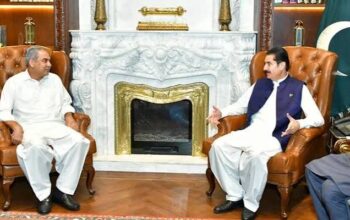
The first round of talks had been scheduled for Friday. Iran did not send its delegation. The postponement to Sunday came after intensive behind-the-scenes diplomacy, including a visit to Tehran by Pakistan’s Interior Minister Mohsin Naqvi, who met both Araghchi and Iranian President Pezeshkian on Saturday. IRNA, Iran’s state news agency, reported that Pezeshkian praised Pakistan’s role in brokering the ceasefire agreement and agreed in principle that a senior Iranian economic delegation — comprising the interior, agriculture, industry and finance ministers — would visit Islamabad to discuss expanding bilateral trade and investment.
Pakistan’s Foreign Minister Ishaq Dar was simultaneously in Egypt, working parallel diplomatic channels.
On the American side, senior envoys Jared Kushner and Steve Witkoff had arrived in Bürgenstock ahead of the talks to begin work on what Vance described as “the technical elements”. US Vice President JD Vance departed Washington on Saturday. Speaking before his departure, he told reporters he was hopeful of making progress on both the Lebanon ceasefire and Iran’s nuclear file, though he said he expected to remain in Switzerland for only a day or two. He described the negotiations as going “well” but said the United States “has all the cards”.
Qatar’s Prime Minister Sheikh Mohammed bin Abdulrahman bin Jassim Al Thani was already in the resort ahead of the formal talks, holding his own preliminary meetings with delegations.
The United States moved quickly on Saturday to challenge Tehran’s claim over the strait. Captain Tim Hawkins, spokesman for US Central Command, said flatly that “Iran does not control the Strait of Hormuz” and that American forces remained present and operating in the area. He said 55 commercial vessels carrying more than 17 million barrels of oil had transited the waterway on Saturday and that safe passage remained intact. Trump told reporters that the strait would remain free of Iranian tolls for the duration of the 60-day negotiation period, though he suggested the United States could impose its own transit fees if no final deal was reached — framing them as payment for American security guarantees in the region.
The MoU signed on 18 June commits both Washington and Tehran to a framework that goes considerably further than a simple ceasefire. It provides for the reopening of the Strait of Hormuz to international shipping, the easing of American sanctions on Iranian oil exports, Tehran’s access to frozen assets, and the launching of formal negotiations on Iran’s nuclear programme. The 60-day clock on those negotiations has already begun running. Under the agreement’s terms, a comprehensive settlement is to be reached within that window or the parties must agree to extend it.
The Islamabad MoU was the product of months of Pakistani and Qatari mediation. Pakistan hosted the first known direct talks between American and Iranian officials in April, a development that would have been unthinkable at the height of the conflict, and Pakistani officials have maintained sustained contact with both sides throughout. Sharif’s decision to travel to Bürgenstock personally — accompanied by Munir, whose presence at diplomatic negotiations of this kind is itself unusual — was a measure of how seriously Islamabad regards the fragility of what has been achieved.
Al Jazeera’s James Bays, reporting from Bürgenstock, said there were indications among diplomats that “things are moving backwards from when the MoU was signed”. He said the Iranians regarded the continuation of Israeli strikes in Lebanon as “a serious breach of the MoU” and that the closure of Hormuz was Tehran’s most powerful available response. Abdulla Banndar al-Etaibi, a professor at Qatar University, described the Iranian move in direct terms: Tehran was seeking to trade the strait for Lebanon. “They want all fighting to stop in Lebanon for the Strait of Hormuz to be restored,” he said.
Copyright © 2021 Independent Pakistan | All rights reserved