By Staff Reporter
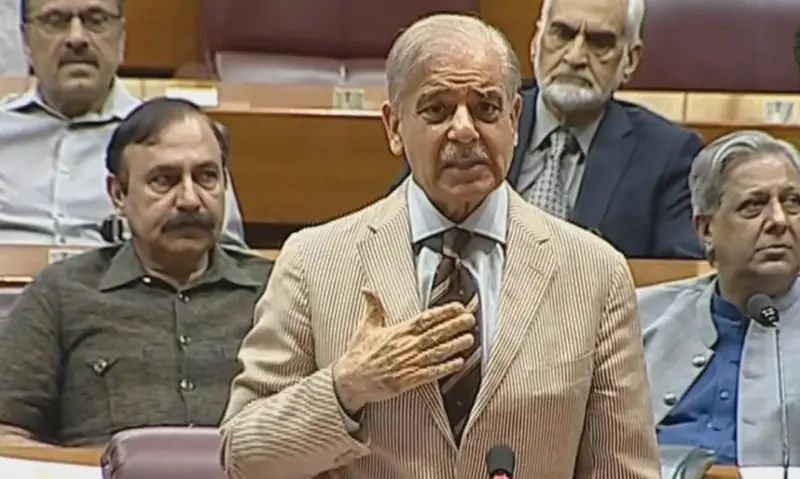
ISLAMABAD: The day after his government laid out an $67.5 billion federal budget built on austerity and IMF discipline, Prime Minister Shehbaz Sharif stood before a restless National Assembly on Saturday and offered something harder to price: an appeal to the political opposition to set aside their differences and forge a shared compact for the country’s future.
“Politics, vision and ideas may differ,” Sharif said from the floor of the lower house, “but if Pakistan exists, we all exist.”
The prime minister used what might have been a routine budget debate to press again for what he has called a “Charter of Economy” and a “Charter of Democracy” — a framework for cross-party cooperation that he has raised before but that has yet to gain traction with the opposition, parts of which remain in political conflict with the ruling coalition and, in some cases, under criminal prosecution.
“I have said more than once that we should move toward a Charter of Economy and a Charter of Democracy,” Sharif told lawmakers. “We have no fight with PTI; they are all our brothers.”
The conciliatory language came against a charged backdrop. Pakistan unveiled its Rs18.77 trillion federal budget for fiscal year 2026-27 on Friday, a spending plan designed to sustain an International Monetary Fund stabilization program and narrow a yawning fiscal deficit after years of economic turbulence. The budget, Islamabad has acknowledged, requires tight expenditure controls — including a freeze on development allocations to the provinces — that have drawn swift criticism from opposition politicians who argue the cuts will fall hardest on health and social services.
The man who opened the debate offered the government both a challenge and an opening.
Mahmood Khan Achakzai, the leader of the opposition in the National Assembly, launched the day’s proceedings with a critique that was at once pointed and surprisingly accommodating in tone. He pressed the government on provincial finances, warned that frozen development budgets would hurt ordinary citizens, and called on Sharif to ease pressure on the leadership of the opposition Pakistan Tehreek-e-Insaf party.
“Do not be so harsh on the PTI founder; this is not a good practice,” Achakzai said, in an apparent reference to the continued legal proceedings against former prime minister Imran Khan.
But Achakzai also extended what sounded like a conditional hand. He said political disputes should be settled through dialogue rather than confrontation, that he was prepared to offer unconditional support for the stability of the system, and that electoral mandates needed to be honored. He urged the prime minister to strengthen parliament — which, he argued, would serve both the government and the public — and proposed a political agreement under which parties would agree not to undermine each other once an election had been won.
“There is no benefit in putting each other in jail,” Achakzai said. “Even dialogue or meetings with political leaders should not be seen as controversial.”
Sharif said he would not offer a detailed response to Achakzai’s criticisms immediately, promising to address them “at an appropriate time.” But he was not entirely deferential. He pushed back on Achakzai’s comments about the Durand Line — the contested border between Pakistan and Afghanistan — saying the billions of rupees spent to secure it were money well spent. “If the billions of rupees spent on that 2,000-kilometer line save the life of even one child,” he said, “then I think the entire money was spent the right way.”
Sharif spent much of his address on what he described as the federal government’s record of investment in Pakistan’s smaller and more remote provinces — a pointed rebuttal to the suggestion, common in opposition circles, that Islamabad favors Punjab at the expense of Balochistan, Sindh, and Khyber Pakhtunkhwa.
He pointed to Pakistan’s share in the Reko Diq copper and gold project, one of the world’s largest untapped mineral deposits, located in southwestern Balochistan. He cited the 2010 National Finance Commission Award, under which Balochistan’s share of the federal divisible pool — the pool of tax revenues distributed among provinces — was doubled. He took pains to frame that not as a gift but as a matter of right.
“This is not a favor,” he said. “I am mentioning it only as a reminder.” And then, in a turn of phrase that landed harder than he may have intended: “Even a house cannot function without financial and social justice.”
The NFC Award has long been among the most sensitive instruments of federal-provincial relations in Pakistan. Critics, particularly from the smaller provinces, argue that the federation gives with one hand and takes with the other — a charge Achakzai voiced explicitly on Saturday, contending that Islamabad had reclaimed resources even as it publicized its generosity.
Sharif also listed specific federal outlays in Balochistan: solar panels distributed to farmers at a cost of Rs75 billion, and the construction of a highway linking Gwadar — the deep-water port at the heart of the China-Pakistan Economic Corridor — to Chaman, near the Afghan border, at an estimated cost of more than Rs300 billion, or roughly $1.08 billion.
“As the prime minister of Pakistan,” he said, “it is my responsibility to do what I can to the best of my ability, so that all four provinces can progress.”
Hovering over the budget debate, and over the prime minister’s address, was the country’s mounting security burden.
Sharif made no attempt to minimize it. He told parliament that 22 army officers and soldiers had been killed just three days earlier — a reference to a helicopter crash in Azad Jammu and Kashmir that claimed the lives of military personnel. He spoke of persistent militant violence in Balochistan, where he said terrorist activity was receiving what he described as “technical support” from outside actors, and in Khyber Pakhtunkhwa, where security forces have faced an intensifying insurgency.
“Our armed forces and law enforcement agencies are fighting terrorists day and night,” he said. “Officers and soldiers sacrifice their lives while protecting millions of citizens.”
The prime minister’s voice appeared to harden when he turned to the country’s martyrs, and to what he said would be owed to their survivors if the nation failed to honor them. “If we do not respect our martyrs, what will the world say?” he asked. “Keep the world aside — what will their orphaned children say?”
The session, which began shortly after 11 a.m., underscored the difficulty of Sharif’s political position as he tries to manage fiscal targets set by the IMF, maintain the support of coalition partners, and simultaneously reach across the aisle to an opposition whose most prominent leader remains in detention and whose party has frequently boycotted parliamentary proceedings.
Sharif has previously pushed for dialogue with the PTI, but those overtures have not produced any sustained negotiations. On Saturday, he returned to the theme with what appeared to be genuine insistence, describing the National Assembly as something like a family — one where members disagree sharply and publicly but are bound by something larger than any single dispute.
“Each one can have their politics and vision,” he said. “But one thing that this House will always attest to is that we are here if Pakistan is.”
Copyright © 2021 Independent Pakistan | All rights reserved