By Staff Reporter
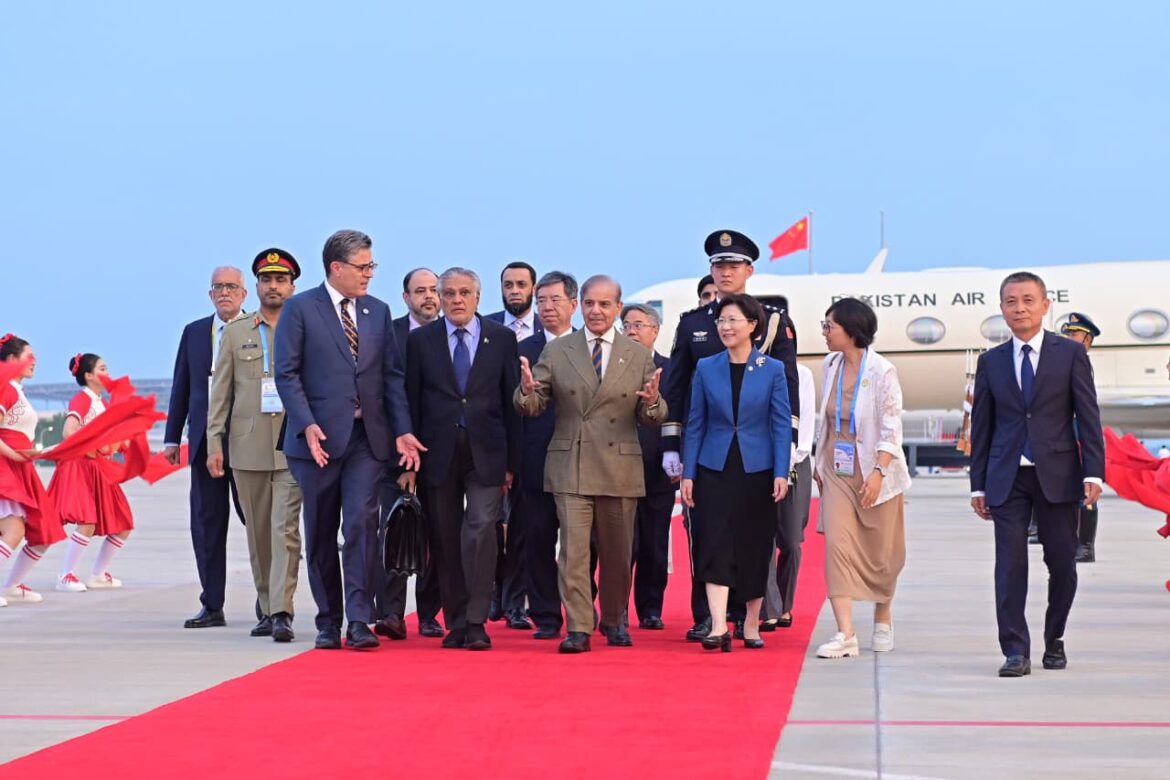
ISLAMABAD: Prime Minister Shehbaz Sharif reached China on Saturday for a summit of the Shanghai Cooperation Organization, voicing eagerness to meet Chinese President Xi Jinping and other leaders at a gathering that highlights the bloc’s expanding role in uniting powers from the Global South.
The two-day summit, starting Sunday in this northern port city, will bring together more than 20 heads of state and government, including Russian President Vladimir Putin, in a display of solidarity among emerging nations. Founded in 2001, the SCO includes member states China, India, Russia, Pakistan, Iran, Kazakhstan, Kyrgyzstan, Tajikistan, Uzbekistan and Belarus, with another 16 countries affiliated as observers or dialogue partners.
Sharif, joined by Deputy Prime Minister and Foreign Minister Ishaq Dar and Information Minister Attaullah Tarar, called his trip “historic” in a post on X. “I look forward to meeting H.E. President Xi Jinping and other world leaders to further build upon our bilateral ties with China, our All Weather Strategic Cooperative Partner, as well as with other key countries of the region,” he wrote, adding that he aimed to “enhance regional cooperation, strengthen multilateralism, and advance shared goals for peace and prosperity.”
In a statement, the Foreign Office said Sharif is leading a delegation to the SCO’s Council of Heads of State summit, set for Aug. 31 to Sept. 1. “The SCO CHS Summit will bring together heads of state and government from SCO member states, including Pakistan, Belarus, China, India, Iran, Kazakhstan, Kyrgyzstan, Russia, Tajikistan, and Uzbekistan,” the statement said.
The meeting will include leaders from Mongolia, Armenia, Azerbaijan, Cambodia, Nepal, Turkiye, Egypt, the Maldives, Myanmar and others in an expanded format, along with the United Nations chief and heads of various regional and international organizations.
“At the SCO CHS Summit, Prime Minister Sharif will present Pakistan’s perspectives on pressing regional and global issues, highlighting strategies to strengthen the SCO’s role in fostering regional cooperation and stability,” the Foreign Office said. Sharif intends to reaffirm Pakistan’s commitment to promoting multilateralism, enhancing regional security and advancing sustainable development, the statement added. He is also expected to hold bilateral meetings with other SCO leaders and invited members to “strengthen diplomatic relations.”
While in China, Sharif will meet with Xi and Premier Li Qiang to discuss “multifaceted dimensions of Pakistan-China bilateral cooperation,” according to the Foreign Office. “He would also attend the military parade with President Xi and other world leaders being held in Beijing to commemorate the 80th anniversary of the World’s Anti-Fascist War,” it said.
Sharif is scheduled to meet with prominent Chinese businessmen and corporate executives to discuss trade, economic and investment ties, and will address a Pakistan-China B2B Investment Conference in Beijing. The Foreign Office portrayed the visit as part of regular leadership-level exchanges, saying it “manifests the importance attached by the two countries to further deepen their All Weather Strategic Cooperative Partnership, reaffirm support on issues of respective core interests, advance Phase-II of CPEC and maintain regular communication on important regional and global developments.”
Ahead of the summit, Dar posted on X: “Pakistan’s all-weather strategic partnership with China is anchored in trust and strategic alignment. We value President Xi’s leadership and initiatives such as the Belt and Road, and the Global Development, Security & Civilisation Initiatives, which continue to transform economies and strengthen regional integration.”
“The SCO has become a pivotal Eurasian platform, advancing cooperation in security, trade, energy, connectivity, and culture under the principles of mutual trust and shared development.” In today’s multipolar world, Dar said, the SCO’s role in promoting multilateralism, stability, and inclusive growth is more vital than ever.
The summit has attracted leaders from Central Asia, the Middle East, South Asia and Southeast Asia for the 25th SCO Heads of State Council. Last week, Pakistani officials said Sharif’s visit would mark the formal launch of the second phase of the China-Pakistan Economic Corridor, or CPEC-II, focusing on industrial cooperation after a delay of about five years. “Prime minister’s upcoming visit will mark the formal launch of CPEC Phase-II, with both sides expected to set clear priorities and agree on tangible, measurable outcomes,” an official announcement said, quoting Planning Minister Ahsan Iqbal, the focal person on the multi-billion-dollar initiative.
In July, the two countries agreed to establish technical working groups to explore and implement projects on high-yield cotton seed development, advanced water-saving irrigation technologies and modern farming techniques.
Indian Prime Minister Narendra Modi arrived in Tianjin after a stop in Japan. His visit is his first to China since 2018. The foreign office earlier said no meeting between the prime ministers of India and Pakistan was planned on the sidelines of SCO Summit.
Bilateral relations between Pakistan and India hit a major low earlier this year when both nuclear-armed states engaged in a brief but intense military standoff, deploying fighter jets, missiles, drones and artillery before a US-brokered ceasefire ended the four-day conflict on May 10. Pakistan has since said it is willing to hold a composite dialogue with New Delhi to discuss all outstanding issues, but Indian officials have ruled out the possibility of diplomatic engagement.
Xi has started welcoming arriving leaders, including Cambodian Prime Minister Hun Manet and Egyptian Premier Moustafa Madbouly. Putin is due in Tianjin ahead of the summit, as China and Russia use the SCO, sometimes viewed as a counter to the Western-led NATO alliance, to bolster ties with Central Asian states.
Other participants include Iranian President Masoud Pezeshkian and Turkish President Recep Tayyip Erdogan, marking the bloc’s largest gathering since its founding.
Multiple bilateral meetings are expected on the margins of the summit. The Kremlin said Friday that Putin will discuss the Ukraine conflict with Erdogan on Monday. Turkiye has hosted three rounds of peace talks between Russia and Ukraine this year, but they have failed to end the stalemate since Moscow invaded its pro-European neighbor in February 2022.
Putin is also set to meet with Pezeshkian on Monday to address Tehran’s nuclear program, amid fresh Western pressure on Iran. Britain, France and Germany, known as the E3, triggered a “snapback” mechanism Thursday to reinstate U.N. sanctions on Iran for failing to comply with the 2015 nuclear deal. Russia’s foreign ministry warned that reimposing sanctions risked “irreparable consequences.”
Moscow and Tehran have strengthened political, military and economic ties over the past decade, with relations growing even closer since Russia launched its offensive against Ukraine.
Copyright © 2021 Independent Pakistan | All rights reserved