By Staff Reporter
QUETTA: Prime Minister Shehbaz Sharif said Tuesday that Pakistan’s military operation against terrorist hideouts in Afghanistan would continue with “full resolve,” even as tensions with Kabul show no sign of easing.
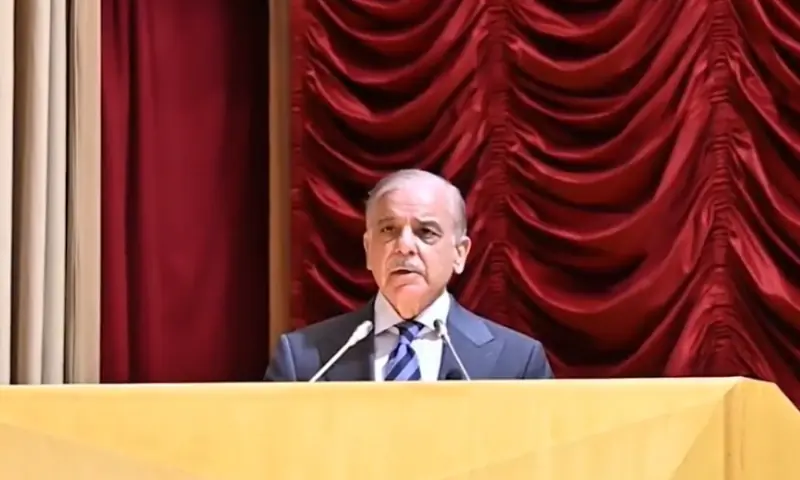
Speaking at the Command and Staff College in the capital of Balochistan province, Sharif said the air-and-ground campaign, code-named Operation Ghazab lil-Haq, or “Wrath for Truth,” was aimed at protecting Pakistani lives and property from militants operating from Afghan soil. The offensive, launched in February, followed a cycle of border clashes that had briefly eased after an October 2025 ceasefire but reignited this month after a suicide bombing killed 15 police officers at a checkpoint in Pakistan’s northwest.
“The Afghan government must take meaningful and credible actions against Islamic State Khorasan Province, Tehreek-i-Taliban Pakistan, and Balochistan Liberation Army, who use Afghan soil to attack Pakistan,” Sharif told faculty members and student officers at the elite military institution.
The prime minister’s visit to Quetta, a day-long trip focused on security issues, came as Islamabad and Kabul continue to trade accusations. Pakistan maintains that the operation has struck militant sanctuaries and killed hundreds of fighters linked to the Afghan Taliban. Afghan officials have denied harboring groups that attack Pakistan and have accused Islamabad of bombing civilian targets, including hospitals and universities — charges Pakistani officials reject.
Sharif’s remarks, delivered in an address broadcast on Pakistani television, were framed by his office as part of a broader assertion of Pakistan’s role as a “net regional stabiliser.” He praised the armed forces’ “professionalism, operational preparedness, and sacrifices” in safeguarding national sovereignty and regional stability, and he paid tribute to the country’s “martyrs” and the unwavering commitment of the military.
The prime minister was received at the college by Field Marshal Syed Asim Munir, Pakistan’s chief of army staff and chief of defence staff. He was accompanied by Defense Minister Khawaja Asif, Information Minister Attaullah Tarar and Balochistan Chief Minister Sarfraz Bugti. Sharif
Much of the speech revisited Pakistan’s brief but intense military confrontation with India last year. Sharif referred to the 19-day conflict — Marka-e-Haq, or Battle of Truth, — as a historic victory under Munir’s leadership. The fighting began after India blamed Pakistan for backing a militant attack on April 22, 2025, in Indian-occupied Kashmir that killed 26 people. Pakistan denied any involvement and called for an independent investigation. India responded in early May 2025 by carrying out strikes inside Pakistani territory, saying it had hit terrorist camps. Pakistan said it shot down six Indian fighter jets. For four days the two sides exchanged fire with jets, drones and artillery before agreeing to a ceasefire on May 10. Tensions have remained elevated since, with each capital continuing to accuse the other of sponsoring militant attacks.
Sharif said Pakistan’s response was measured and responsible. “The enemy falsely perceived itself as stronger than Pakistan,” he said. “They rejected our sincere offer of dialogue to resolve differences and remove misunderstandings; instead, they chose the path of provocation, violence, and aggression. India did not recognise that Pakistan’s peace offer was never its weakness; it was, in fact, our strength.”
He added that Pakistan had exercised “responsible conduct and escalation control” and that its “mature, prudent and just stance” had been acknowledged internationally. “On the diplomatic front, Pakistan’s narrative was fully vindicated and that of our enemy was debunked and dismissed completely,” he said. Sharif reaffirmed Pakistan’s determination “to defend sovereignty and territorial integrity against any misadventure at all costs.” He also reiterated Islamabad’s longstanding positions on two other flash points: Indian-occupied Kashmir, and the Israeli-Palestinian conflict.
“Pakistan has consistently advocated the right of the Palestinian people, who have been facing illegal Israeli occupation as well as its brutal oppression,” he said. A just resolution, he added, would be “the establishment of an independent Palestinian state in accordance with the UN Charter.”
The speech came against the backdrop of renewed friction with Afghanistan. Earlier this month, Pakistan issued a formal demarche to Kabul’s chargé d’affaires after the deadly suicide attack on the police post. Officials have repeatedly accused the Afghan government of facilitating attacks by militants inside Pakistan, a charge Kabul denies. Despite multiple rounds of talks, the two neighbors have failed to reach a lasting agreement, largely because of Afghan Taliban regime’s reluctance to crack down on terrorist groups using its territory.
Propaganda, Proxy Terrorism Cannot Derail National Progress
Separately, Field Marshal Munir said that neither propaganda and fake news nor externally sponsored terrorism would obstruct the country’s “destined rise,” delivering the message in the heart of Balochistan, the southwestern province long plagued by separatist insurgency.
Munir made the remarks during a visit to Quetta, where he addressed student officers and faculty at the Command and Staff College before interacting with troops from formations deployed across the province. The military’s media wing, Inter-Services Public Relations, said the army chief reviewed the prevailing security environment and reaffirmed the armed forces’ commitment to eradicating terrorism “in all its forms and manifestations,” with the steadfast support of the Pakistani people.
“Pakistan’s destined rise cannot be obstructed through propaganda, fake news or externally sponsored terrorism,” the ISPR quoted Munir as telling the officers and troops. He added that hostile forces trying to derail the country’s progress through proxies and propaganda “will ultimately fail due to the resilience of the state and the unity of its people.”
Balochistan is rich in minerals and natural gas yet remains one of Pakistan’s poorest and least-developed provinces. Ethnic Baloch militant groups have long accused the central government in Islamabad of exploiting the region’s resources while neglecting its people. Pakistani authorities reject those claims, pointing to major investments in roads, energy projects and welfare initiatives intended to integrate the province more fully into the national economy.
Munir repeatedly emphasized that sustainable peace in Balochistan would require more than military action. “Long-term progress depends upon a people-centric approach, inclusive development and improved governance alongside security efforts,” the ISPR statement said. He praised the provincial government’s focus on public welfare, socio-economic uplift and “strengthening the bond between the state and the people of the province.”
The army chief also commended the “high morale, operational readiness and professional commitment” of the officers and troops he met, saying they continued to maintain peace, stability and the writ of the state across Balochistan.
At the Command and Staff College, Munir told the assembled officers and faculty that the institution’s “high standards of training, intellectual rigour and professionalism” remained its hallmark. He expressed satisfaction that graduates of the college had “continued to distinguish themselves through their exceptional performance and dedication to the profession.” Turning to the broader evolution of conflict, Munir highlighted the rapidly changing character of modern warfare. He stressed the need for the armed forces to stay ahead of emerging technologies, master multi-domain operations, deepen tri-services synergy and prepare for future battlefield challenges.
Officers must “continuously train themselves and their troops to effectively respond to the changing character of war,” he said, while upholding “the highest standards of professionalism, preparedness and operational excellence.” The theme of technological adaptation has been a recurring one for Munir. Earlier this month, at a ceremony commemorating “Marka-i-Haq,” he noted that future wars would involve multi-domain operations in which cyber and electronic warfare, drones, long-range precision weapons and artificial intelligence would play decisive roles.
He outlined steps already taken to align Pakistan’s forces more closely with those realities. In January, during a visit to the Bahawalpur Garrison in Punjab, he described a major transformation under way across multiple domains of the armed forces. Days before the Quetta visit, the director general of Inter-Services Public Relations, Lt. Gen. Ahmed Sharif Chaudhry, had similarly spotlighted the military’s growing indigenous capabilities.
Copyright © 2021 Independent Pakistan | All rights reserved