By Staff Reporter
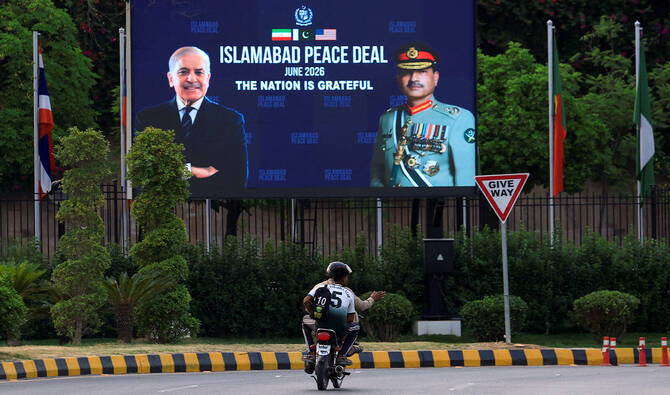
ISLAMABAD: Prime Minister Shehbaz Sharif told his Iranian counterpart President Masoud Pezeshkian on Thursday that the peace agreement brokered by Islamabad between Washington and Tehran would “go a long way” towards rebuilding Iran, as Donald Trump signed the deal at a candlelit dinner with Emmanuel Macron at the Palace of Versailles and critics on both sides of the Atlantic rounded on its terms.
The two leaders spoke by phone for more than 30 minutes — their first direct contact since the Islamabad Memorandum of Understanding entered into force — as oil prices fell by more than three percent following confirmation that the Strait of Hormuz would reopen under the accord’s immediate provisions.
Pezeshkian used the call to thank both Sharif and Chief of Defence Forces Field Marshal Syed Asim Munir for their “extremely critical roles” in steering the mediation “with great skill and sincerity”, according to Prime Minister’s Office. Tehran would always remember Pakistan’s “positive and constructive efforts and its support for Iran during these difficult times,” the Iranian president said.
Sharif, who signed the 14-point agreement as mediator, separately announced that Hormuz would “instantly reopen” and that the US would simultaneously lift its naval blockade of Iranian ports. Washington also committed to immediately waiving oil sanctions that had crippled Iran’s economy since the conflict began in February. A $300 billion reconstruction fund, supported by regional nations, will be released once a final agreement on Iran’s nuclear programme is reached, the deal states.
The accord’s formal signing unfolded in circumstances that few of the diplomats who spent months negotiating it had anticipated. Trump put his name to the document in thick black ink during a dinner with Macron at Versailles on Wednesday evening — the same palace where the treaty ending the First World War was signed in 1919, a parallel Macron was not slow to draw. The French president shouted “bravo” as Trump signed. Pezeshkian subsequently added his signature electronically, making it, in the words of Iran’s foreign ministry spokesman Esmaeil Baqaei, the first agreement formally signed by both a US and Iranian president since the Islamic Republic’s founding in 1979.
The signing rendered unnecessary a formal ceremony that had been planned for Friday at the Swiss resort of Bürgenstock, where US Vice President JD Vance and Iran’s parliament speaker Mohammad-Bagher Ghalibaf had been expected to sign in the presence of Pakistani and Qatari representatives. Sharif’s planned visit to Switzerland was subsequently cancelled. A senior official at his office confirmed that “with the objective of the MoU signing having been achieved,” Pakistan would continue its mediating role for the technical talks ahead, “whenever the parties are ready.”
Senior Pakistani diplomats, state television crews and journalists had already arrived in Switzerland when the cancellation was announced.
The deal ends more than 100 days of conflict that began when the United States and Israel launched military operations against Iran in February, killing Supreme Leader Ayatollah Ali Khamenei and senior military commanders on the first day. The war has killed more than 7,000 people, the majority in Iran and Lebanon, driven up global energy prices and prompted fears of a food supply crisis in developing countries. Thirteen US service members were killed and a significant portion of American ammunition stockpiles expended.
Under the agreement’s terms, a 60-day negotiating period now begins, during which Washington and Tehran are expected to seek a longer-term settlement on Iran’s nuclear activities and sanctions relief. The UN’s nuclear watchdog said it was ready to define “concrete steps” towards implementation. Its chief, Rafael Grossi, told reporters in Geneva that Iran had agreed to dilute its enriched uranium stocks, possibly by down-blending on site under IAEA supervision.
The deal has drawn immediate criticism from within Trump’s own party. Republican senator Bill Cassidy called it “the worst foreign policy blunder in decades,” arguing that Iran’s nuclear ambitions had not been curbed and that Tehran had “learned that threatening the Strait of Hormuz works.” Fox News, usually sympathetic to the administration, cited critics who said the agreement granted Iran “huge financial benefits” without requiring dismantlement of its nuclear programme. Iran’s ballistic missile programme was not mentioned in the agreement at all, despite Israel’s longstanding demands for its inclusion. “Iranian missiles are only for firing, not for negotiations,” Baqaei said.
Trump moved swiftly to pre-empt the criticism. “These fools, who think I haven’t been tough enough on Iran, when the Stock Market Just Hit A RECORD HIGH, and Oil prices are ‘tumbling’ down, are either jealous, bad people, or stupid,” he posted on social media after the signing. He had already warned at the G7 that he was prepared to “bomb the hell” out of Iran if they violated the deal — a warning he sharpened further after signing. “If I don’t like it, if they don’t behave, we’ll go right back to dropping bombs right smack in the middle of their head,” he said.
There has also been dissent within Iran, where the conflict has been described as an “imposed war” comparable to the 1980-88 war with Saddam Hussein’s Iraq. Ghalibaf sought to reframe the terms as a US “failure.” Pezeshkian called it “historic.”
Lebanon’s position under the deal remains unclear. Hezbollah drew the country into the conflict on 2 March by firing rockets at Israel in support of Iran, triggering a large-scale Israeli military campaign and ground invasion. An Israeli drone strike in south Lebanon killed one person on Thursday, according to Lebanese state media, despite a reduction in violence since the agreement was announced.
Copyright © 2021 Independent Pakistan | All rights reserved