By Staff Reporter
ISLAMABAD: Health officials in Pakistan reported on Saturday that poliovirus had been detected in 40 environmental samples collected from sewage sites across all four provinces and the federal capital during December, signalling persistent challenges in eradicating the disease despite intensive vaccination efforts.
The findings, based on tests of 127 sewage samples from 87 districts, show the virus’s resilience in a country that remains one of the last strongholds for wild poliovirus globally. Of the samples analysed at the polio laboratory of the National Institute of Health in Islamabad, 87 tested negative, while the remaining 40 were positive, according to an official at the institute.
The positive detections were widespread, touching every major administrative region except Azad Jammu and Kashmir and Gilgit-Baltistan, where all five samples collected were negative. In Balochistan, 2 out of 23 samples were positive; in Khyber Pakhtunkhwa, 8 out of 34; in Punjab, 6 out of 31; and in Sindh, 23 samples tested positive while only 6 were negative. In Islamabad, one of five samples showed traces of the virus.
The official explained that a positive environmental sample indicates the presence of the virus in sewage, which can circulate undetected among under-immunised populations. By contrast, a confirmed polio case is recorded only when the virus causes paralysis in a child. “A sewage water sample from an area is a basic parameter used to determine whether polio vaccination campaigns are being carried out successfully,” the official said. “After detection of positive samples, polio campaigns are immediately launched to eradicate the virus from the area.”
Such detections, he added, often point to gaps in local immunity levels, even as people move frequently between cities, potentially carrying the virus. “A polio case can be reported in any city due to the frequent movement of people from one city to another, but the presence of the virus in sewage water means that a vaccination campaign in the area did not meet its target,” the official said. “The presence of the virus in sewage water also indicates that the immunity level of local children has fallen and that they are at risk of the disease.”
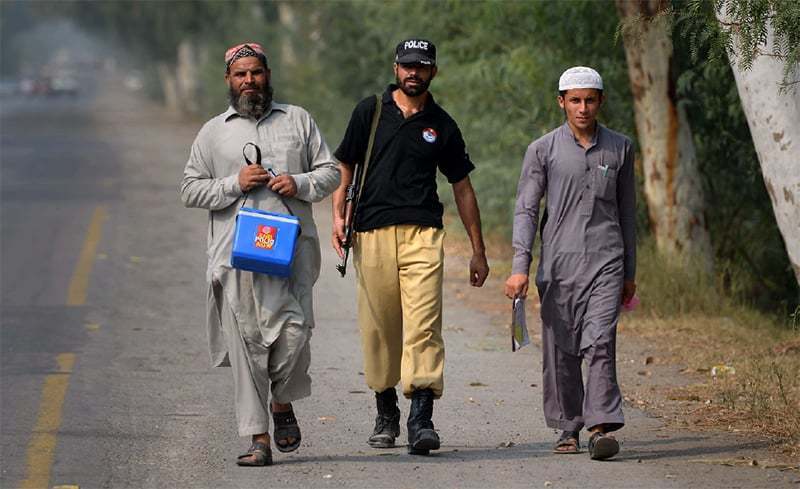
Pakistan’s struggle with polio has drawn international attention, with the World Health Organization classifying it alongside Afghanistan as the only two countries where the wild poliovirus remains endemic. The detections come after a year of aggressive response measures. In 2025, the National Emergency Operations Center for Polio Eradication, under government leadership, carried out six vaccination drives — five nationwide and one focused on specific regions — that reached more than 45 million children, according to a statement from the center.
Looking ahead, the first nationwide campaign of 2026 is set to run from Feb. 2 to 8, covering all four provinces, Azad Jammu and Kashmir, Gilgit-Baltistan and Islamabad, with a goal of vaccinating over 45 million children under age 5. The effort aims to build on routine immunisation services, which the government provides free of charge to children up to 2 years old. “Together, routine immunisation and repeated polio vaccination provide the strongest and most reliable protection against polio and other preventable diseases,” the statement said. It added an urgent appeal: “Parents and caregivers are strongly urged to ensure that children under five receive polio drops during every vaccination campaign to protect them from lifelong disability.”
While the number of confirmed polio cases in Pakistan dropped sharply in recent years — from hundreds annually a decade ago to just a handful in 2024 — the sewage positives suggest the virus could rebound if immunity gaps persist. International partners, including the Bill and Melinda Gates Foundation and Rotary International, continue to support the program, but experts warn that complete eradication requires closing every vulnerability.
Copyright © 2021 Independent Pakistan | All rights reserved