By Staff Reporter
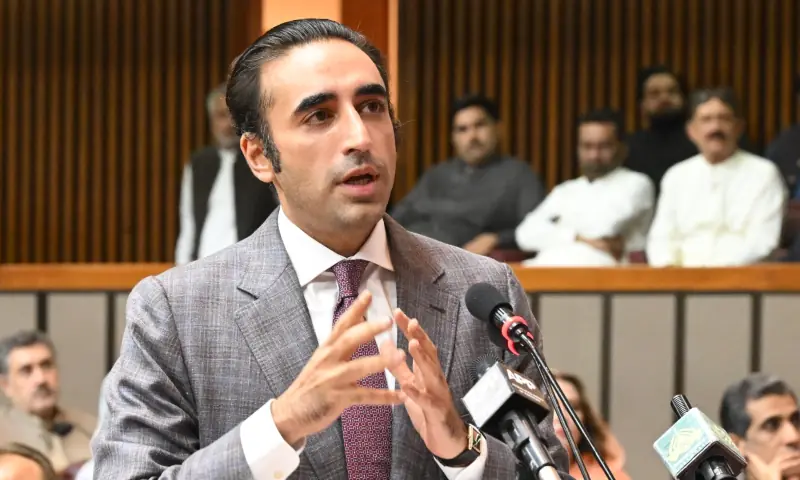
ISLAMABAD: Bilawal Bhutto-Zardari stepped into the National Assembly on Thursday with the authority of a man who had extracted concessions from a government desperate for his presence — and used the occasion not merely to endorse a budget compromise, but to deliver a sweeping indictment of how Pakistan’s federation actually functions beneath its constitutional veneer.
The PPP chairman, who had threatened to boycott the session entirely just two days earlier and had to be coaxed to the chamber for the tabling of the FY27 budget, told parliament that provinces had received a firm guarantee: their allocations under the 7th National Finance Commission award would be “protected”, and that beyond the one concession already secured, the Centre would not be returning for more.
“The provinces’ NFC award and financial resources have been kept protected; no damage will be caused to them,” he said. “Besides this decision, the provincial governments will not be required to make any sacrifices.”
The assurance amounted to a public ratification of a deal struck at the Prime Minister’s residence the previous evening, where PM Shehbaz Sharif is reported to have personally addressed the PPP’s concerns — concerns significant enough that Bhutto-Zardari had initially refused to attend the session at all, reportedly telling colleagues that the budget as presented differed from the document his party had been shown in advance.
The compromise at the heart of the agreement is a three-year freeze on development allocations to the provinces, intended to generate upwards of Rs900 billion in additional resources for what the government has described as strategic defence and national security requirements. Bhutto-Zardari cast the arrangement not as a capitulation but as a constitutional instrument, citing Article 164 as the mechanism that permitted provinces to voluntarily grant funds to the Centre — or vice versa — for expenditure outside either tier’s normal domain.
“We came up with such a constitutional and democratic solution which meets national security needs and also minimises complaints from the provinces,” he said, praising PM Shehbaz, Deputy Prime Minister Ishaq Dar and Finance Minister Muhammad Aurangzeb for remaining engaged with PPP representatives throughout. “This is not just a financial or administrative success, but the success of Pakistan’s politics.”
Yet the PPP chairman was careful — perhaps deliberately so — to describe the arrangement in the same breath as a stopgap. He called such moves “non-sustainable solutions” and pressed both tiers of government to move towards long-term, growth-oriented economic policies rather than an indefinite cycle of provincial sacrifice underwriting federal needs.
‘No province has been given its due share’
What gave Bhutto-Zardari’s speech its sharper edge was not the concessions he endorsed but the grievances he chose to air alongside them. The same politician who stood in parliament to validate the freeze proceeded to catalogue, in some detail, what he described as systematic deprivation of provincial revenues.
He cited the petroleum development levy as a case in point — a charge originally introduced as a temporary measure during the floods of a previous PPP government, now, he argued, permanently entrenched in violation of both the NFC formula and the 18th Amendment. “Instead of distributing the petroleum levy among the Centre and provinces under the NFC formula, the Centre retains 100 per cent of it,” he said. “That petroleum levy is being collected till today, and provinces are not getting their due share from petrol and gas levies. They are being deprived of their resources and their rights.”
He went further, challenging the premise — circulating in federal policy circles and occasionally surfacing in public debate — that provinces had been enriched by the post-18th Amendment settlement while the Centre was left cash-starved. “The Centre may have economic challenges, so do all the provinces,” he said, dismissing what he called “strange rumours” about abolishing the 18th Amendment or revisiting the NFC architecture altogether. “It is also true that despite these, no province has been given its due share.”
The forced surplus requirements that provinces must show in their budgets — demanded, Bhutto-Zardari made plain, to help Pakistan sustain its IMF programme — drew some of his most pointed language. Punjab, he noted, had made the “biggest sacrifice” in this regard. As for his own party’s government in Sindh: the Rs400 billion surplus it was obliged to declare this year could, in different circumstances, have been deployed for Karachi’s Lyari and Korangi areas, or for Larkana and Nawabshah. “Every provincial government is asked to show their surplus in their provincial budget, and that surplus means that we cannot spend that money on our people.”
‘I want to see Azad Kashmir azad’
On the simmering unrest in Azad Jammu and Kashmir, Bhutto-Zardari’s remarks were a mixture of firmness and pointed empathy — while firmly closing the door to what he characterised as extremist or unlawful tactics.
He warned that protesters “cannot damage Pakistan or the Kashmir cause, nor would they be allowed to”, and called on those demonstrating to distance themselves from elements “adopting extremist politics and taking the law into their hands”. Echoing comments he had made earlier in the week, he said the unrest was tarnishing Pakistan’s standing at a moment when its mediation efforts in the US-Iran dispute had drawn international praise.
But Bhutto-Zardari also acknowledged complexity. On the Joint Awami Action Committee’s demand to abolish the twelve seats in the AJK assembly reserved for refugees from Indian-occupied Jammu and Kashmir, he did not dismiss the underlying sentiment entirely — “it is not objectionable if a region wants to make decisions about its future itself” — while insisting such matters must be resolved through the AJK parliament rather than street pressure. His party’s red line was unambiguous: “There can be no compromise on the refugees’ representation and their vote. If this is not acceptable to anybody else, to hell with that.”
The line that may be most quoted, however, was his invocation of Indian-occupied Kashmir as a warning. “I want to see Azad Kashmir azad,” he said. “I do not want to see Azad Kashmir like occupied Kashmir.”
BISP, Gilgit-Baltistan and the weight of unfinished business
The speech ranged across a considerable stretch of national policy. On the Benazir Income Support Programme — which Bhutto-Zardari said had been “targeted in an unfortunate and shameful manner” — he made four distinct arguments for its continuation and expansion: its internationally recognised effectiveness, its alignment with religious obligation, its role in generating demand from the bottom of the economy upwards, and — in a framing that was clearly deliberate — its function as a national security instrument. “If you have to fight insurgency, militancy, extremism and terrorism, you have to win hearts and minds,” he said. “The assistance in the form of BISP wins people’s hearts.”
He thanked PM Shehbaz for committing to expand the programme in the FY27 budget despite what he termed attacks upon it.
On Gilgit-Baltistan, where the PPP recently secured a victory, Bhutto-Zardari renewed his call for the region’s people to be granted parliamentary representation on an interim basis pending resolution of their constitutional status. “Till when will we keep the people who secured their independence from Dogra, deprived of their right to sit with me here in this house?” He asked that MNAs and senators from GB be permitted to participate in parliamentary discussions, framing it as a minimum gesture of inclusion for what he called “the most patriotic Pakistanis”.
He also flagged the failure of the proposed budget to extend tax exemptions for the merged tribal districts of Khyber Pakhtunkhwa — which expire this year — and said both federal and provincial governments had failed to honour commitments to development in those areas despite the merger’s promise.
On the question of regional security, Bhutto-Zardari opened his address with a nod to Pakistan’s role in the US-Iran peace process, before striking a more cautionary note. The “India-Israel nexus”, he warned, remained active — Israeli soldiers conducting high-altitude training with Indian personnel in occupied Kashmir, he claimed — and would not be quieted by diplomatic progress elsewhere. “Do not think that after this memorandum, the India-Israel nexus will get quiet. They are still hatching conspiracies against Pakistan.”
His sign-off was directed at the PTI, which governs Khyber Pakhtunkhwa and which, he noted, had been part of the consensus on the development freeze. “If PTI and our opposition allies adopted similar politics, where there could be political differences but we work together in national interest, then there is no issue that we cannot face.”
Copyright © 2021 Independent Pakistan | All rights reserved