By Staff Reporter
ISLAMABAD: Imran Khan’s party called off its long-threatened march on Islamabad on Friday, postponing by more than a week a protest that had triggered one of the most extensive security lockdowns the Pakistani capital has seen in years.
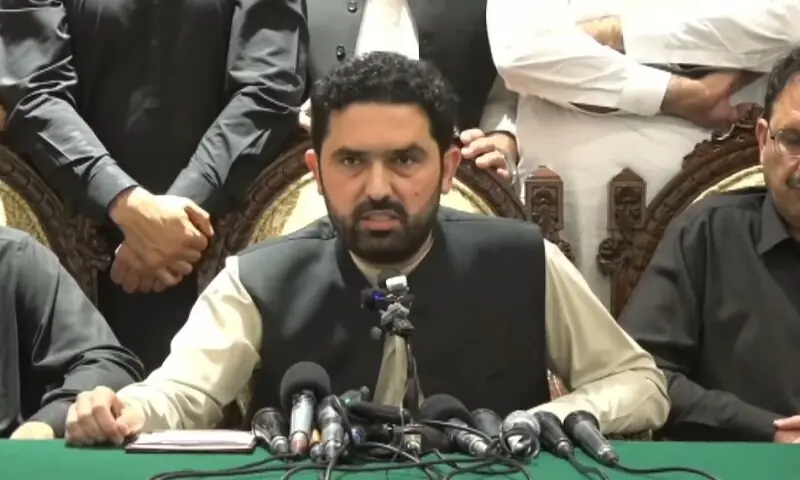
Pakistan Tehreek-e-Insaf had spent weeks mobilising supporters for a mass demonstration that was due to begin on Sunday, when caravans from across the country were meant to converge on the federal capital to demand Khan’s release from Adiala jail in Rawalpindi, where the former prime minister has been held since his 2023 conviction. Khyber Pakhtunkhwa Chief Minister Sohail Afridi announced at a press conference in Peshawar that the march would instead set off from the city on October 4, telling reporters the party’s political committee had “unanimously agreed” to the new date.
“This struggle of ours is just for the supremacy of the Constitution, restoration of the independent judiciary, media freedom and Haqiqi Azadi, as envisioned by Imran Khan,” Afridi said.
The climbdown followed a week in which the government sealed off major roads into the capital, deployed paramilitary Rangers and detained scores of party workers — a clampdown so extensive that PTI leaders claimed the protest had achieved its purpose before a single marcher had set off.
A senior PTI offcial, speaking on condition of anonymity, said the party’s political committee had judged that Islamabad was already effectively shut down in anticipation of the protest, and that forcing the government to maintain that lockdown was itself a form of victory. “There was a proposal to exhaust the federal government and law enforcement agencies, as they have already closed down the federal capital and a number of routes,” the official said. “They have closed down roads and are spending hundreds of millions on law enforcement.”
It was a retreat dressed up as strategy — and one reached only after a fractious two-day debate inside the party that exposed just how divided its leadership had become.
According to party sources, a meeting of PTI’s political committee at the Chief Minister’s House in Peshawar on Friday, chaired by party chairman Barrister Gohar Ali Khan and attended by Afridi, cabinet members and parliamentarians, had initially settled on October 5 — the birthday of Imran Khan — as the new date. But the committee wanted the postponement announced jointly with its opposition allies rather than by PTI alone, and that plan swiftly collapsed.
Sources said Afridi and Gohar separately asked Mahmood Khan Achakzai, who leads the allied Tehreek Tahafuz-e-Ayeen-e-Pakistan grouping, to be the one to announce the delay. Achakzai refused outright. “Why should we announce the postponement when no consultation took place when the call for the protest was issued?” he is reported to have told them, a rebuke that laid bare tensions between PTI and an alliance it had been courting for months. Achakzai argued instead that the original September 27 date should stand, and pressed for the protest to begin then and run through to October 5. Despite continued pressure from Gohar and Afridi, he would not take responsibility for calling it off.
Senate opposition leader Raja Nasir Abbas took a similar line, having earlier declared that only Khan himself had the standing to call off the march — a position that left PTI’s own leadership looking as though it lacked the authority to make the call on its own founder’s behalf.
The confusion spilled into the open. Leaked audio from a PTI Zoom call, circulated on social media, captured MNA Asad Qaiser proposing a postponement so the party could consult the Jamiat Ulema-e-Islam-Fazl and the Pakistan Peoples Party, while Salman Akram Raja pressed Afridi on the state of preparations. Barrister Gohar was recorded warning against escalation. With the alliance still refusing to play along, PTI ultimately settled on October 4 and announced it alone.
Even that did not fully hold. Shaukat Yousafzai, the party’s information secretary in Khyber Pakhtunkhwa, moved to insist reports of a climbdown were wrong. “No decision has been taken to call off the march and the party is fully prepared for it,” he told a local television channel, adding that any postponement would only be considered if the federal government agreed to talks, and accusing the government of defying a court ruling by using containers to block roads.
Weeks of defiance give way
The retreat came after weeks of defiant rhetoric from Afridi, who had insisted as recently as Friday morning that the protest would go ahead “no matter what,” dismissing the deployment of containers and reports of nails driven into roads at the Khyber Pakhtunkhwa–Punjab border as attempts to cut his province off from the rest of the country. “No matter how many nails they put in the roads, this long march will not be stopped,” he told the same press conference, hours before his party opted to stand it down. He also used the platform to accuse Islamabad of running a coordinated campaign against Khyber Pakhtunkhwa, saying ministers and officials were being harassed and that a narrative had taken hold casting the province as a threat to the rest of the country. He further criticised federal ministers over recent remarks made against him, saying one “cannot even win a union council election.”
He also condemned what he described as the arbitrary detention of PTI leaders and workers, including sitting ministers, and alleged that authorities in Punjab had been directed to take action against the party inside Khyber Pakhtunkhwa itself.
Barrister Gohar had spent the preceding days pressing the government for direct talks rather than confrontation, warning the standoff had curdled into a battle of egos on both sides. “We are peaceful and are coming out for our rights,” he told reporters outside parliament, appealing to the authorities not to deploy net launchers against demonstrators. “We are raising the voice for justice and have repeatedly said that we were not heard and were not given justice.” He also rejected claims that PTI intended to target state institutions or the capital itself, warning that pushing a major political party out of the democratic space could carry serious consequences.
The about-turn followed days of speculation that PTI might step back from confrontation in exchange for concessions. Naeem Haider Panjutha, a lawyer close to the party leadership, had local media a postponement was possible if the government committed to holding elections within six to eight months, released Khan and other political prisoners, and opened investigations into the crackdowns that followed protests on May 9, 2023, and November 26 last year. Party spokesman Sheikh Waqas Akram publicly denied any such offer was on the table, insisting only Khan could sanction a deal even if one existed.
A capital under lockdown
Whatever the internal wrangling, the scale of the government’s security operation left little doubt about how seriously it was taking the threat. Punjab imposed a 13-day ban on public gatherings and outlawed incitement to unlawful assembly, while Section 144 — which bars gatherings of more than a handful of people — was extended across Islamabad for two months. The provincial government asked the interior ministry to downgrade or jam mobile and internet coverage at specific locations in Rawalpindi and Attock, and the federal cabinet approved the deployment of Rangers across Islamabad and several Punjab districts from September 20 to October 5, with troops authorised to respond in self-defence to any violence encountered on duty.
By Thursday night, the Hassan Abdal Road linking Haripur with Punjab had been sealed with containers, and the Haripur-Khanpur-Taxila Road blocked, cutting Hazara’s most direct links to Rawalpindi and Islamabad. More than 43,000 police were assigned to the Rawalpindi division alone, with roughly 14,250 personnel stationed at sealing points along the M-1 motorway and a further 11,450 along the N-5 and N-80. Police requested armoured personnel carriers, water cannon, prison vans and surveillance drones. In Rawalpindi’s Faizabad area, hotels, guest houses and hostels were ordered to close, their owners told to submit affidavits confirming the premises had been vacated.
The clampdown extended to Khan’s own family. All three of his sisters — Uzma Khan, Noreen Khan and Aleema Khan — were taken into custody, part of what human rights monitors described as a broader sweep against the party’s grassroots network. The Human Rights Commission of Pakistan said it had documented the arbitrary detention of scores of workers, including women, with some relatives left with no information about where they were being held. “Pre-emptive mass detention and restrictions on freedom of movement cannot be justified as proportionate or necessary,” the commission said in a statement, adding that repeated recourse to Section 144 was “an affront to democratic principles,” and calling on the government to release those held without charge and resume genuine dialogue with the opposition.
Government dismisses the delay
The government showed little inclination to soften its stance in response. Information minister Attaullah Tarar used a televised address to accuse the Khyber Pakhtunkhwa administration of deliberately allowing militancy to flourish, alleging it was complicit in a “political, terror-crime nexus” bankrolled by illegal gold mining and the timber and tobacco trades. He said the province had recorded 2,456 terrorist attacks so far in 2026 — an average of ten a day — in which 472 police, army, Rangers and Frontier Corps personnel had been killed and more than 1,500 wounded.
Tarar reserved his sharpest language for Afridi personally, describing him as behaving “more like a commander of the TTP than a chief minister” and branding the provincial government the “B-team” of the Pakistani Taliban. He pointed to a recent drone strike near Kohat, launched from across the Afghan border and intercepted by the air force, and to cross-border firing in Kurram, saying Khyber Pakhtunkhwa’s leadership had offered no public solidarity with the troops involved. He dismissed the postponement as proof the party had never been ready to follow through. “If you have courage, then come and do your dharna,” he said. “I have visited K-P and know that they have no preparation.”
Khyber Pakhtunkhwa’s governor, Faisal Karim Kundi, went further, telling reporters in Peshawar that consultations had already taken place over the possibility of imposing governor’s rule in the province — a constitutional mechanism that would allow the centre to suspend the provincial government. He suggested party members were losing their nerve over the prospect of arrest. “PTI people are giving themselves up for arrest,” he said. “They are looking for a way out.” He also accused the provincial government of trying to turn the police into what he called a “tiger force” loyal to the party rather than the public, and vowed to resist any such move — remarks that sat oddly with Tarar’s own comments days earlier explicitly ruling out governor’s rule and calling instead for better governance.
Copyright © 2021 Independent Pakistan | All rights reserved