By Staff Reporter
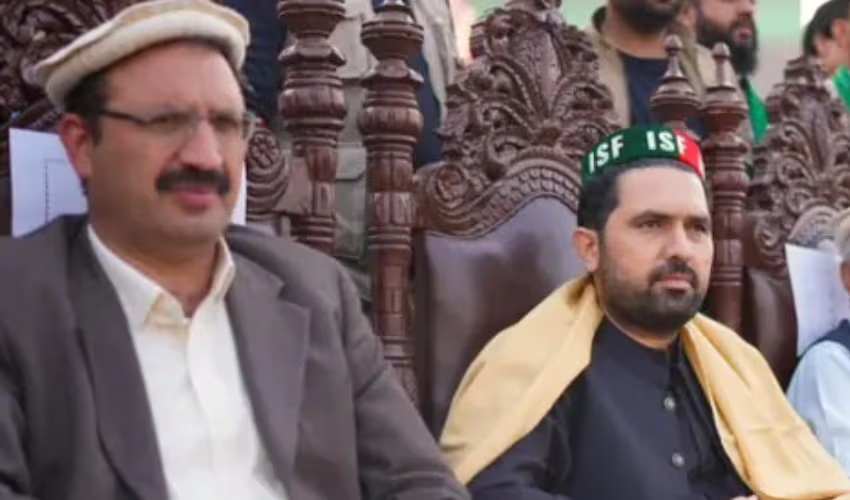
PESHAWAR: Leaders of Imran Khan’s Pakistan Tehreek-e-Insaf (PTI) said on Sunday that the party’s Khyber Pakhtunkhwa chief minister, Sohail Afridi, and its provincial president, Junaid Akbar, had been arrested, hours after the federal government suspended the elected provincial administration.
The claim first appeared in a post on Akbar’s official X account, which said both men had been taken into custody. Authorities had not confirmed or denied the arrests.
Shahid Khattak, the PTI’s parliamentary leader in the National Assembly, said Afridi had been taken away in a police van. He urged people across the province, and residents of Peshawar in particular, to take to the streets, and called on those in the southern districts, including Karak, to block the national highway.
Shafi Jan, a former provincial information minister, who had been travelling with the chief minister, also said Afridi was in custody. He called on people across Khyber Pakhtunkhwa to gather in Peshawar, and singled out residents of Kohat and the tribal districts.
“The tribal people must come out for their chief minister,” he said. “Wherever the people assemble, you will find me among them.”
Videos circulating on social media appeared to show an empty container used by the chief minister during the long march, with accompanying claims that he and the marchers had left it in Charsadda. The footage could not be verified. The claims of the arrests and the call to protest have also not been independently confirmed.
Emergency and governor’s rule
The arrests were claimed after the government announced an emergency and governor’s rule in the province earlier on Sunday. The measures were invoked under Articles 232 and 234 of the constitution and effectively suspend the PTI government. President Asif Ali Zardari said he had approved recommendations from a cabinet meeting chaired by Prime Minister Shehbaz Sharif.
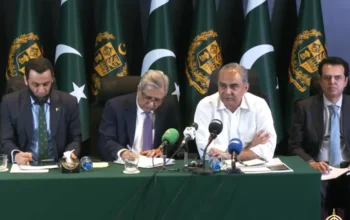
The provincial governor will take charge with an advisory council, the law minister, Azam Nazeer Tarar, told a press conference, adding that the arrangement would initially last six months. Mobile network and data services were throttled or shut in selected urban areas, though not across the whole province.
A statement from the prime minister’s office said cabinet members had taken note of the provincial government’s “deliberate disengagement from the fight against terrorism”. The interior minister, Mohsin Naqvi, and the law and information ministers said the decision followed more than a month of efforts to reach an understanding with the provincial government.
The information minister, Attaullah Tarar, alleged that the PTI-led administration had a “nexus” with terrorist groups and claimed that intelligence and law enforcement reports showed militants held influence in several districts. The PTI has rejected allegations linking it to militant groups.
PTI response
The PTI’s chairman, Barrister Gohar Ali Khan, said the party “strongly condemns” and “categorically rejects” the move, calling it an undemocratic step and a “grave political mistake”.
“The people will never accept such measures against their rights,” he said.
Gohar said there was no disagreement over the need to eliminate terrorism, but that the fight against militancy could not be used to suppress public voices, pursue political aims or restrict the province’s constitutional powers. “Countering terrorism is possible only through national unity and a joint strategy,” he said.
He urged the federal government to reverse its decision, saying it could still be undone within days. “Reconsidering political decisions is not a sign of weakness but an indication of wisdom in the national interest,” he said.
At a press conference, he asked why governor’s rule had been imposed across the whole province if terrorism affected 12 districts. He said the provincial government had increased police capacity, provided security resources and attended counterterrorism meetings. He also claimed terrorism had not been discussed in 15 meetings with government representatives before 2 October.
The PTI’s secretary general, Salman Akram Raja, said the provincial government could not grant the federal government unrestricted powers. “We cannot give anyone written permission to do whatever they want and then endorse it,” he said. He described the emergency as a hasty decision, saying talks had been progressing satisfactorily.
Asad Umar, a former federal minister, said Sharif and Zardari had begun a process that could dismantle the existing system. “Everyone is going to be buried in this political grave,” he said, referring to political parties.
Asad Qaiser, the former National Assembly speaker, said: “Governor’s rule is unacceptable, emergency is unacceptable.” He called the move a “robbery on the constitutional rights of the province”.
Zulfikar Bukhari, a PTI spokesman, told Reuters the decision would lead only to “further bloodshed, instability and collateral damage”, and said it showed the government never intended to negotiate.
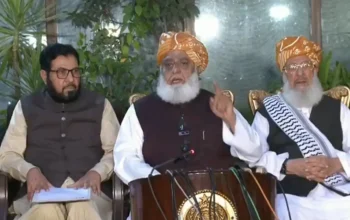
Allama Raja Nasir Abbas, head of the Majlis Wahdat-i-Muslimeen, who has been involved in the talks, said his party could not support military operations in which civilians became victims. The Tehreek-i-Tahafuz Ayin-i-Pakistan, the opposition alliance, said it would challenge governor’s rule in the courts, the assemblies and public forums.
Sheikh Waqas Akram, the PTI’s information secretary, said that arresting or harassing elected leaders undermined democratic principles and provincial rights. He called for adherence to the rule of law and due process.
Long march
The crisis has been building around a PTI march on Islamabad to demand Khan’s release. The protest was first set for 27 September, then postponed to 4 October to allow talks. Those discussions broke down over the party’s demand for access to Mr Khan before calling off the protest, while the government insisted the demonstration be ended first. The PTI says the talks collapsed over counterterrorism cooperation and access to Mr Khan, including a visit by his personal doctor. Each side blames the other.
The government has said it will not let the march into the capital, and has used shipping containers to block the main routes into Islamabad. Heavy police deployments and container barricades have also gone up on key routes around Peshawar.
Afridi, who took office in October 2025, had said on Saturday that he would not accept any “illegal move”. If governor’s rule was imposed, he said, the march would head for Peshawar and then on towards D-Chowk in Islamabad.
Akbar said before his reported arrest that marchers had reached Swabi and the march would go ahead whatever the government did. “Neither pressure can stop us, nor threats weaken our resolve,” he said. Raja said there had been no change to the plan. “We will not throw stones,” he said. “Through peaceful protest, we have to express our moral position.”
Gohar also called for the release of political prisoners and for Khan to be moved to hospital, with his family allowed to visit. He said the party had gone to the Supreme Court and high courts 19 times seeking relief for the former prime minister. He claimed around 1,500 PTI workers were in jail in Punjab, along with 10 provincial assembly members, three of them ministers, and eight members of the National Assembly. Those figures have not been independently verified.
Copyright © 2021 Independent Pakistan | All rights reserved