By Staff Reporter
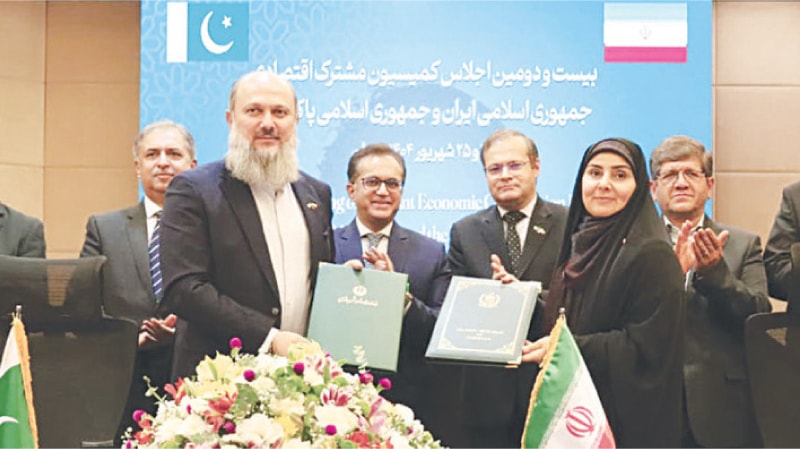
ISLAMABAD: Pakistan and Iran signed a raft of protocols on Wednesday aimed at enhancing bilateral trade to $10 billion annually, a near tripling of current levels.
The agreements, finalised at the 22nd Pakistan-Iran Joint Economic Commission in Tehran, focus on slashing tariff and non-tariff barriers, expanding energy flows, and bolstering cross-border connectivity to unlock economic potential in a geopolitically fraught region.
The deals were sealed by Pakistan’s Commerce Minister Jam Kamal Khan and Iran’s Minister for Roads and Urban Development Farzaneh Sadeq, capping days of talks.
Pakistan’s commerce ministry, in a statement, said the protocols “will help achieve a $10 billion trade target between the two countries,” signalling a bold bet on economic integration despite US sanctions on Iran and Pakistan’s fiscal strains.
The centerpiece of the accords is a commitment to dismantle obstacles stifling commerce. Pakistan and Iran vowed to eliminate tariff and non-tariff barriers, activate cross-border markets, and foster regular business-to-business engagements to cement commercial ties.
In a separate meeting, Khan and Iran’s First Vice President Mohammad-Reza Aref discussed easing trade frictions, aligning regulations, and scoping out new export-import avenues, according to ministry details.
The agreements come as both nations seek to leverage their geographic adjacency to counter economic headwinds. Current trade hovers around $3 billion, leaving ample room to hit the $10 billion mark if implementation holds.
Energy cooperation took center stage, with both sides agreeing to revive construction of a 220-kilovolt transmission line to Gwadar, Pakistan’s strategic port city. The project aims to boost electricity exchanges, addressing chronic shortages in Balochistan. Talks also covered joint renewable energy ventures, with a new Joint Working Group tasked with steering power sector investments. Water resource management and sustainable urban development were flagged as priorities.
In agriculture, the protocols outline agreements on veterinary standards, pest control, and joint development of seeds and equipment to lift productivity. Environmental measures target climate challenges, including sand and dust storm mitigation and mangrove conservation along the Gulf of Oman.
Health cooperation advanced with pacts on joint training, harmonized pharmaceutical regulations, and cross-border disease surveillance, critical for border regions vulnerable to outbreaks. A Joint Committee on Labour Cooperation will facilitate workforce mobility in construction, textiles, and agriculture, while streamlined visa rules for businesspeople and drivers aim to ease trade flows.
Transportation emerged as a linchpin, with plans to strengthen road, rail, air, and maritime links. Initiatives include boosting rail cargo capacity, upgrading air navigation systems, and exploring passenger ferry services for Zaireen pilgrims between designated seaports.
Cultural ties got a boost through planned festivals, joint media projects, academic exchanges, and vocational training to deepen people-to-people connections. Both nations also reaffirmed their anti-narcotics stance, pledging intensified intelligence-sharing and border coordination to curb trafficking.
Copyright © 2021 Independent Pakistan | All rights reserved