By Staff Reporter
ISLAMABAD: Pakistan and India exchanged lists of their nuclear installations on Thursday, adhering to a longstanding agreement aimed at preventing attacks on such facilities, even as Islamabad raised fresh concerns over New Delhi’s plans for a hydroelectric project that it said could violate a separate water-sharing treaty.
The annual swap, conducted through diplomatic channels, underscores the fragile mechanisms that the nuclear-armed neighbors have maintained to manage risks despite decades of hostility, including three wars since their independence in 1947 and the most latest in May last year.
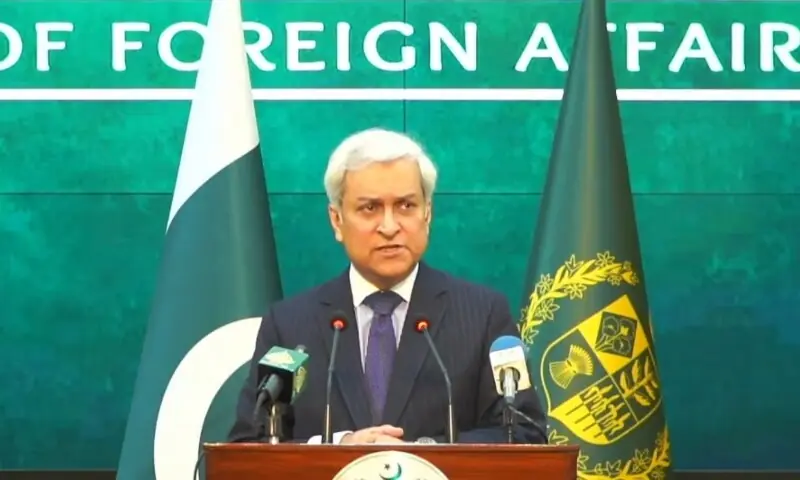
“A list of nuclear installations and facilities in Pakistan was officially handed over to the representative of the Indian High Commission in the Foreign Office today,” Tahir Hussain Andrabi, the Foreign Office spokesman, said at a weekly briefing. “I understand that the Indian government is also sharing the list of Indian nuclear installations with our High Commission in New Delhi today.”
The exchange stems from the Agreement on the Prohibition of Attacks Against Nuclear Installations and Facilities, signed on Dec. 31, 1988, and effective from Jan. 27, 1991. Under its terms, the two countries must inform each other annually about their nuclear sites, a practice that has continued uninterrupted since 1992.
In a separate statement, the Foreign Office confirmed that the lists were handed over simultaneously in Islamabad and New Delhi. The agreement requires the disclosure on the first day of each calendar year. Alongside the nuclear lists, the two sides also shared details of prisoners in each other’s custody, as mandated by the 2008 Agreement on Consular Access, which calls for such exchanges twice a year, on Jan. 1 and July 1. Pakistan provided India with a list of 257 Indian prisoners, 58 civilians and 199 fishermen, held in its jails, Andrabi said. “The Indian government is also sharing the list of Pakistani prisoners in their custody with the Pakistani high commission in New Delhi,” he added.
The prisoner swaps often involve fishermen arrested for inadvertently crossing maritime borders in the Arabian Sea, a recurring issue between the two nations. Andrabi’s remarks came against a backdrop of heightened scrutiny over India’s water projects in the disputed region of Jammu and Kashmir. Responding to reports of New Delhi’s approval for the 260-megawatt Dulhasti Stage-II hydropower project on the Chenab River in Kishtwar district, he accused India of failing to share required details under the Indus Waters Treaty. Signed in 1960 under World Bank auspices by Pakistan’s president, Ayub Khan, and India’s prime minister, Jawaharlal Nehru, the treaty allocates the eastern rivers — Ravi, Sutlej and Beas — to India, while granting Pakistan control over the western rivers — Indus, Jhelum and Chenab. India is allowed limited use of the western rivers for power generation and other purposes, subject to strict conditions.
“We have seen these media reports regarding Indian plans to construct the Dulhasti Stage-II hydroelectric project on the Chenab River,” Andrabi said. “Obviously, these reports raise serious concerns as no prior information or notification was shared with Pakistan with regard to this project.” He emphasized that such sharing is required by the treaty. “Such acts of commission and omission yet again exemplify a complete disregard of international law and bilateral treaties,” he said.
The Pakistani commissioner for Indus waters has sought clarification from his Indian counterpart on the project’s details, including whether it is a new run-of-the-river scheme or an addition to an existing one. “Any such project on the western river is subject to strict design and operational controls as well as information sharing requirements,” Andrabi said. “In the absence of formal communication from the Indian side, Pakistan is unable to access the project’s conformity with the treaty provisions,” he added. “We, therefore, call upon India to urgently return to treaty compliance and respond to the queries raised by our Indus water commissioner in his latest as well as his earlier communications.” Pakistan, he said, views the treaty as a binding international agreement and remains committed to peaceful dispute resolution but “would never compromise on our existential water rights.”
The briefing also touched on broader regional issues. Andrabi reiterated Pakistan’s support for China amid tensions over Taiwan, particularly in response to recent US arms sales to the island. “Pakistan has consistently supported China, in all matters of its core interests, including Taiwan,” he said. Pakistan adheres to the One-China principle, regarding Taiwan as “an inalienable part of China.” “We would urge all relevant countries to abide by their historical commitments, take steps to foster peace, security and development in Taiwan,” he added, calling on them to “refrain from measures that may aggravate tensions or undermine peace and stability in the region.”
On Afghanistan, Andrabi updated reporters on the return of stranded Pakistanis following a border closure. “15 students and another 291 individuals had safely returned to Pakistan,” he said. A total of 1,199 Pakistanis, including 549 students, had sought assistance from the embassy in Kabul. “We are in contact with the Afghan authorities,” he added.
Turning to the Middle East, Andrabi expressed solidarity with Saudi Arabia amid escalating tensions in Yemen, where a Saudi-led coalition conducted airstrikes on Dec. 30 targeting weapons shipments reportedly destined for forces backed by the United Arab Emirates. “Pakistan expresses complete solidarity with the Kingdom of Saudi Arabia and reaffirms its commitment to security of the Kingdom,” he said. Islamabad supports resolving the Yemen crisis “through dialogue and diplomacy” and hopes for an “inclusive and enduring settlement” that safeguards regional stability.
He emphasized Pakistan’s opposition to “unilateral steps” by any Yemeni party that could escalate the situation and reaffirmed support for Yemen’s unity and territorial integrity. The comments followed a phone call on Wednesday between Prime Minister Shehbaz Sharif of Pakistan and Saudi Crown Prince Mohammed bin Salman, during which they discussed bilateral ties and regional matters, reaffirming commitments to cooperation in various fields. Pakistan and Saudi Arabia formalized their military alliance in September 2025 with a defense pact treating an attack on one as an assault on both. The kingdom, a key economic partner, has extended billions in loans to Pakistan and hosts over two million Pakistani expatriates, making it the top source of remittances.
Copyright © 2021 Independent Pakistan | All rights reserved