By Staff Reporter
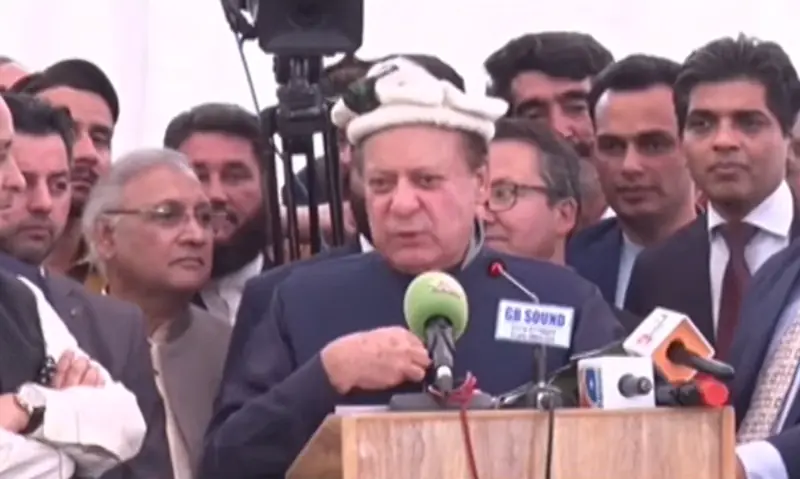
GILGIT: He stepped off the plane and onto broken roads, and Nawaz Sharif could not hide his dismay.
The three-time former prime minister of Pakistan had not visited Gilgit-Baltistan in years, and what greeted him on Tuesday upon leaving the airport was a testament to the benign neglect that has defined Islamabad’s relationship with one of its most spectacular, and most overlooked, territories. Crumbling pavement. Potholed streets. An airport frozen in time, unchanged since his own tenure in power.
“When I saw the condition of the roads after exiting the airport, I cannot even describe it,” Sharif told a rally crowd in Gilgit, his voice heavy with something that sounded less like campaigning than genuine remorse. “It hurt me immensely. Where is the Gilgit that I used to know?”
Four days before Gilgit-Baltistan’s general elections — delayed four months from their original date because of severe winter weather and now scheduled for Sunday — Pakistan’s most powerful political dynasties converged on the territory in a final push for votes. Sharif’s Pakistan Muslim League-Nawaz and the Pakistan Peoples Party, led by Bilawal Bhutto-Zardari, mounted competing rallies across the region, each party casting itself as the true champion of a people accustomed to hearing promises that rarely survive the trip back down the mountain.
The tableau was striking: two of the country’s most prominent surnames, Sharif and Bhutto, each making the case that only their family’s party understood what ailed these high-altitude valleys. Sharif, 74, the patrician elder who serves as PML-N president and as informal political guardian to his daughter, Punjab Chief Minister Maryam Nawaz, spoke with the weariness of a man surveying a project left half-finished. Bilawal, 36, the son of President Asif Ali Zardari and the late Prime Minister Benazir Bhutto, spoke with the fervor of a politician still building his own legacy in his family’s long shadow.
In Gilgit, Sharif leaned into the politics of grievance and nostalgia — not without cause. He recalled a highway project his government had begun that was never extended to Gilgit, and a road to Skardu that cost 50 billion rupees but stopped short of Khunjerab. A nine-hour journey between Gilgit and Skardu, he noted with evident pride, had been reduced to three hours under PML-N. Yet the airport sat unchanged. Load-shedding in winter, he acknowledged, stretches beyond 20 hours a day; in summer, 12.
“It is unacceptable to me,” he said.
Much of his address was a sustained lament for infrastructure deferred and opportunity squandered — punctuated by the kind of audience-baiting that has always been one of Sharif’s political strengths. “Tell me if any other party has even placed a brick here,” he said at one point, and his supporters roared that no other party had.
He promised to meet with Prime Minister Shehbaz Sharif — his younger brother — to press for airport expansion and relief from electricity outages, pledging to visit the region every two to three months if his party won. He also vowed to push for housing loan schemes, interest-free business loans for young people, and the construction of a women’s university.
The former prime minister was accompanied by a notable delegation — Defence Minister Khawaja Asif, Planning Minister Ahsan Iqbal, and Inter-Provincial Coordination Minister Rana Sanaullah among them — a signal of how seriously the party regards the territory’s dozen or so assembly seats. He was greeted on the tarmac by his son-in-law, retired Captain Mohammad Safdar, and by Hafiz Hafeezur Rehman, PML-N’s former chief minister of the region.
Sharif could not resist addressing the elephant in every room he enters in Pakistan: his own history of removal from office. “Do not complain to me,” he told the crowd, with a rhetorical twist that was part wounded pride and part political theater. “I am not ready to hear this grievance because this is your fault as well — that you let a person like me be exiled.”
“Why did I have to leave the country and go abroad? Why were we jailed?”
In Skardu, Bhutto-Zardari struck a different register — expansive, ideological, and steeped in the Bhutto family’s long-cultivated identity as the voice of Pakistan’s poor. He was joined by his sister, First Lady Aseefa Bhutto-Zardari, daughter of the president.
Bhutto-Zardari built his address around what he called the three pillars of his party’s mission for Gilgit-Baltistan: the right to self-governance, the right to ownership of the region’s land and resources, and the right to employment. The frame was deliberate — each pillar an implicit critique of the status quo, and of the federal government his party nominally props up.
“All this land, from the mountains to the river — the resources of the people of GB,” he said. “Until Islamabad agrees, neither GB nor Islamabad will progress. They will have to accept that this land, resources, and minerals are yours.”
He invoked a study conducted in the 1970s by Dr. Mubashir Hassan — Zulfikar Ali Bhutto’s finance minister and one of the PPP’s founding figures — which estimated Gilgit-Baltistan’s potential electricity generation at up to 50,000 megawatts. The region, he said, could not only power itself but export surplus capacity to the rest of Pakistan. He promised to develop the infrastructure to realize that potential.
The electricity line resonated in a territory where wintertime blackouts can stretch the better part of a day. So did his remarks on constitutional status — Bhutto-Zardari argued that extending to Gilgit-Baltistan the autonomy provisions of Pakistan’s 18th Amendment, which devolved significant powers to the provinces in 2010, would begin to address the governance vacuum that has long plagued the region.
He also targeted the Benazir Income Support Programme — Pakistan’s flagship social safety net, which provides financial assistance to more than 10 million low-income families, most of them women — claiming the PML-N-led federal government intended to abolish it. “It is unfortunate that the rulers want to end the Benazir Income Support Programme,” he said. “We will save it.”
The charge sharpened a political contrast Bhutto-Zardari has been pressing with increasing intensity. The federal government denies plans to eliminate BISP outright; a minister said last month that devolution to the provinces was being considered, not abolition. Bhutto-Zardari dismissed the distinction. “Across the world, these responsibilities are undertaken by the federal government,” he said at a separate rally in Shigar on Monday. “Handing BISP to the provinces would amount to ending it.”
He also pledged to replicate PPP’s Sindh People’s Housing for Flood Affectees initiative in Gilgit-Baltistan under a new program he called the Gilgit-Baltistan People’s Housing Initiative, and to bring the free specialist-hospital model operating in Karachi to the region.
Before the main thrust of his speech, Bhutto-Zardari paused to acknowledge the regional situation that had dampened, at least in tone, the usual exuberance of campaign season. He condemned what he described as Israeli attacks on Iran, including strikes that killed students, and referenced the assassination of Supreme Leader Ayatollah Ali Khamenei. “It did not seem appropriate to run an election campaign in an elaborate manner,” he said, adding that there was an “air of grief” over him and the people of Gilgit-Baltistan. He praised Field Marshal Syed Asim Munir, the army chief and chief of defence forces, for what he described as ongoing efforts toward peace in the Middle East.
Before Sharif’s arrival, senior PML-N figure Khawaja Saad Rafique addressed a separate gathering in Skardu, where he raised the question that every politician visiting Gilgit-Baltistan eventually confronts — and few have ever answered.
“Till how long will the issue remain undecided?” Rafique asked, referring to the territory’s unresolved constitutional status. Gilgit-Baltistan is governed under a patchwork of federal orders and special statutes; it is neither a province nor — despite decades of demands from its residents — constitutionally integrated into Pakistan. The ambiguity touches virtually every aspect of governance, from resource rights to representation in the national parliament.
Rafique acknowledged that five-year terms were insufficient to solve what generations of governments had left untouched. But a direction, he argued, could be set. “The time has come for the parliament to debate the matter,” he said, calling on all parties and state institutions to act collectively.
He also renewed PML-N’s call for an equitable share for Gilgit-Baltistan and Azad Jammu and Kashmir in the National Finance Commission Award, the formula that distributes federal revenues among the country’s administrative units.
For the voters who filled these rally grounds — many of them young, many living with the daily realities of road networks barely suitable for the traffic they bear and electricity grids that fail them for most of winter — the question of which promises will survive contact with Islamabad is one they have learned, through long experience, to hold lightly.
Sharif, ever the pragmatist, framed his appeal in the plain language of infrastructure: roads, hospitals, power plants, an airport that could handle a commercial jet. Bhutto-Zardari, carrying the Bhutto tradition’s heavier ideological freight, spoke of rights and ownership and constitutional dignity.
“It is exam day for you three days from now,” Sharif told his supporters in Gilgit, with the hint of a smile.
Copyright © 2021 Independent Pakistan | All rights reserved