By Staff Reporter
ISLAMABAD: Pakistan’s two principal ruling coalition partners reached broad agreement on Monday on the framework for the country’s federal budget, with the Pakistan Peoples Party signalling it would back the fiscal plan put forward by Prime Minister Shehbaz Sharif’s Pakistan Muslim League-Nawaz government — even as uncertainty lingered over when the budget would actually be presented.
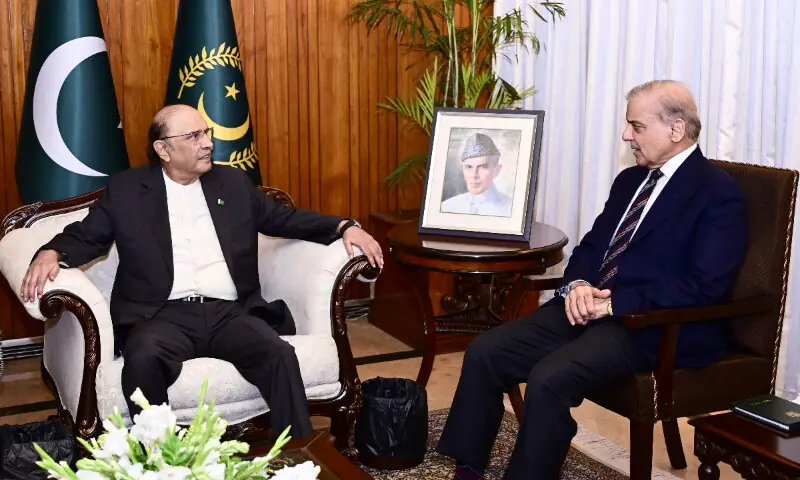
The accord emerged from a high-level meeting at Aiwan-e-Sadr, the presidential palace, where President Asif Ali Zardari hosted Sharif and a large delegation of cabinet ministers alongside PPP Chairman Bilawal Bhutto-Zardari and senior party figures. Both sides described the talks as constructive, and technical committees were tasked with resolving a handful of outstanding issues before the fiscal framework is finalised.
The meeting reflected the delicate coalition arithmetic that has complicated budget preparations for fiscal year 2026–27. The government had already pushed back the budget presentation once — from June 5 to June 10 — after coalition partners raised objections to proposed amendments the government was seeking to pass ahead of the budget session. By Monday evening, there were fresh indications it might slip again, to June 12, with Federal Minister for Planning Ahsan Iqbal citing both the compressed timeline and the approaching Islamic month of Muharram as complicating factors.
“He could not confirm whether the budget schedule would change,” Iqbal told reporters, acknowledging that several matters remained pending.
The stakes of the intra-coalition negotiations extend well beyond scheduling. The International Monetary Fund has urged Islamabad to introduce at least Rs430 billion in additional budgetary measures in the upcoming budget, with a roughly equivalent amount expected to be generated by Pakistan’s four provinces. That provincial revenue demand placed the PPP — which governs Sindh, the country’s most commercially significant province — at the heart of the talks.
At Sunday’s pre-budget session with Finance Minister Muhammad Aurangzeb’s predecessor in the key interlocutor role, Deputy Prime Minister and Foreign Minister Ishaq Dar, the PPP laid out its reservations over proposed taxation measures. Dar offered assurances those concerns would be incorporated into the budget. PPP leaders argued the government should broaden its tax base rather than intensify the burden on existing taxpayers — a position reflecting both economic principle and the political sensitivities of governing a province bearing a disproportionate share of the tax pressure.
Monday’s presidential meeting brought together some of the most senior figures in current political setup. On the government side, Sharif was flanked by Dar, Interior Minister Mohsin Naqvi, Law Minister Azam Nazeer Tarar, Finance Minister Muhammad Aurangzeb, and Rana Sanaullah, Sharif’s adviser on political affairs. The PPP contingent included Bilawal, Sindh Chief Minister Syed Murad Ali Shah, Azad Jammu and Kashmir Prime Minister Raja Faisal Rathore, former National Assembly Speaker Raja Pervez Ashraf, and senators Sherry Rehman, Saleem Mandviwalla, and Ahad Cheema, as well as MNA Syed Naveed Qamar.
Zardari, speaking through an official readout from the Presidency, said the budget should prioritise “public welfare, provincial rights and economic stability,” and directed that economic growth objectives be harmonised with social welfare programmes.
Aurangzeb, for his part, struck a reassuring tone last week, telling local media that discussions with coalition partners had been “positive” and that the budget was being prepared in close coordination with the IMF, allied parties, and other stakeholders. He said the government’s focus was on improving tax administration through enforcement and widening the tax net rather than introducing new levies.
Pakistan’s fiscal consolidation programme, anchored by a $7 billion IMF bailout agreed last year, has left little room for political horse-trading on revenue targets, even as coalition partners push for relief measures aimed at an electorate still reeling from the highest inflation in decades.
Copyright © 2021 Independent Pakistan | All rights reserved