By Staff Reporter
KARACHI: Pakistan’s central bank raised its benchmark interest rate by half a percentage point to 12%, its second increase this year, saying the war in the Middle East and a jump in domestic wheat prices have darkened the inflation outlook.
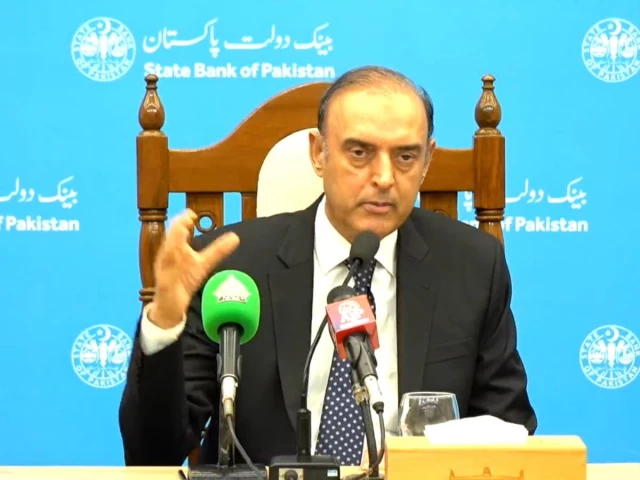
The State Bank of Pakistan’s Monetary Policy Committee voted nine to one on Monday to lift the policy rate from 11.5%, effective Oct. 27. Governor Jameel Ahmad told a press conference in Karachi that the dissenting member wanted a bigger move. “While one member held a different view and favoured a larger increase,” he said.
The decision matched the expectations of most market participants. A Topline Securities poll found 61% of respondents expected a hike, with 54% forecasting 50 basis points and 7% forecasting 100. The remaining 39% expected no change. Topline said the bank had acted “in line with our expectations.”
The committee said the conflict is the main driver. It noted that “the intensification in the Middle East conflict, and low prospects of its near-term resolution, are keeping global energy prices at persistently elevated levels.” Brent crude climbed back above $100 a barrel on Sept. 9 for the first time since July 24, as hopes faded for a lasting resolution to the US-Iran conflict that began on Feb. 28. Ahmad said prices have hovered around that level.
The statement said the hit to the domestic economy “has remained contained so far amidst proactive monetary policy adjustment and continued fiscal discipline.” It added that “geopolitical developments have worsened the inflation outlook as compared to the earlier assessment.”
The committee called the increase “necessary to keep inflation expectations anchored, contain second-round effects of the ongoing supply shock, and bring inflation within the target range” of 5% to 7%. In the inflation section, it said the move was important “to keep the real policy rate adequately positive on forward-looking basis.”
Inflation Pressure
Consumer prices rose 10.26% in September from a year earlier, easing from 11.15% in August but far above the 5.76% a year before. The statement said the reading “turned out higher than the MPC’s expectation.” Core inflation has “steadied at an elevated level of around 8.4 percent”. Headline inflation had returned to double digits in April at 10.9%, exceeding official projections. Wholesale inflation accelerated to 13.33% in September, its strongest reading in five months.
The committee named “the re-escalation in the Middle East conflict and domestic wheat supply frictions” as the two major factors keeping inflation elevated. It also warned that “there is a risk that elevated food and energy inflation may further increase inflation expectations, which may seep into core inflation going forward.”
Ahmad cited the same pressures. “The inflation outlook deteriorated significantly because of the ongoing geopolitical crisis, including the US-Iran conflict, and other developments in the Middle East,” he said and added that wheat prices had risen over the past two to three months. Earlier assessments in July and August had pointed to inflation of around 7% toward the end of the year, he said, but getting back to that level will now take longer.
The statement flagged risks from “geopolitical tensions, global commodity price volatility, unanticipated adjustments in energy tariffs, further uptick in wheat and allied product prices, and adverse weather conditions.”
External Accounts
The current-account deficit was $874 million in the July-September quarter. The bank still expects the full-year gap to stay within 0% to 1% of gross domestic product. “The good thing is that its impact is still between zero and one percent of GDP and it will stay between that,” Ahmad said.
Remittances reached $10.9 billion in the quarter, and the governor said the bank raised its full-year forecast to $45 billion from $44 billion. He said exports are improving but not yet at the pace the economy needs, with projected shipments of $32.5 billion to $33 billion this fiscal year. Imports are expected to reach about $71 billion. The statement said imports “are also rising sharply, led by non-energy imports, in line with the recovery in economic activity and higher prices.”
The central bank’s reserves held at about $21.5 billion, equal to three months of import cover. They stood at about $15.8 billion in late April. The statement cited “continued FX purchases” as the support.
Growth and Fiscal Picture
The committee said economic activity “has started to recover gradually.” Large-scale manufacturing grew 1.9% in July-August from a year earlier, compared with 0.4% in the previous April-June quarter. Private-sector credit growth reached 14.1%, and broad money growth quickened to 12.7%. The bank kept its growth projection for the fiscal year ending June 30 at 3.5% to 4.5%, while warning of risks “from further intensification in the Middle East conflict, as well as from adverse climate events amidst worsening El Niño conditions.”
Federal Board of Revenue collections rose 7% in the first quarter, beating the target by 33 billion rupees. The statement said that “the intensification in the Middle East conflict has made fiscal management more challenging,” and urged broadening the tax base and faster structural reforms. It stressed “the importance of increasing external and fiscal buffers to further strengthen the economy’s resilience.”
The decision follows a staff-level agreement with the International Monetary Fund on Oct. 8 covering the fourth review of the Extended Fund Facility and the third review of the Resilience and Sustainability Facility, which would unlock about $1.2 billion once the IMF board signs off.
The bank raised its rate by 100 basis points to 11.5% on April 27, its first hike in almost three years. It had cut rates from a 22% peak to 10.5% by December 2025. It then held at 11.5% in June, July and September. Yields had already drifted above the old policy rate. Cut-off yields on fixed-rate government bonds ranged around 12.4% to 12.5% for two- to 10-year maturities as of the end of September.
Analysts have flagged Pakistan as among the countries most exposed to the global energy shock, given its reliance on Gulf liquefied natural gas, its history of high inflation and its balance-of-payments weaknesses. The IMF said last week that fiscal policy should go beyond meeting primary-balance targets and protecting debt sustainability.
Some economists saw a case for moving early. Foundation Securities, which had forecast the 50-basis-point increase, argued that “persistent above-target inflation driven by oil price volatility amid war in the Middle East, rising inflation expectations, a thin real interest rate and a pickup in growth argue for a measured, pre-emptive hike.” It estimated the move would lift the real interest rate to about 2.5% on its October inflation estimate, from about 1.2% in September.
The Pakistan Institute of Development Economics had urged the bank to hold. “While the balance of risks has shifted toward tightening, current macroeconomic conditions do not yet establish a compelling case for an immediate rate increase,” it said, adding that the evidence did not yet show “generalised demand overheating or sufficiently broad-based second-round inflation pressures.”
Copyright © 2021 Independent Pakistan | All rights reserved