By Staff Reporter
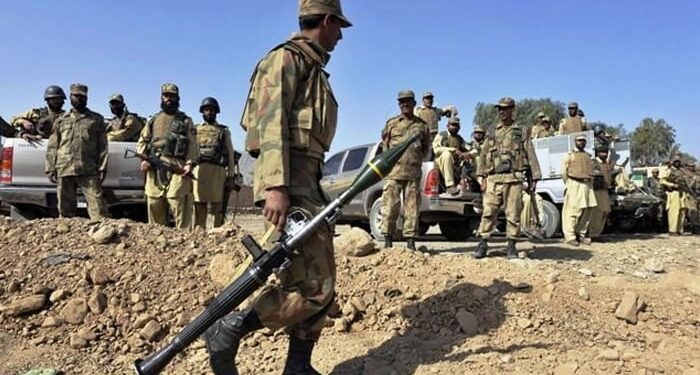
ISLAMABAD: In a series of sharp counterterrorism operations along restive border regions, Pakistani security forces killed 22 militants on Wednesday night and Thursday, the military said, dealing a significant blow to the banned Tehreek-i-Taliban Pakistan by eliminating its second-in-command.
The operations, which unfolded in Khyber Pakhtunkhwa and Balochistan provinces, came amid heightened tensions with neighboring Afghanistan, where Islamabad accuses the Taliban government of harboring anti-Pakistan militants.
Among the dead was Amjad, who used the alias Mazahim and served as deputy to the group’s leader, Noor Wali Mehsud, while heading its Rehbari Shura, or leadership council. Amjad, a resident of Lower Dir district in Khyber Pakhtunkhwa, carried a bounty of Rs5 million, and had been placed on a United States terrorism list in December 2022. The military described him as “actively involved” in orchestrating attacks from Afghan soil.
The most prominent strike occurred in Bajaur district of Khyber Pakhtunkhwa, where troops detected a group “attempting to cross into Pakistan” on the night of Oct. 29-30. In what the Inter-Services Public Relations, the military’s media wing, called “precise and skillful engagement,” four militants were killed, including Amjad. “Efficiently engaged and thwarted,” the effort was, according to an ISPR statement.
The action followed a separate intelligence-based operation a day earlier in Kurram district’s Dogar area, where seven militants were killed, part of a broader push that the military framed as disrupting infiltration bids orchestrated from Afghanistan. “It is pertinent to highlight that the leadership of Fitna al-Khawarij (TTP) while residing in Afghanistan is orchestrating infiltration attempts into Pakistan, primarily to project an impression of domestic presence and to raise the diminishing morale of their khwarij in Bajaur and Mohmand because of effective operations of security forces,” the ISPR said.
The statement urged the Afghan interim government to take “concrete measures” to prevent its territory from being used for cross-border terrorism. A “sanitisation operation” continues in the area to eliminate any remaining militants, the military added, vowing to press forward under “Azm-i-Istehkam,” a national counterterrorism campaign approved by the Federal Apex Committee on the National Action Plan.
The TTP confirmed Amjad’s death, according to a report by BBC Urdu, underscoring his influence within the group.
In Balochistan, two intelligence-based operations yielded 18 more deaths. In the Chiltan Mountains southwest of Quetta, troops targeted suspected hideouts, killing 14 militants after “an intense exchange of fire. “Further south, in the Buleda area of Kech district, security forces “busted” a hideout and “successfully neutralised” four others. “Weapons, ammunition and explosives were also recovered from the killed terrorists, who remained actively involved in numerous terrorist activities,” the ISPR reported.
Balochistan Chief Minister Sarfraz Bugti hailed the results. “These operations are proof that the state institutions are fully mobilised and united to protect the peace and national stability of Balochistan,” he said. He praised the forces’ “bravery, determination and professionalism” and their commitment to eradicating terrorism under a “vision of determination for stability.” Bugti emphasised that “the intentions of the enemies of peace in Balochistan would never succeed,” vowing to dismantle “terrorist networks running under Indian patronage” and restore lasting peace and development.
The operations coincided with pointed criticism from Field Marshal Asim Munir, the chief of army staff, who accused the Taliban regime in Kabul of abetting attacks on Pakistan despite Islamabad’s repeated overtures. Speaking during a visit to Peshawar, where he met with a jirga, or council, of tribal elders, Field Marshal Munir said the Taliban had provided “all possible assistance” to militant groups.
“Despite the continued cross-border militancy from Afghanistan, Pakistan, over the last few years, exercised patience and extended multiple diplomatic and economic overtures to Afghanistan aimed at improving Pak Afghan bilateral relations,” he said, according to an ISPR statement.
Pakistan “sought peace with all its neighbours, including Kabul, but would not allow cross-border militancy to be perpetrated from Afghan soil against Pakistan,” the field marshal added. He charged that instead of acting against “India-sponsored terror proxies Fitna Al Khwarij and Fitna Al Hindustan,” the Afghan Taliban had aided them, terms the Pakistani state uses for the TTP and Balochistan-based insurgents, respectively, to invoke their alleged foreign backing.
The tribal leaders, in turn, “reiterated their full support to the armed forces against militancy and also against the Afghan Taliban,” the statement said. They declared the militants’ “twisted ideology” had “no acceptance” among the tribes and expressed an “unwavering commitment to peace in Pakistan.”
Copyright © 2021 Independent Pakistan | All rights reserved