By Staff Reporter
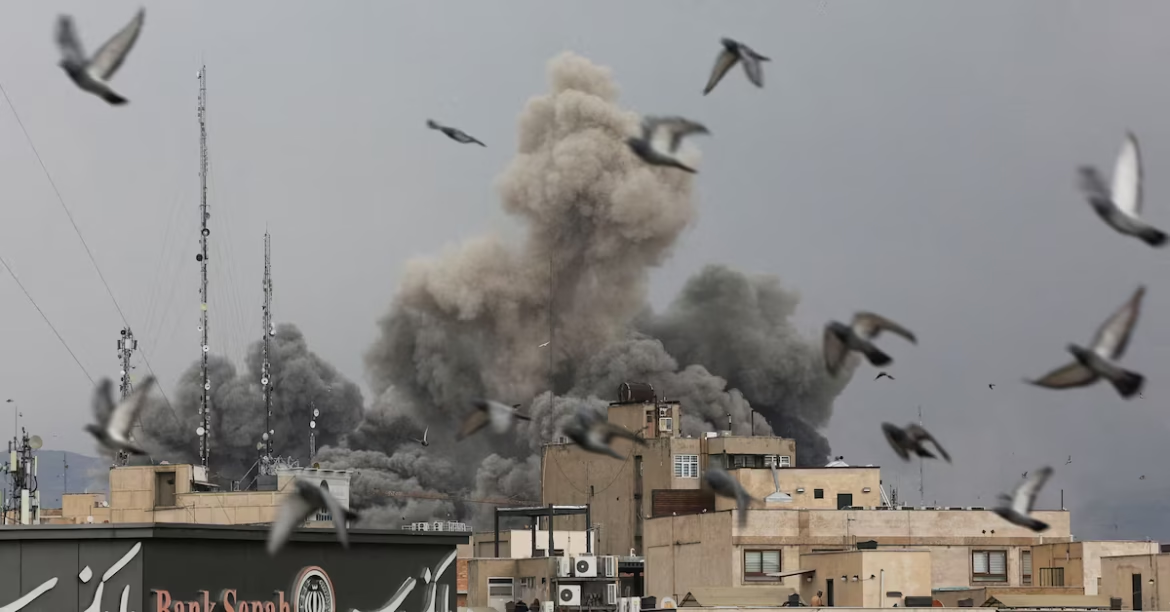
The United States and Iran are, by all credible accounts, about to sit down face to face for the first time since this war began. Germany’s foreign minister, Johann Wadephul said a direct meeting is expected “very soon” in Pakistan. Hours earlier, President Trump’s special envoy Steve Witkoff confirmed that Pakistan had delivered Washington’s 15-point peace plan to Tehran. These are not rumors; they are the first concrete signs that diplomacy may still have a chance to end a conflict that has already killed thousands, closed the Strait of Hormuz – the lifeline of global economy and pushed the Middle East to the brink of a wider conflagration.
Yet the path to those talks is littered with land mines. Unless Washington, Tehran and their respective patrons make painful concessions now, Pakistan’s mediation will collapse, Saudi Arabia and the United Arab Emirates will escalate, and the war will drag on — with American troops potentially bogged down on Kharg Island and global energy markets in free fall. The United States has a narrow window to seize this off-ramp. It should take it, even if that means accepting less than total victory. Islamabad has quietly relayed messages for weeks; its foreign minister has noted parallel efforts by Turkey and Egypt. But mediation alone will not suffice. The American 15-point plan, as described by officials close to the talks, is a non-starter in its current form. It demands the effective dismantling of Iran’s nuclear program, drastic curbs on its missile arsenal and international control over the Strait of Hormuz. Iranian officials have reviewed it and concluded, not unreasonably, that it serves only American and Israeli interests. Tehran has sent its own counter-proposals and insists publicly that it is not negotiating directly. The Revolutionary Guard has reiterated its blockade of shipping to or from ports of “allies and supporters of the Israeli-American enemies.” These are not tactical feints; they reflect a regime that, though bloodied and leaderless, still believes it can outlast Washington.
The Gulf monarchies are also pushing in the opposite direction. Saudi Arabia has urged the United States not merely to continue the campaign but to intensify it. A Saudi intelligence source confirmed what The New York Times first reported: Crown Prince Mohammed bin Salman told Trump that the war represents a “historic opportunity” to remake the Middle East. The president himself called the crown prince “a warrior” fighting alongside America. Riyadh has not yet committed troops, but analysts close to the kingdom warn that failure of the Pakistani track will cross a red line. “If Iran rejects the conditions and continues its attacks,” said Mohammed Alhamed, a Middle East analyst, “the threshold for Saudi action will be crossed.” This is not impulsive saber-rattling. Saudi Arabia and Iran have been regional rivals for decades, each claiming leadership of the Sunni and Shiite worlds. A 2008 State Department cable quoted King Abdullah urging Washington to “cut off the head of the snake.” After Iranian missiles struck Saudi facilities in 2019 and the first Trump administration failed to retaliate, Riyadh pivoted toward détente, sealing a China-brokered agreement with Tehran in 2023. That bet has now been upended. Iranian drones have already hit the Red Sea port of Yanbu; if the Houthis join with their own missiles, Saudi Arabia’s alternative export route will be in jeopardy. The United Arab Emirates has been even more explicit. Ambassador Yousef Al Otaiba wrote in The Wall Street Journal that a simple cease-fire is insufficient; Tehran must suffer a conclusive defeat. The Emiratis, their own oil exports throttled, see no middle ground. Saudi Arabia, with its Red Sea pipeline, has more to lose from deeper entanglement and has so far avoided overt calls for expanded bombing. But Ellie Geranmayeh of the European Council on Foreign Relations is right: once the bombs stop, Riyadh will have to rethink its security dependence on Washington. The kingdom has lost its wager that Iran would not lash out; it is now deciding whether to double down.
President Trump has kept military pressure alive even while praising diplomatic progress. American forces have already struck Kharg Island, which handles 90 percent of Iran’s oil exports. The administration is weighing a ground assault involving Marines and airborne troops. Analysts at the Foundation for Defense of Democracies argue that seizing and holding the island would more likely expand and prolong the war than end it, handing Iran graphic propaganda victories via drone footage of American casualties. Trump sees Kharg as leverage to force reopening of the strait. Tehran’s likely response — more mines, coastal attacks, possibly Houthi coordination — would turn the Gulf into a maritime killing zone. These military options make genuine negotiation harder. Iran has every incentive to play for time and portray concessions as surrender. The United States, facing midterm elections and domestic war fatigue, wants a deal that looks like victory. History shows that neither side gets what it wants without giving something it would rather keep.
For the talks in Pakistan to succeed, three hard truths must be accepted. First, the 15-point plan must become a basis for bargaining, not an ultimatum. Iran will never accept effective capitulation on its nuclear and missile programs. Washington cannot tolerate indefinite closure of the strait. A realistic compromise would include verifiable limits on uranium enrichment, monitored missile restraints and a phased reopening of Hormuz linked to targeted sanctions relief and security guarantees for Gulf shipping. Anything less invites stalemate. Second, the Gulf states cannot be relegated to the sidelines. Saudi Arabia and the United Arab Emirates have legitimate security fears rooted in decades of Iranian provocations. Excluding them risks a separate escalation track. Riyadh and Abu Dhabi should be brought into parallel or trilateral discussions. Their buy-in is essential for any deal to hold beyond the first missile exchange. Third, the talks must address the war’s immediate human and economic costs. Millions across the region depend on desalinated water and reliable electricity; fertilizer prices have spiked, threatening food security. A short humanitarian pause allowing limited oil flows could build confidence without signaling weakness.
None of this will be easy. Mistrust is profound. Iran continues to arrest alleged spies for Israel and the United States. Washington still weighs ground operations on Kharg. Saudi Arabia keeps its options open. European powers are raising alarms about Russian assistance to Iran in the form of satellite imagery and drone upgrades. Yet the alternative is worse: deeper Saudi and Emirati involvement, Houthi escalation, a prolonged blockade and an energy crisis that punishes every economy from Karachi to Kansas City. The United States now faces a choice. It can treat Pakistan’s role as a face-saving venue to dictate terms, in which case the talks will fail and the war will widen. Or it can treat Islamabad as the last viable bridge, accept that total victory is illusory and negotiate the best achievable outcome: a degraded but not destroyed Iran, a reopened strait, verifiable limits on Tehran’s most dangerous programs and a regional security framework that gives Saudi Arabia and the Emirates reason to stand down. That outcome will not satisfy the hawks in Washington, Riyadh or Jerusalem. It will not satisfy the hard-liners in Tehran. But it may spare the region — and the Iranian public — the far greater costs of a war that neither side can afford to win outright. The window is closing. If the United States and Iran walk away from the table in Pakistan, they will have only themselves to blame when the next escalation arrives.
Copyright © 2021 Independent Pakistan | All rights reserved