By Staff Reporter
ISLAMABAD: The Supreme Court of Pakistan has ruled that the Pakistan Army Act (PAA) of 1952, while providing due process protections, falls short of constitutional standards by denying civilians tried in military courts an independent right to appeal in civilian courts.
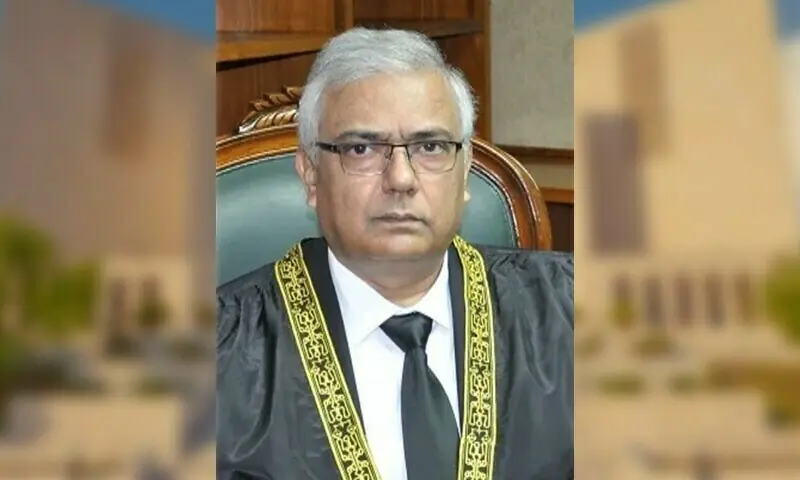
In a detailed 68-page judgment, Justice Aminuddin Khan called for legislative action to address this gap, giving parliament 45 days to enact reforms. The ruling elaborates on a May 7 short order that resolved 38 intra-court appeals challenging an October 23, 2023, decision invalidating key PAA provisions allowing military trials of civilians.
Justice Khan emphasized the need for amendments to ensure appeal rights in high courts for convictions under Section 2(1)(d)(i) and (ii) and Section 59(4) of the PAA. “The absence of an independent right of appeal to a civilian court has rendered its application to civilians constitutionally incomplete,” he wrote.
The Constitutional Bench referred the issue to parliament, expecting lawmakers to respect this “institutional deference” and pass legislation within 45 days. Justice Khan stressed that a fair trial requires an impartial forum governed by transparent rules. He found that the PAA, when applied within statutory limits and with procedural safeguards, meets constitutional fairness standards.
On May 7, a seven-judge Constitutional Bench, by a 5-2 majority, restored PAA provisions used to convict civilians for their roles in the May 9, 2023, arson attacks on military installations. The decision overturned the October 2023 ruling, which had struck down those provisions by a 4-1 margin.
Justice Khan criticized the earlier ruling’s use of the “reading down” interpretive technique, calling it inappropriate. “The doctrine of reading down was a tool of judicial restraint designed to preserve the constitutionality of statutes by construing them narrowly in case of ambiguity,” he wrote.
The October 2023 order, he argued, misused this approach to override the clear text of Article 8(3)(a), substituting “judicial preference for constitutional command.” This, he said, crossed into the realm of constitutional amendment, stressing, “The judicial function is to interpret, not to legislate.”
Article 8(3)(a), Justice Khan noted, explicitly exempts laws governing the armed forces for discipline and duty from fundamental rights protections, reflecting a deliberate choice by the Constitution’s framers.
He dismissed the application of Article 8(5), which addresses rights suspensions during emergencies, as “doctrinally and textually unsound” in this context. Article 8(3)(a), he added, recognizes a parallel regime for military discipline, reinforced by Article 245, which empowers the armed forces to defend Pakistan and assist civil authorities.
Military courts’ jurisdiction over civilians, he concluded, does not violate the constitutional separation of powers under Article 175(3).
In a concurring note, Justice Muhammad Ali Mazhar observed that trying civilians for specific offences under Section 2(d)(i) and (ii) of the PAA is not new. “It is a ground reality that the provisions of PAA extending jurisdiction to certain civilians have stood connected appeals for several decades, receiving the tacit approval of successive legislatures and the silent acquiescence of the Supreme Court,” he wrote.
These provisions, he noted, went unchallenged until the May 9, 2023, unrest, when civilian prosecutions under the PAA gained public and political attention.
Justice Mazhar questioned whether the law itself is flawed or if recent scrutiny reflects a “sudden urgency” at odds with decades of acceptance.
The ruling follows heated debate over military courts’ role in Pakistan’s justice system, intensified by the 2023 protests and attacks on military sites after the arrest of former prime minister Imran Khan. Critics argue that military trials of civilians undermine democratic principles, while supporters cite national security imperatives.
Copyright © 2021 Independent Pakistan | All rights reserved