By Staff Reporter
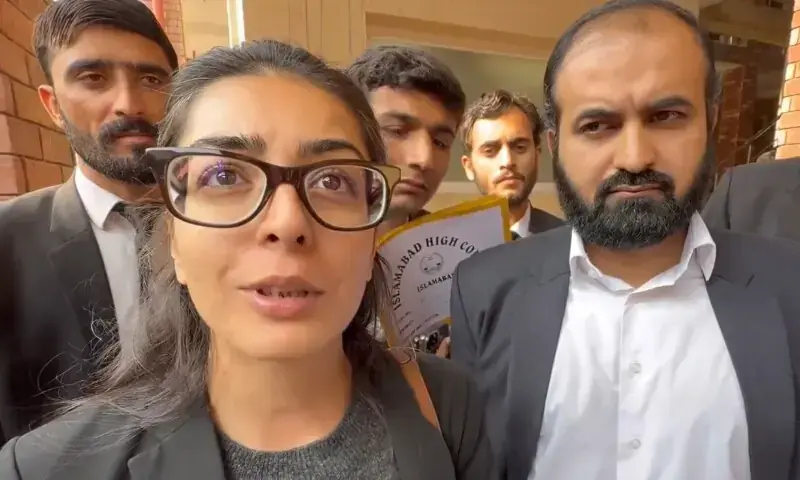
ISLAMABAD: The Supreme Court of Pakistan is set to hear an urgent plea on Thursday from human rights lawyer Imaan Zainab Mazari-Hazir, who is seeking to halt her ongoing trial in a high-profile case involving controversial social media posts that allegedly incited linguistic divisions and portrayed the armed forces as engaged in terrorism.
The three-judge bench, led by Justice Muhammad Hashim Khan Kakar and including Justices Salahuddin Panwhar and Ishtiaq Ibrahim, will consider Mazari’s application for an early hearing of her appeal against a lower court’s refusal to grant interim relief. The move comes as the trial against Mazari and her husband, Hadi Ali Chatha, nears its conclusion in an Islamabad court, raising concerns about potential violations of due process and fair trial rights.
Mazari and Chatha, represented by counsel Faisal Siddiqi, filed the appeal after the Islamabad High Court on Dec. 1 denied their request for ad-interim relief to stay the proceedings. In a subsequent application submitted Dec. 4, the couple argued that the criminal trial before an additional sessions judge and special judge under the Prevention of Electronic Crimes Act (PECA) of 2016 was at its final stages, demanding immediate Supreme Court intervention.
“The criminal trial is at its concluding stage, the balance of convenience is in favour of the petitioners because the prosecution would not be prejudiced if the trial is delayed for two weeks,” the application stated. The petitioners contended that evidence had been recorded in their absence, violating Section 353 of the Code of Criminal Procedure (CrPC), which requires evidence to be taken in the presence of the accused, as well as their constitutional rights to due process and a fair trial under Article 10A.
They also filed a criminal revision before the Islamabad High Court challenging the trial proceedings on similar grounds, but warned that without a stay, that effort would become moot. “It is obvious and apparent that this unfair trial is leading to a criminal conviction of the petitioners,” the application said.
Court documents highlighted a Nov. 29 order from the additional sessions judge indicating the trial had reached the stage of recording statements under Section 342 of the CrPC, which allows examination of the accused. “There was a clear and present danger that this trial would lead to the criminal conviction of the petitioners. Thus, the present criminal appeal will become infructuous,” the filing argued. Invoking Section 7 of the Supreme Court (Practice and Procedure) Act of 2023, the application noted that urgent pleas must be scheduled within 14 days. It emphasized the case’s implications for the petitioners’ liberty, aligning with the court’s policy on prioritizing such matters. “Failing an urgency being allowed by this court, the interest of justice will seriously be prejudiced and irreparable loss would be caused to the petitioners in the form of possible criminal convictions,” it stated.
The case stems from a complaint filed by the National Cyber Crime Investigation Agency (NCCIA), which accused Mazari of disseminating and “propagated narratives that align with hostile terrorist groups and proscribed organisations” through posts on the social media platform X, some dating back to 2021. Chatha was implicated for reposting some of his wife’s content, with allegations that the posts sought to incite divisions on linguistic grounds and create the impression that the armed forces were involved in terrorism within the country.
Additional District and Sessions Judge Muhammad Afzal Majoka indicted the couple earlier this year; both denied the charges. According to the appeal, the complaint lacked specific allegations and relied on cherry-picked posts without broader context. Mazari, a prominent advocate known for her work on human rights and civil liberties, and Chatha have maintained that the proceedings infringe on fundamental rights. Without Supreme Court action, they argued, not only would their revision application before the high court be rendered unnecessary, but they would suffer irreparable harm from what they described as procedural flaws leading inexorably to conviction. The hearing on Thursday could determine whether the trial is paused, potentially reshaping the trajectory of a case that has drawn scrutiny over the application of cybercrime laws in Pakistan amid broader debates on free speech and judicial fairness.
Copyright © 2021 Independent Pakistan | All rights reserved