By Staff Reporter
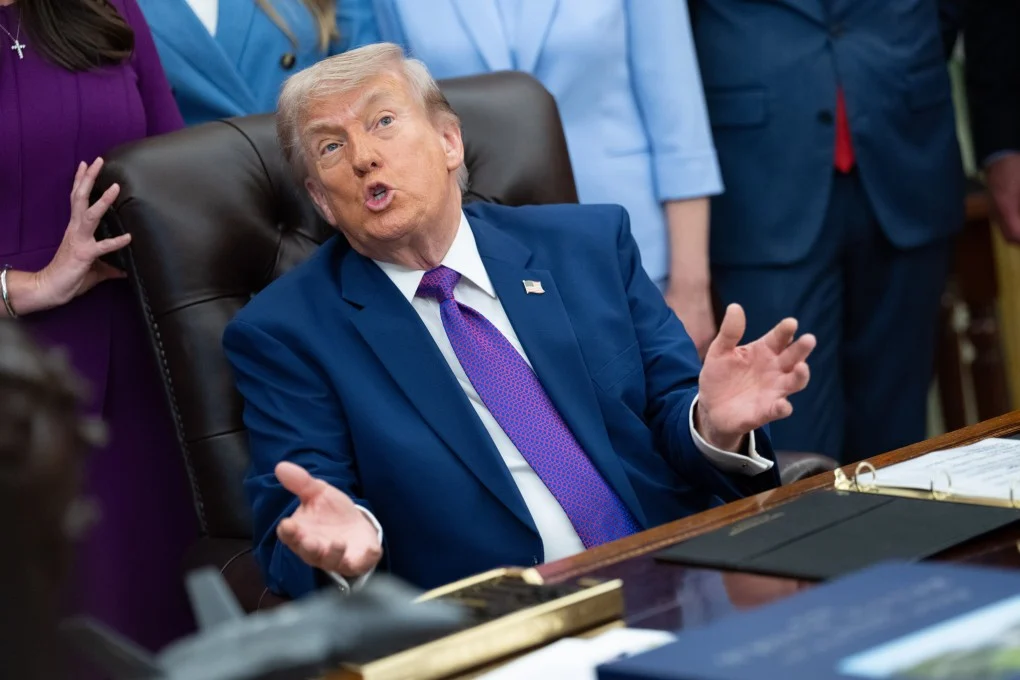
ISLAMABAD: US President Trump convened an emergency meeting in the White House Situation Room on Friday to weigh what he described as a sweeping agreement with Iran — one that would demand Tehran permanently renounce nuclear weapons, reopen the Strait of Hormuz to unrestricted shipping, and allow American forces to unearth and destroy the Islamic Republic’s stockpile of highly enriched uranium.
Iranian officials, speaking with barely concealed contempt, said no such deal exists.
The yawning gap between the two governments’ accounts — one triumphalist, the other dismissive — threw into sharp relief the fragility of a diplomatic process that has lurched forward in fits and starts since a ceasefire halted seven weeks of open warfare between the United States, Israel, and Iran. With the truce’s future uncertain and global oil markets rattled, Friday became a test of whether Trump’s signature brand of pressure-as-negotiation could be converted into an actual accord — or whether it would collapse, again, under the weight of its own contradictions.
“I will be meeting now, in the Situation Room, to make a final determination,” Trump posted on Truth Social, framing what appeared to be an ongoing negotiation as a fait accompli requiring only his signature of approval. He added that ships trapped in the strait by Iran’s effective closure of the waterway “may start the process of heading home,” and offered a personal message to their crews: “Say HELLO to your wives, husbands, parents, and families from me, your favorite President!”
The bravado was not matched in Tehran.
Iran’s Foreign Ministry spokesman, Esmaeil Baqaei, told state television that “exchanges of messages are continuing, but no final agreement has been reached yet.” The semi-official Tasnim news agency said Trump’s announcement was “in line with his usual pattern of making unilateral and egotistical statements.” The Fars news agency, citing sources close to the government, said Trump had published a “mixture of truth and lies” — that the memorandum of understanding between the two sides contained no provision to destroy Iranian nuclear material, no agreement to open the strait without fees, and that Trump had essentially drafted his own wish list and presented it as a completed negotiation.
The framework under discussion, according to American officials who spoke on condition of anonymity, would extend the ceasefire by 60 days and launch formal talks on the long-term future of Iran’s nuclear program. The proposed agreement would also prohibit Iran from imposing tolls on the Strait of Hormuz and require Tehran to remove all sea mines from the waterway within 30 days. In exchange, Washington would gradually lift its naval blockade on Iranian ports and ease sanctions, allowing Iran to sell more oil on global markets.
One element that has emerged from back-channel diplomacy is the fate of Iran’s uranium stockpile. The International Atomic Energy Agency estimates Iran holds roughly 441 kilograms of uranium enriched to 60 percent purity — a technical step away from weapons-grade levels. Kazakhstan has signaled it may be willing to accept the stockpile if a deal is reached, according to IAEA Director General Rafael Grossi, who disclosed the offer to the Financial Times. Senior Iranian officials, however, flatly denied any intention to transfer the material to a third country. Ebrahim Azizi, chairman of the Iranian parliament’s national security and foreign policy commission, said the Islamic Republic “has no intention of handing over or transferring these materials.”
The contradictions extended to the Strait of Hormuz itself. Trump demanded the waterway be reopened immediately, free of tolls and mines. Iranian officials said the strait’s management — including the collection of fees — was Tehran’s sovereign prerogative, and that the wider world had already accepted as much. Ebrahim Rezaei, the spokesman for the same parliamentary commission, was more pointed: “The only one who hasn’t believed it, or doesn’t want to believe it, is Trump; every now and then he sends his army to open the strait, they come and get beaten and go back.”
Iran shut the strait — through which roughly a fifth of the world’s oil and gas typically flows — after the United States and Israel launched a surprise military offensive on Feb. 28 that killed Iran’s supreme leader and decimated its senior military and political leadership. The closure sent fuel prices surging across the globe and helped push economies into turmoil. Some commercial traffic has resumed in recent weeks, with Iranian authorities allowing roughly two dozen vessels daily through the waterway — a fraction of the more than 100 ships that passed each day before the war — while charging tolls and dispatching Islamic Revolutionary Guard Corps naval escorts.
Washington responded this week with a new round of sanctions targeting the Iranian gatekeeper agency set up to manage the transit process.
On Thursday night, Vice President JD Vance had offered a carefully hedged assessment of where talks stood. Negotiators were working through “a couple of language points,” he said, particularly around the question of uranium enrichment. “We’re not there yet, but we’re very close and we’re going to keep on working at it.” He also acknowledged that the war’s legacy on Iran’s nuclear program would be incomplete at best: rather than eliminating that program, the United States was now seeking to “substantially set back” it — not just during Trump’s term, he said, but “over the long term.”
That formulation was notably less ambitious than the maximalist demands Trump laid out in his Friday post, which called for Iran to commit that it would “never” possess a nuclear weapon or bomb — a threshold Iranian officials have repeatedly said is not on the table.
“Why should we commit to America that we will not build a nuclear weapon?” Rezaei said in a televised interview. “This matter is none of America’s business.”
The man leading Iran’s negotiating team offered the sharpest assessment of the moment’s stakes. Mohammad Bagher Qalibaf, a former military commander and longtime political figure who serves as Iran’s chief negotiator, posted a statement on social media Friday that doubled as a warning. “No trust in guarantees or words — only actions are the measure,” he wrote. “No step will be taken before the other side acts.”
Then, ominously: “We do not gain concessions through talks, but through missiles. The winner of any agreement is the one who is better prepared for war from the day after.”
Iran’s president, Mahmoud Pezeshkian, adopted a markedly different register — thanking Pakistani mediators for their efforts and speaking by phone with Pakistani Prime Minister Shahbaz Sharif. Pakistani Foreign Minister Ishaq Dar traveled to Washington on Friday for a separate meeting with Secretary of State Marco Rubio, underscoring Islamabad’s role as a crucial back-channel in the talks.
The diplomatic complexity is compounded by Israel, whose cooperation Trump may need to secure any sustainable ceasefire. Israeli Prime Minister Benjamin Netanyahu has not explicitly endorsed the deal and spent much of the week intensifying military operations in Lebanon, where Israeli forces have pushed deep into Hezbollah-controlled territory. Israeli strikes have killed more than 3,200 people in Lebanon, according to the Lebanese Health Ministry, and displaced hundreds of thousands more. Israel says it has lost 23 soldiers and four civilians in the same period.
Netanyahu did not comment on the Iran deal Friday. Instead, he issued a battlefield update: “Our forces have crossed the Litani and advanced into strategic areas. We are operating in Beirut, in the Bekaa Valley, and across the entire front.”
Iran wants any deal to include a halt to the Israeli campaign in Lebanon. That demand — threading together the Iran ceasefire, the Hezbollah front, and the question of nuclear weapons — has given the negotiations a complexity that has repeatedly frustrated progress even as both sides profess to want an end to the fighting.
Since the ceasefire took effect on April 8, Trump has returned again and again to the theme of imminent agreement, only to see the moment pass. Accusations of ceasefire violations have flown in both directions. Full-scale hostilities have not resumed, but neither has anything approaching normalcy. Oil prices fell and stock markets rose Friday on the possibility of a deal — a market vote of confidence in optimism that the two governments’ own officials seemed reluctant to share.
Copyright © 2021 Independent Pakistan | All rights reserved