By Staff Reporter
ISLAMABAD: US President Donald Trump announced on Tuesday evening that the United States would temporarily halt its newly launched naval operation to escort stranded commercial vessels through the Strait of Hormuz, saying the pause would allow time for negotiations toward a broader agreement to end the conflict with Iran.
The decision, disclosed by Trump in a post on social media, came just one day after the Pentagon began what it called Project Freedom, an effort to reopen the narrow waterway that carries about one-fifth of the world’s oil and liquefied natural gas.
Trump said the pause was prompted by a request from Pakistan, which has served as an intermediary between Washington and Tehran, as well as by what he described as “tremendous Military Success” in the campaign against Iran and “Great Progress” toward “a Complete and Final Agreement.”
The White House did not immediately provide additional details about the state of the talks, which have largely been conducted through back-channel messages and appeared stalled despite a fragile ceasefire that took hold nearly a month ago.
The announcement marked a sudden shift in tone after a day of forceful public statements from senior administration officials who had portrayed the operation as essential to restoring freedom of navigation and protecting civilian mariners. It also drew immediate claims of victory from Iranian state media, which portrayed the pause as evidence that Trump had “retreated” in the face of Tehran’s resistance.
US Secretary of State Marco Rubio, speaking to reporters at the White House earlier on Tuesday, had said the operation was strictly defensive, and the administration still preferred a diplomatic path. “We would prefer the path of peace,” Rubio said. “What the president would prefer is a deal.”
Rubio, however, blamed Iran for not choosing that route. “That is so far not the route that Iran has chosen,” he said. “What that may lead to in the future is speculative.”
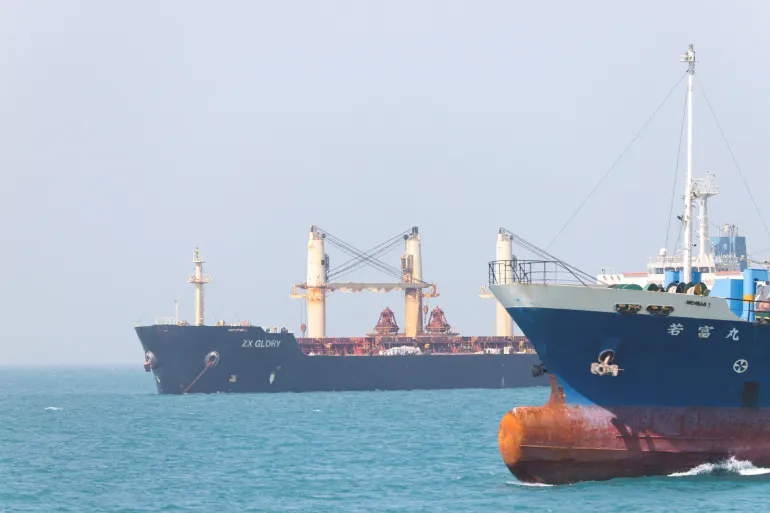
The operation to reopen the strait began on Monday after weeks of mounting economic pressure from Iran’s effective closure of the waterway. US officials said American forces had established a protected lane through the southern portion of the strait, in Omani territorial waters, and had sunk six Iranian fast-attack boats that threatened commercial shipping. Only two merchant vessels — both US-flagged — were known to have transited the new route under the operation, including a vehicle carrier operated by the Danish shipping giant Maersk that exited safely with U.S. military assistance.
Hundreds of other ships remain bottled up in the Persian Gulf, their crews described by Rubio as “sitting ducks, isolated, starving, vulnerable.” At least 10 sailors have already died as a result of the disruptions, he said.
Iran disputed the American account of Monday’s clashes, saying two small civilian cargo boats were hit, killing five civilians. Tehran has insisted that any vessel seeking to pass through the strait must use a northern route along its coastline, submit to inspection by the Islamic Revolutionary Guard Corps, and, in some cases, pay a fee.
The Trump administration has maintained that its actions are separate from a broader naval blockade imposed on Iranian ports in mid-April, which remains in place. That blockade has deprived Tehran of crucial oil revenue needed to stabilise its economy, which US officials say has suffered “generational destruction” from earlier American and Israeli strikes.
The pause in Project Freedom came hours after Rubio, US Defence Secretary Pete Hegseth and Gen. Dan Caine, chairman of the Joint Chiefs of Staff, told reporters that the initial phase of the US-Israeli military campaign against Iran — known as Operation Epic Fury — had achieved its objectives and was effectively over.
Operation Epic Fury began Feb. 28 with a wave of airstrikes on Iranian targets. Iran responded by blocking the Strait of Hormuz, firing missiles and drones at Gulf states and harassing commercial shipping. A ceasefire announced in early April halted major Iranian attacks on U.S. allies, including the United Arab Emirates, but few vessels have managed to transit the strait since then.
On Tuesday, Hegseth said the ceasefire “certainly holds” but that the United States would continue to watch closely. Caine described recent Iranian actions against US forces — more than 10 since the truce began — as “below the threshold” that would trigger a return to full-scale combat. “Right now the ceasefire certainly holds, but we’re going to be watching very, very closely,” Hegseth said.
Late Tuesday, the British military’s United Kingdom Maritime Trade Operations reported that a cargo vessel had been struck by an unknown projectile in the strait. Details were not immediately available.
The United Arab Emirates, a close US and Israel partner, said its air defences had engaged Iranian drones and missiles for a second consecutive day. On Monday, Emirati forces intercepted 15 missiles and four drones; one strike sparked a fire at an oil facility in Fujairah, outside the strait, wounding three Indian nationals. British authorities reported two cargo vessels ablaze off the UAE coast that day. Iran denied carrying out the attacks, with a military spokesman saying that “if such an action had been taken, we would have announced it firmly and clearly.”
Iran’s parliament speaker and chief negotiator, Mohammad Bagher Qalibaf, signalled continued defiance. “We know full well that the continuation of the status quo is intolerable for America; while we have not even begun yet,” he wrote on X. In an earlier statement, he said shipping security had been jeopardised by “the US and its allies with the ceasefire violations and blockade. However, their evil acts will fail.”
Major shipping lines have so far refused to test the US-guarded route in large numbers. Hapag-Lloyd, one of the world’s largest container operators, said its risk assessment “remains unchanged” and that transits through the strait “are for the moment not possible for our ships.”
The waterway, just 21 miles wide at its narrowest point, leaves vessels vulnerable to Iranian cruise missiles, drones, fast-attack craft and mines. Former US military officers who have patrolled the area described reopening it as highly dangerous even with escorts, which the Pentagon is not currently providing to commercial traffic.
Torbjorn Soltvedt, principal Middle East analyst at the risk intelligence firm Verisk Maplecroft, said shipping and insurance companies were waiting to see how the pause played out. “For shipping companies and for insurance companies, they still have to wait and see how this plays out,” he said.
The disruptions have already sent global fuel prices soaring and rattled energy markets. Reopening the Strait would remove Iran’s primary leverage as the Trump administration presses Tehran to roll back its nuclear program.
Trump told reporters he still believed a negotiated settlement was possible and said he would discuss reopening the strait with Japanese officials. He also said he expected a positive conversation with Chinese President Xi Jinping when he visits China next week. Iranian Foreign Minister Abbas Araghchi is also scheduled to visit Beijing on Wednesday.
Copyright © 2021 Independent Pakistan | All rights reserved