By Staff Reporter
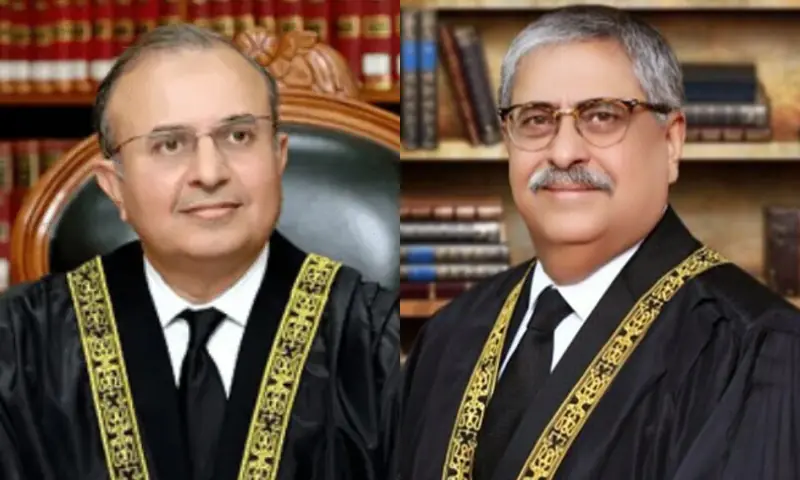
ISLAMABAD: Two of Pakistan’s most respected Supreme Court justices, Syed Mansoor Ali Shah and Athar Minallah, resigned on Thursday only hours after President Asif Ali Zardari signed into law the 27th Constitutional Amendment, a sweeping overhaul that shifts the power to interpret the Constitution from the Supreme Court to a new Federal Constitutional Court whose judges will be appointed through a process dominated by the government.
The departures, announced in separate letters that amounted to the sharpest judicial repudiation yet of legislation that senior lawyers and opposition parties have denounced as an executive power grab dressed up as judicial reform. The resignations leave the Supreme Court without two of its most independent and outspoken members at a moment when the judiciary’s very structure has been fundamentally altered.
Justice Shah, widely regarded as the most likely next chief justice before the amendment upended the seniority principle, wrote directly to the president that the new law “stands as a grave assault on the Constitution of Pakistan” that “dismantles the Supreme Court of Pakistan, subjugates the judiciary to executive control, and strikes at the very heart of our constitutional democracy.” “By fracturing the unity of the nation’s apex court,” he continued, “it has crippled judicial independence and integrity, pushing the country back by decades.”
Justice Shah warned that history showed “such a disfigurement of the constitutional order is unsustainable and will, in time, be reversed — but not before leaving deep institutional scars.” The justice said he faced a stark choice: remain on a bench whose “constitutional voice has been muted” or resign. “Staying on would not only amount to silent acquiescence in a constitutional wrong,” he wrote, “but would also mean continuing to sit in a court whose constitutional voice has been muted.”
He noted that, unlike the 26th Amendment passed last year, the Supreme Court had previously retained jurisdiction to review constitutional questions. The 27th Amendment, he said, “has stripped this court of that fundamental and critical jurisdiction and authority.”
Justice Minallah, in his own letter, was equally unsparing. Eleven years earlier, he wrote, he had taken an oath to defend “the Constitution” — not merely “a constitution.” The document he swore to protect, he declared, “is no more.” “What is left of it is a mere shadow; one that breathes neither its spirit, nor speaks the words of the people to whom it belongs.”
He lamented that the judiciary’s robes, meant to symbolise “that most noble trust,” had too often in Pakistan’s history “stood as symbols of betrayal through silence and complicity alike.”
Both justices had earlier written separately to Chief Justice Yahya Afridi urging him to summon a full-court meeting and a national judicial conference to debate the amendment’s implications. No such meeting was called. The resignations came after a whirlwind legislative process. The bill cleared the National Assembly on Wednesday with amendments and returned to the Senate on Thursday. Amid protests and walkouts by opposition senators, Chairman Yousuf Raza Gilani announced the tally: 64 votes in favor, 4 against — comfortably above the required two-thirds majority. Hours later President Zardari, co-chairman of the ruling Pakistan Peoples Party, gave his assent.
Justice Shah, 61, is a former chief justice of the Lahore High Court whose reputation for independence and intellectual rigor had made him the frontrunner to succeed Chief Justice Qazi Faez Isa before last year’s 26th Amendment changed the selection process.
Justice Minallah, 58, brings a particularly poignant personal history to his decision. The eldest son of a senior civil servant of the 1960s and 70s and son-in-law of Justice Safdar Shah — who wrote a dissenting opinion in the controversial 1979 death sentence of former prime minister Zulfikar Ali Bhutto and suffered for it under Gen. Zia ul Haq’s dictatorship — Justice Minallah once served in the customs service before resigning to join the bar.
He was a prominent figure in the 2007-2009 lawyers’ movement that restored Chief Justice Iftikhar Muhammad Chaudhry, only to later criticise the restored court for overusing its suo motu powers and neglecting ordinary litigation. He was elevated to the Supreme Court in November 2022.
Supporters of the amendment, led by the government of Prime Minister Shehbaz Sharif, insist it will reduce the Supreme Court’s crushing caseload, ensure provincial representation on constitutional benches, and deliver speedier justice. The centerpiece is the new Federal Constitutional Court, which will take exclusive jurisdiction over constitutional matters while the existing Supreme Court handles appeals and other cases.
Critics, however, point to the appointment mechanism: a 13-member parliamentary committee — eight members from the government coalition, five from the opposition — will nominate judges to the new court. The committee’s recommendations go to the president for formal appointment. Many lawyers call this a politicisation of the highest level of constitutional adjudication.
President Zardari is expected to administer the oath to the first chief justice of the Federal Constitutional Court as early as Friday at the Presidency.
Copyright © 2021 Independent Pakistan | All rights reserved