By Staff Reporter
ISLAMABAD: The United Nations Security Council on Tuesday unanimously adopted a resolution sponsored by Pakistan, urging all nations to resolve disputes through peaceful means such as negotiation, mediation, arbitration, judicial settlement, or other methods.
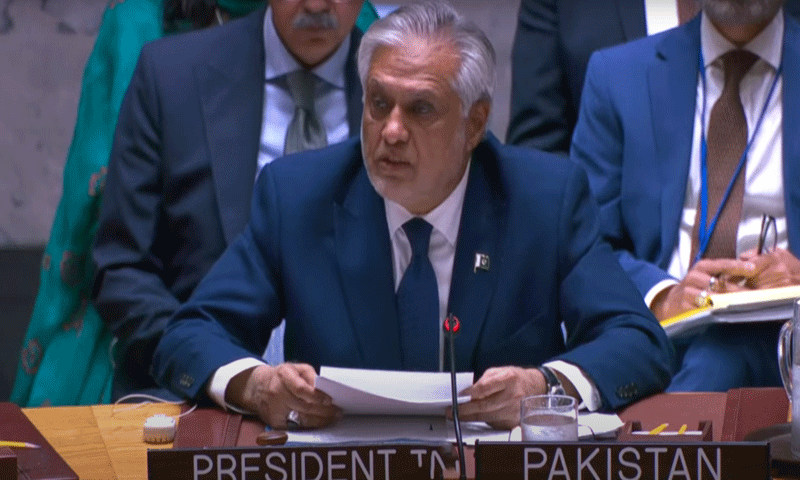
The measure, adopted during a session presided over by Pakistan’s Deputy Prime Minister and Foreign Minister Ishaq Dar, underscores the critical role of preventive diplomacy and conflict prevention in safeguarding global stability.
Dar opened the session as he chaired the UNSC Open Debate on “Promoting International Peace and Security through Multilateralism and the Peaceful Settlement of Disputes,” the first of two signature events for Pakistan during its presidency of the Security Council in July. The debate drew high-level participation, reflecting the urgency of the issues at hand.
The resolution, titled “Strengthening Mechanisms for Peaceful Settlement of Disputes,” builds on Chapter VI of the United Nations Charter, which outlines peaceful means for resolving conflicts. It calls on member states to effectively utilize these tools and to take concrete steps to implement Security Council resolutions aimed at settling disputes without violence. It also encourages both member states and the United Nations to explore ways to keep disputes from escalating, including through timely diplomacy, mediation, confidence-building, and dialogue at international, regional, and subregional levels.
Pakistan’s Foreign Office hailed the resolution’s adoption as a milestone. “This is an important contribution to the promotion of international peace and security through the use of preventive diplomacy, conflict prevention measures, and dispute resolution by peaceful means,” the office said in a statement. It added that the resolution urges regional and subregional organizations to bolster their efforts in peacefully settling disputes and to deepen cooperation with the United Nations.
The Foreign Office emphasized Pakistan’s commitment as an active Security Council member to advancing peace and security, both regionally and globally. “The adoption of this Pakistan-sponsored resolution would serve as an important instrument to achieve these goals,” it said, noting that the measure reaffirms Pakistan’s steadfast belief in multilateralism and the UN Charter’s principles.
Speaking at the session, Dar pressed for urgent action on some of the world’s most pressing conflicts. “We call for an immediate, unconditional, and permanent ceasefire in Gaza,” he said, pointing to Israel’s latest offensive, which he noted had killed over 58,000 Palestinians, mostly women and children. “The humanitarian situation is dire, with civilians bearing the brunt of the violence and deprivation.”
Dar framed the debate as a vital moment for global cooperation. “Today’s debate is both timely and urgent. Multilateralism is not merely a diplomatic convenience; it is the need of the hour. Peaceful settlement of disputes is not just a principle; it is the lifeline of global stability,” he said.
Turning to the long-standing Kashmir dispute, Dar insisted that its resolution must adhere to UN Security Council resolutions and the will of the Kashmiri people. “No cosmetic measures can serve as a substitute for the fundamental and inalienable right to self-determination of the Kashmiris as guaranteed by the relevant UNSC resolutions,” he added.
He also criticized India’s unilateral suspension of the Indus Water Treaty, a decades-old agreement governing water sharing between the two nations. “It is most unfortunate and regrettable that India has chosen to illegally and unilaterally hold this treaty in abeyance on baseless grounds, with the intention of withholding the flow of water to 240 million people of Pakistan, who rely on it for their livelihood and survival,” Dar said.
UN Secretary General Antonio Guterres echoed Dar’s concerns about Gaza, condemning the “horror” unfolding there. “We need look no further than the horror show in Gaza, with a level of death and destruction without parallel in recent times,” he told the council. Guterres warned that intensified Israeli operations have pushed the region’s humanitarian system to its “last gasp,” layering “devastation upon devastation.”
Guterres praised Dar for convening the debate and leveraging Pakistan’s presidency to advance the resolution. “This is needed now more than ever,” he said. “The architects of the United Nations Charter recognized that the peaceful resolution of disputes is the lifeline when geopolitical tensions escalate, when unresolved disputes fuel the flames of conflict, and when states lose trust in each other.”
He painted a grim picture of the broader global landscape. “Around the world, we see an utter disregard for, if not outright violations of, international law, including international human rights law, international refugee law, international humanitarian law, and the UN Charter itself, without any accountability,” Guterres said. He stressed that these failures, coupled with widening geopolitical divides, exact a staggering toll in human lives, broken communities, and lost futures. Yet, he held firm to the power of diplomacy: “It still holds the power to stop them.”
Dar closed his remarks with a rallying cry for the council. “Let this debate serve as a collective reaffirmation of our faith in multilateralism, a recommitment to the peaceful settlement of disputes, and a solemn promise to those who look to this Council not for words, but for action,” he said.
Beyond the session, Dar’s schedule reflects Pakistan’s diplomatic push. On the sidelines, he is set to meet with the Saudi minister of economy and planning, the UK minister for Africa, the United Nations, Commonwealth and Multilateral, and Thailand’s foreign minister. He will also sit for an interview with a foreign media outlet and attend a reception hosted by Pakistan’s Permanent Representative to the UN, Ambassador Asim Iftikhar Ahmad, for select UN ambassadors and senior officials.
Copyright © 2021 Independent Pakistan | All rights reserved