By Staff Reporter
ISLAMABAD: US Secretary of State Marco Rubio said on Friday that the United States is awaiting an Iranian response later in the day to a US proposal aimed at ending the conflict in the Persian Gulf, even as fresh military exchanges between the two sides have cast doubt on the durability of a fragile cease-fire.
“We should know something today. … We’re expecting a response from them,” Rubio told reporters in Rome after meeting with Pope Leo XIV. “We’ll see what the response entails. The hope is it’s something that can put us into a serious process in negotiation.”
The comments came one day after Iranian officials said they were still reviewing messages from Washington, transmitted through Pakistani mediators, and had not yet formulated a reply, according to Iranian state media.
News outlets, including Axios, reported earlier this week that the two governments were close to finalizing a 14-point memorandum of understanding that would halt the fighting and restart negotiations over Iran’s nuclear program. The war began in February when the United States and Israel launched military operations against Iran.
Rubio’s remarks reflected cautious optimism about diplomacy even as the cease-fire appeared to fray in the strategic Strait of Hormuz. President Donald Trump insisted Thursday that the truce remained in effect, dismissing recent strikes as “just a love tap” and saying the Iranians “wanted to make a deal very much.” Yet both sides reported new attacks in the narrow waterway, which carries roughly one-fifth of the world’s oil and liquefied natural gas. The disruption has triggered a global energy shock that the International Energy Agency has described as “the biggest energy security threat in history.”
Rubio warned on Friday that any Iranian attempt to assert control over shipping in the strait would cross a red line. “We’ve seen a report overnight that Iran has established, or trying to establish, some agency that’s going to control traffic in the straits,” he said. “That would be a problem. That would actually be unacceptable.”
Iranian officials, for their part, portrayed the latest US actions as evidence that Washington reverts to force whenever a diplomatic opening appears. Foreign Minister Abbas Araghchi, writing on X, accused the United States of opting for a “reckless military adventure” every time “a diplomatic solution is on the table.” Iranians, he said, “would never bow to pressure.” “Is it a crude pressure tactic?” Araghchi asked. “Or the result of a spoiler once again duping POTUS into another quagmire?”
President Masoud Pezeshkian, also posting on X, struck a broader tone, declaring that “the policy of colonialism and exploitation will have no place in the future world.” Iran’s established policy, he wrote, is “to expand friendly relations based on mutual respect and shared interests.” He added that just as tolerance is “deeply rooted” in Iranian culture, “the struggle against oppression shines throughout the history of this land,” and that this identity “will continue in order to elevate the name of Iran.”
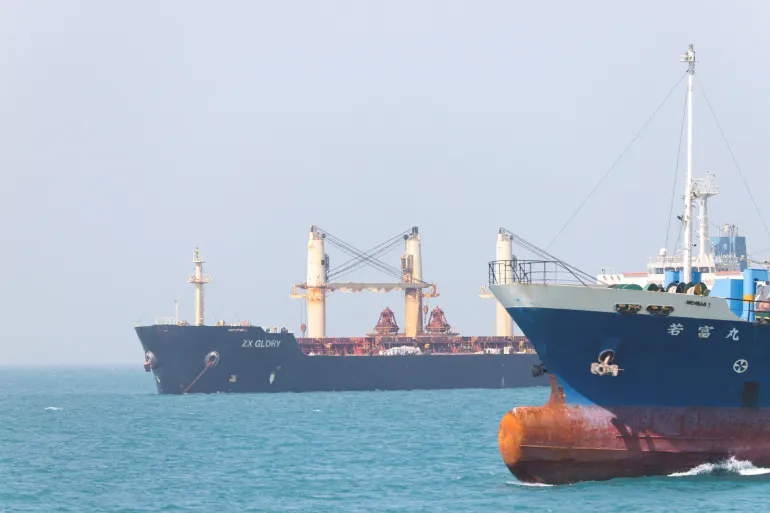
The immediate trigger for the latest flare-up was a series of clashes on Thursday in the Strait of Hormuz. US Central Command accused Iran of launching missiles, drones and small boats in an “unprovoked attack” against three American warships. Iran’s military command countered that U.S. forces had targeted an Iranian oil tanker and another vessel near the strait and conducted aerial strikes on several coastal areas.
One cargo vessel attacked near the waters off Minab caught fire, according to Mohammad Radmehr, an official in Iran’s southern Hormozgan province. Ten injured sailors were transferred to a hospital, Radmehr told the state news agency Mehr, and local teams were searching for others still unaccounted for.
On Friday, US forces escalated their enforcement of a naval blockade around Iranian ports. Central Command said American warships disabled two Iranian-flagged, unladen oil tankers attempting to enter an Iranian port in the Gulf of Oman “in violation of the ongoing US blockade.” Precision munitions were fired into the vessels’ smokestacks to prevent them from proceeding. The statement said US forces were now blocking more than 70 tankers from entering or leaving Iranian ports.
Trump, posting overnight on Truth Social, described the US response in more expansive terms. “The US had destroyed multiple small boats, missiles and drones,” he wrote, adding that “great damage” had been done to the Iranian attackers. He warned: “Just like we knocked them out again today, we’ll knock them out a lot harder, and a lot more violently, in the future, if they don’t get their Deal signed, FAST!”
Earlier this week, Trump ordered — and then paused — a US military operation to free about 2,000 commercial vessels stranded in the region since February, when Iran began controlling the strait and attacking US allies in the Gulf in retaliation for the initial American and Israeli strikes. The blockade of Iranian ports is intended to increase pressure on Tehran to accept US terms.
Despite the violence, Rubio said the administration still hoped Iran’s anticipated response would open the door to substantive talks. “I hope it’s a serious offer, I really do,” he said during his visit to Italy.
Copyright © 2021 Independent Pakistan | All rights reserved