By Staff Reporter
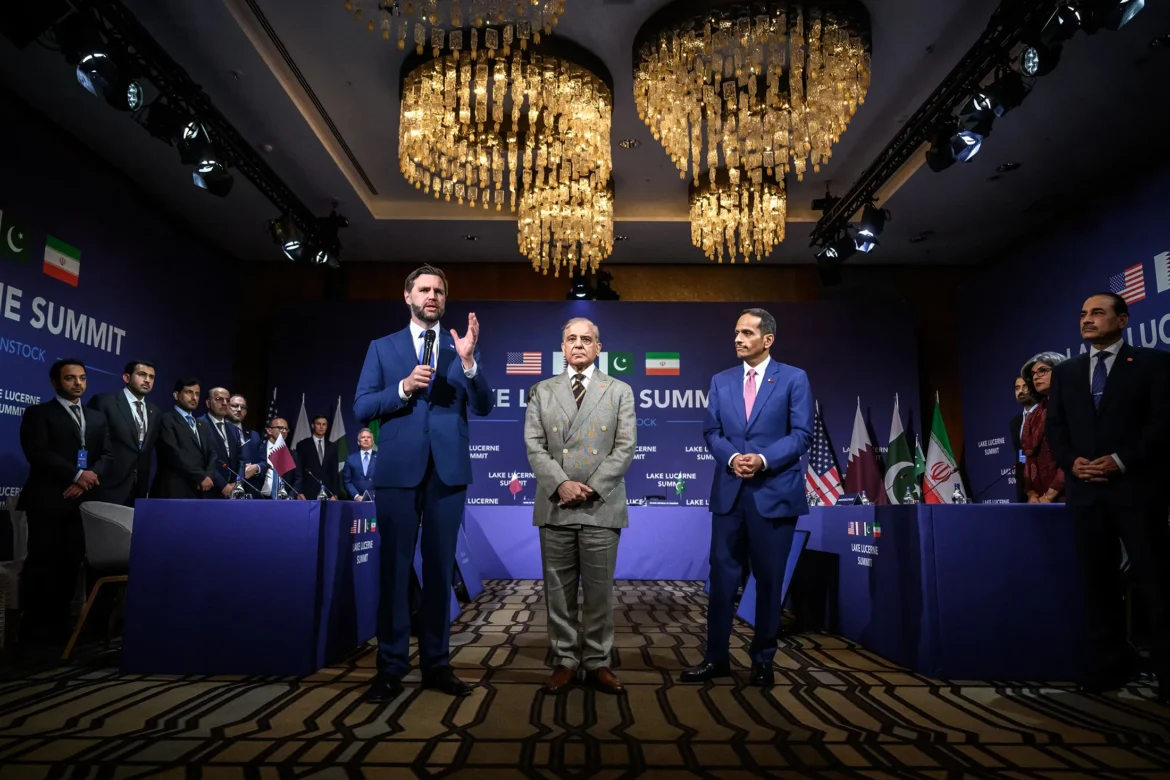
ISLAMABAD: Senior American and Iranian officials have opened direct negotiations in Switzerland to implement a fragile ceasefire agreement, with US Vice President JD Vance warning that both sides faced a choice between peace and “going back to doing things the old way” as escalating violence in Lebanon threatened to undermine the talks almost before they had begun.
The four-way summit at the Bürgenstock resort near Lake Lucerne — also attended by mediators from Pakistan and Qatar — marks the second time officials from Washington and Tehran have sat across a table at this level of seniority. Earlier a direct US-Iran talks hosted by Pakistan in Islamabad in April, the first such face-to-face engagement between the two sides.
The session, dubbed the Lake Lucerne Summit, opened Sunday morning and launched a formal 60-day countdown to reach a comprehensive agreement on Iran’s nuclear programme, the lifting of US sanctions, the unfreezing of Iranian assets, and the future status of the Strait of Hormuz — the waterway through which roughly a fifth of the world’s traded oil and natural gas passes.
The talks follow a Memorandum of Understanding signed this week by President Donald Trump and Iranian President Masoud Pezeshkian, brokered by Pakistan, which ended nearly four months of direct military conflict between the United States and Iran. The agreement committed both sides to cease hostilities across all fronts, reopen the Strait of Hormuz and begin negotiations on a permanent settlement.
Speaking at the opening ceremony, Vance said Trump had directed his team to “turn over a new leaf” with Iran. “If Iran’s leadership is willing to give up being a driver of regional instability, if they are willing to give up nuclear weapons ambitions for the long term, then the United States is willing to fundamentally transform our relationship with that country,” he said.
He added that “great progress” had already been made and that he expected further advances during the day’s sessions. “What today really represents is the beginning of a technical negotiation that’s not going to solve every disagreement, but is going to allow us to sit together as teams — for the first time, really, in history — to figure out what matters most to the respective parties.”
Minutes after Vance finished speaking, however, Trump posted on social media threatening to strike Iran again if it failed to rein in Hezbollah in Lebanon. “If they don’t, we’ll hit Iran very hard again, just like we did last week, only harder!!!” Trump wrote, in a message that illustrated the contradictions the negotiating teams must manage throughout the 60-day process.
Lebanon threatens to unravel the deal
The most immediate threat to the negotiations came not from the nuclear question — which both sides expected to require sustained diplomacy — but from Lebanon, where fighting between Israel and the Iranian-backed Hezbollah continued through the weekend despite a ceasefire agreed on Friday.
Lebanese health authorities reported at least 16 deaths from Israeli air strikes on Saturday. Israel said it was responding to Hezbollah attacks. Hezbollah said it would not permit Israel “freedom of movement” in Lebanese territory. Since fighting escalated earlier this year, Lebanon’s health ministry says more than 4,000 people have been killed. At least 34 Israeli soldiers have died in Lebanon, and four civilians in northern Israel.
Iran cited continued Israeli attacks as justification for announcing on Saturday that it had closed the Strait of Hormuz — a declaration that, if enforced, would represent a fundamental breach of the MoU. US Central Command disputed Tehran’s claim, stating that American forces were monitoring the waterway and that traffic continued to flow. Maritime tracking data showed tankers and cargo vessels passing through the strait on Sunday, though some vessels had been stationary on the western approach for several days, and tracking data may be incomplete as some ships switch off their transponders.
Iran’s foreign ministry spokesman Esmail Baghaei made clear before the talks that Tehran’s primary demand on Sunday was for the US to enforce the ceasefire commitments it had signed up to. “The implementation of any document is more important than its signing,” Baghaei said. Iranian officials were insisting, he added, that the deal’s implementation begin with the section calling for a cessation of all military operations — including between Israel and Hezbollah. The US, he said, had so far been “unable or unwilling” to hold Israel to that commitment.
Neither Israel nor Hezbollah is a signatory to the US-Iran agreement. Israeli Prime Minister Benjamin Netanyahu has publicly vowed to keep Israeli forces in southern Lebanon until all threats to Israel are eliminated, regardless of what Washington and Tehran agree.
Iranian President Pezeshkian, speaking to state media on Sunday, added a further complication on the nuclear question. “What is certain is that we will never back down from the right to enrich uranium, and the other side is also forced to accept it,” he said — a statement that sits in direct tension with Washington’s stated goal of constraining Tehran’s nuclear activities.
The structure of the talks
The day’s proceedings began with a series of bilateral and tripartite meetings before the four-way session. Vance first met Pakistani Prime Minister Shehbaz Sharif and Field Marshal Asim Munir, Pakistan’s Chief of Defence Forces, who have served as the principal mediators between Washington and Tehran throughout the conflict. Vance was accompanied by Trump’s son-in-law Jared Kushner and special envoy Steve Witkoff, who had arrived in Switzerland several days earlier to work on the technical groundwork.
The Iranian delegation — led by parliamentary speaker Mohammad Bagher Ghalibaf and Foreign Minister Abbas Araghchi, and also including the governor of Iran’s central bank and the chief executive of the National Iranian Oil Company — then held separate meetings with the Pakistani and Qatari mediating teams. Iran’s state broadcaster reported a tripartite session between Iranian, US and Qatari delegations focused specifically on the Lebanon ceasefire and frozen Iranian assets.
In a notable moment captured by the media, Iranian Foreign Minister Araghchi briefly entered the opening ceremony room and embraced PM Sharif. He did not interact with Vance, who was on the other side of the room, and left shortly afterwards.
Qatar’s foreign ministry announced the formation of specialist technical groups to negotiate the clauses of the final agreement, alongside separate oversight groups to monitor implementation of the existing MoU. Qatari Prime Minister Sheikh Mohammed bin Abdulrahman Al Thani said Qatar would remain committed to the mediation process until a comprehensive settlement was reached. “This is just the beginning,” he said.
Pakistan’s foreign ministry confirmed Islamabad would hold bilateral meetings with all four delegations on the margins of the talks, describing its role as “principled, balanced, and constructive.” Sharif told the opening session he was hopeful the discussions would produce “very productive results in times to come.”
What is on the table
Beyond the ceasefire and Lebanon, the agenda for the 60-day negotiations covers the full scope of the Islamabad MoU. The agreement signed this week allows Iran to resume selling its oil on international markets and provides a framework for the US to lift its military blockade of Iranian ports. It also opens discussions on the unfreezing of Iranian assets and includes a reported $300bn reconstruction plan for Iran.
The nuclear question — the issue Trump cited as the primary reason for the military campaign against Iran — remains entirely unresolved. In his first term, Trump withdrew the United States from the 2015 nuclear deal negotiated under Barack Obama and reimposed sweeping economic sanctions. Under the current interim agreement, Iran has committed to diluting its stockpile of highly enriched uranium, believed to be held at sites targeted in US strikes. Rafael Grossi, director general of the International Atomic Energy Agency, met Swiss Foreign Minister Ignazio Cassis on the sidelines of the summit; the IAEA monitored the original 2015 accord.
The agreement also states that commercial vessels may pass through the Strait of Hormuz for 60 days without charge, but does not rule out Iran imposing future fees. Trump separately threatened on Saturday to impose American tolls on the strait if no final deal was reached within 60 days, saying the money would compensate the United States for acting as “Guardian Angel to the countries of the Middle East.”
The talks drew immediate scrutiny in Washington, where Republican hardliners have compared the emerging framework unfavourably to the Obama-era agreement that Trump spent years denouncing. The announcement of the initial deal last week caused oil futures to fall almost 8 per cent, and financial markets are expected to track the progress of Sunday’s negotiations closely.
Pakistan’s State broadcaster PTV, reporting from Bürgenstock, said technical-level talks could extend into Monday and that no formal timeframe had been set. Iran’s foreign ministry said it had planned for a single day of sessions. Senior officials from the Prime Minister’s Office in Islamabad said it was not yet confirmed when the Pakistani delegation would return.
Copyright © 2021 Independent Pakistan | All rights reserved